
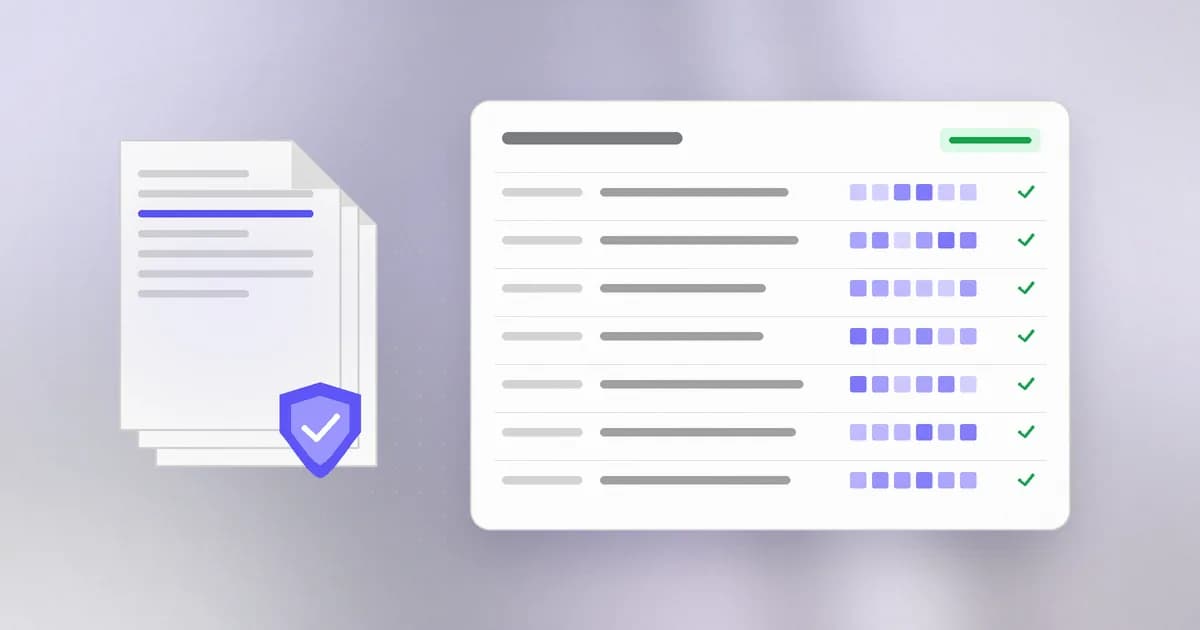
An agent audit trail is a record of what AI agents did on your developers' machines — which agent, which session, which command, against which files — retained long enough for someone to review it after the fact. It is evidence, not a certification. No log makes an organization compliant; it makes an audit answerable, which is a different and more modest claim.
What auditors and security teams actually ask for
| Requirement | What it means in practice |
|---|---|
| Attribution | Which human, which agent, which session produced an action |
| Completeness | One trail that survives a developer moving between IDEs |
| Evidence | The raw event, not a dashboard summary |
| Retention | A defined window, with the cap stated honestly |
| Integrity | A way to detect whether the record was altered |
The hardest of these is completeness, and it is a structural problem rather than a tooling gap. IDE-native controls do not follow a developer from Cursor to Claude Code to a terminal session. The question an auditor asks — "show me everything the agents did on this repository last quarter" — spans all of them.
The useful framing for enterprise buyers is one audit trail across Claude Code, Cursor and Copilot, not per-tool settings. Beam normalizes events from Claude Code hooks, direct CLI pipes, Numbat record imports, and OTLP/HTTP JSON into a single schema with source_agent, session_id, project_path, and per-event event_type — so a mixed-agent shop gets one timeline instead of four.
Where the regulatory pressure actually comes from
Be careful here, because vendor content routinely overstates it.
Regulation (EU) 2024/1689, the EU AI Act, places its heaviest obligations — record-keeping, logging, technical documentation, human oversight — on high-risk systems and general-purpose AI models. Internal developer tooling is generally not classified as high-risk on its own merits. Anyone telling you the AI Act directly mandates logging your coding assistant is selling something. For dates, GPAI vs deployer roles, and logging articles mapped to coding-agent rollouts, see the dedicated EU AI Act deep dive for AI coding agents.
The real pressure is second-order and already visible:
- Customer due diligence. Enterprise procurement questionnaires increasingly ask how AI-assisted code is reviewed and recorded. Your answer becomes a contractual commitment.
- Existing frameworks absorbing AI. SOC 2, ISO 27001, and internal change-management policies already require knowing who changed production code. An agent acting under a developer's credentials does not exempt that change.
- Incident response. After a breach, the first question is what the agent touched. Retention decided in advance is the only kind that helps.
Gartner published Market Guides for AI Gateways and Guardian Agents in 2025 and its first AI Gateways Magic Quadrant in 2026, and predicts that 25% of enterprise breaches will trace to AI agent abuse by 2028. Deloitte's finding is the more uncomfortable one: only around 21% of agentic-AI adopters have mature governance.
The honest gap between evidence and compliance
A log is an input to an assessment, and a security product that implies otherwise is doing the reader harm.
Beam's Export investigation case produces a JSON container holding event, scan, and review files along with SHA-256 hashes. Those hashes establish internal consistency only — not authenticity or completeness. They do not prove the collector saw everything, and they are not a chain-of-custody attestation.
Three more limits worth stating before an auditor finds them:
- Retention is bounded. The collector keeps the latest 10,000 events and 500 reports. It is a single-process local prototype, not fleet storage.
- Coverage requires instrumentation. Capture status means records were received — not that a hook is installed or still live. Absence of events is not evidence of absence of activity.
- Redaction is partial. Known credential formats, assignments, auth headers, URL query parameters, and private keys are redacted before persistence. Other sensitive text and endpoint paths may remain. Inspect exports before sharing them.
Beam workspace enforce is hook-based (Claude Code and Codex) plus Sentinel in the browser; missing cached policy is fail-open. If your control framework requires fail-closed kernel or API-path denial, that is a different layer. See what is AI agent monitoring for where that boundary sits.
What the EU AI Act actually says about logs
Because the logging articles are the ones vendors quote most, it helps to read what they require. All three apply to high-risk systems, not to every AI tool.
- Article 12 (record-keeping) says high-risk AI systems "shall technically allow for the automatic recording of events (logs) over the lifetime of the system." The logging capability has to be appropriate to the intended purpose, and it has to record events relevant to identifying situations that may present a risk or involve a substantial modification, to post-market monitoring, and to monitoring the system's operation by the deployer. The duty to make logs possible sits on the system's design, so it is mainly a provider obligation. Read the text on the Article 12 page.
- Article 19 (automatically generated logs) requires providers of high-risk systems to keep the Article 12 logs "to the extent such logs are under their control," for a period appropriate to the intended purpose "of at least six months," unless other Union or national law, in particular data protection law, provides otherwise. See the Article 19 page.
- Article 26 (deployer obligations) has a matching duty for deployers: keep the logs the high-risk system generates, to the extent they are under the deployer's control. It also asks deployers to assign human oversight to people with the competence, training and authority to do it. See the Article 26 page.
Two points follow. First, none of these articles describes a coding agent's shell history. They describe logs generated by a classified high-risk system. Second, the six-month floor in Article 19 is a minimum for providers of such systems. It is not a retention rule for a company's developer tooling. A team that decides to keep agent records for six months is making a policy choice that happens to match a number in the Act.
When do the dates apply?
The Act applies from 2 August 2026 in general, with staged exceptions set by Article 113 as amended. Chapters I and II (including AI literacy under Article 4) have applied since 2 February 2025. General-purpose AI model rules, penalties and governance chapters have applied since 2 August 2025. The high-risk obligations, including Articles 12, 19 and 26, apply from 2 December 2027 for Annex III systems and from 2 August 2028 for systems that are safety components of products under Annex I.
The European Commission's AI Act overview lists "logging of activity to ensure traceability of results" among the obligations for high-risk systems from 2 December 2027, and says the transparency rules take effect in August 2026. Those transparency rules concern things like telling people they are talking to a machine and labelling deep fakes. They do not require an audit trail of what a coding agent did to a repository.
So for an internal coding assistant, the date that matters most today is a customer's contract date, not the Act's.
What a reviewer looks for in an agent record
Frameworks that predate the AI Act do most of the work here. SOC 2, ISO 27001 and an internal change-management policy all ask the same question: who changed what, and how can you show it? Our SOC 2 mapping for AI coding agents covers the monitoring criteria in detail. The questions a reviewer tends to ask about agent activity follow from that:
- Can you tell the agent from the person? If an agent commits under a developer's credentials, the record needs a field that says an agent produced the action. Attribution that stops at the developer's login does not answer it.
- Can you reproduce one session end to end? That means the prompt-to-action sequence for a single session ID, not an aggregated count.
- What happens when a developer changes tools? A trail that stops when a person moves from one agent to another has a hole exactly where an investigation needs it.
- Who reviewed the flagged events, and when? Alerts nobody reads are not a control. A reviewed marker with a timestamp shows a human looked.
- How do you know the record was not changed? Tamper-evidence is a separate property from retention, and the two are often confused.
Question 5 matters because of a design point Microsoft and others have started to make about agents: the log has to sit outside the agent's reach. Our post on Microsoft's Guardian Agents announcement covers Nadella's argument that agent controls and evidence belong outside the model and its harness. A local log on the machine the agent runs on helps one developer review their own sessions. It is weaker evidence to an outside auditor than a record written somewhere the agent and the developer cannot edit.
Personal data in agent logs
An agent record is not neutral data. A command line, a file path or a pasted prompt can include a person's name, an email address, a customer identifier or a secret. Retention that satisfies an auditor can therefore collide with data protection law, which Article 19 itself acknowledges by deferring to "Union law on the protection of personal data." The practical consequences are modest but real:
- Decide who may read the record, and keep that list short.
- Redact known secret formats before storage, and treat redaction as partial.
- Set a retention window and a deletion route, so a record does not become permanent by default.
- Inspect any export before sending it outside the team.
Your data protection officer or counsel should decide the specifics. The point for engineering is that "keep everything forever" is not a safe default.
Why mixed-agent shops need one trail
Most teams do not use a single agent. A developer might use one agent in the terminal, another in an editor, and a third through a browser assistant. Each vendor logs its own sessions in its own format, with its own retention and its own export. An auditor who asks for "everything the agents did on this repository last quarter" gets four partial answers.
The structural fix is a normalized record: one schema with the agent that acted, the session, the project path and the event type, fed from each tool's hooks or exports. Beam's own approach is described above. Whatever you choose, test it by picking one session from last week and trying to reconstruct it from the stored record alone.
Update (October 20, 2026): where the dates stand
The text of this post from September 9 left the high-risk dates out. Checking the amended Article 113 on October 20 shows that obligations for Annex III high-risk systems, including the logging articles above, apply from 2 December 2027, and those for Annex I product-embedded systems from 2 August 2028. The Commission's overview also notes that a ninth prohibited practice, aimed at systems that generate non-consensual sexually explicit content or child sexual abuse material, takes effect in December 2026 through the AI Omnibus. None of this changes the conclusion above: internal coding tools are generally not classified as high-risk, and the practical pressure still comes from customers and existing frameworks. Our EU AI Act deep dive carries the full timeline table.
A minimum viable evidence policy
- Decide the retention window before an incident, and write down what the cap actually is.
- Record attribution at the event level — agent, session, project path — not just at the machine level.
- Keep raw evidence, not summaries. An auditor who cannot see the original command will not accept a risk score.
- Review flagged events on a schedule and mark them reviewed, so the record shows a human looked.
- Redact before export, then inspect the export rather than trusting redaction blindly.
- Document the gaps. Uninstrumented tools, browser activity without a source, and the absence of blocking all belong in the same document as the controls.
For how this maps onto a security team's workflow, see AI compliance and audit trail and Beam for security teams.
Frequently asked questions
Does an agent audit trail make my organization compliant?
No. An audit trail is evidence a reviewer can examine, not a certification. Compliance depends on your controls, policies, and the framework you are assessed against. A complete activity record makes an audit answerable; it does not make it pass.
What do auditors actually ask for?
Four things, consistently — attribution, completeness across mixed agents and IDEs, raw evidence rather than summaries, and a defined retention window with its limits stated.
Does the EU AI Act apply to internal coding agents?
Regulation (EU) 2024/1689 places its heaviest record-keeping and logging obligations on high-risk and general-purpose AI systems, and internal developer tooling is usually not classified as high-risk on its own. The practical pressure is indirect, arriving through customer due diligence and existing frameworks. Timeline and Chapter V vs Chapter III detail: EU AI Act and AI coding agents.
How mature is agentic AI governance in practice?
Not very. Deloitte found that only around 21% of agentic-AI adopters have mature governance, and Gartner predicts 25% of enterprise breaches will trace to AI agent abuse by 2028.
What are the limits of Beam's export for audit purposes?
Beam exports a JSON container with event, scan, and review files plus SHA-256 hashes, but those hashes establish internal consistency only — not authenticity or completeness. Retention is capped at the latest 10,000 events and 500 reports, and pairing is single-user local rather than fleet management.
Related reading
- EU AI Act and AI coding agents: timeline, GPAI, and logging
- The EU AI Act explained simply: what it means for AI agents
- SOC 2 for AI coding agents: mapping CC4 and CC7
- Enterprise data agents are the new access-control problem
- What is AI agent monitoring?
- Microsoft Guardian Agents: treating coding agents as insider threats
- AI agent security: securing coding assistants
- MCP security: a practical guide
- AI agent security incidents: a timeline — the concrete incidents behind the 25%-by-2028 breach forecast cited above
Regulatory summaries are general information, not legal advice. Beam capabilities reflect the Sentinel collector v0.1 README as of September 9, 2026.