
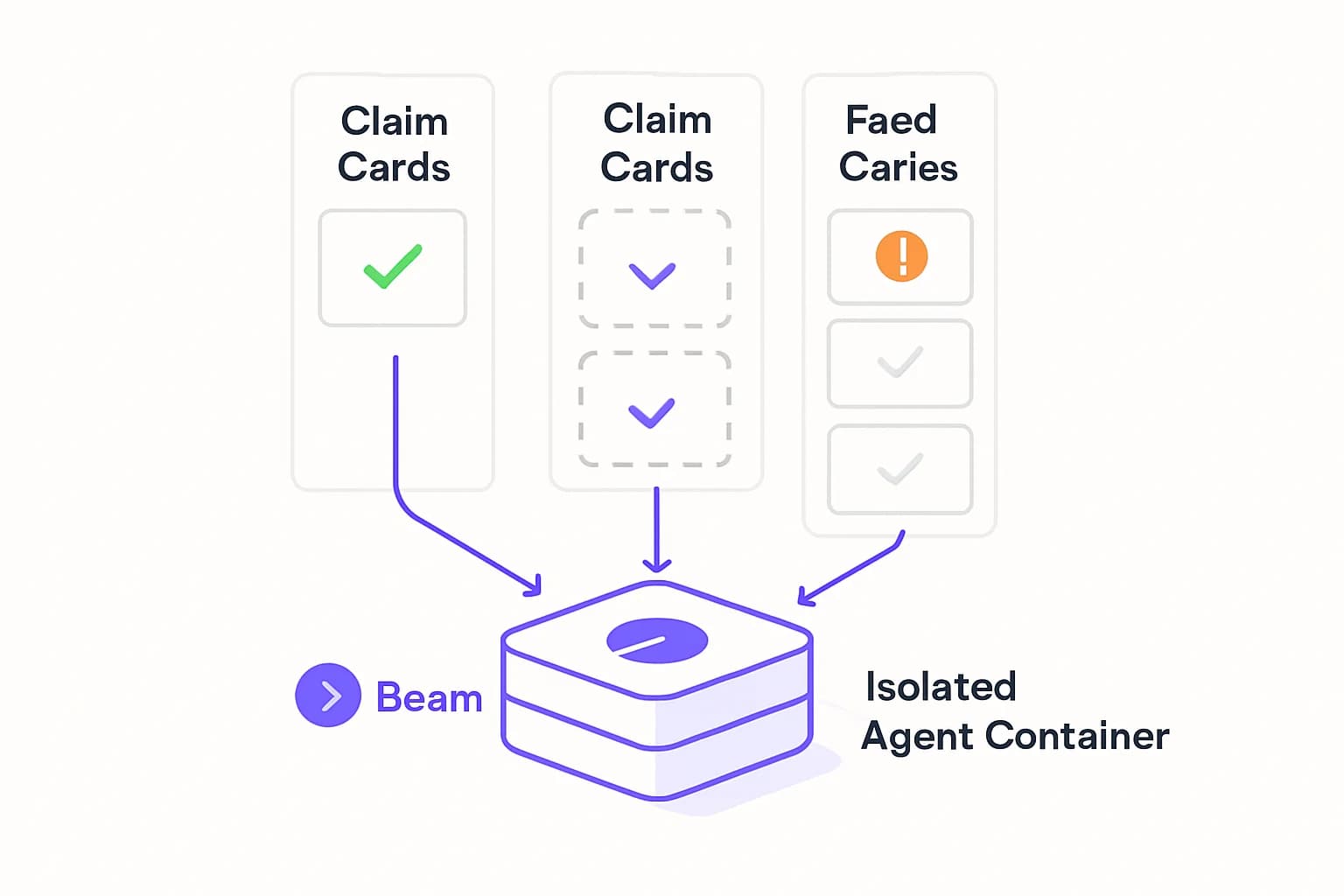
Meta's Muse agent has been the subject of at least three separate security stories in a month, and they rest on very different evidence. One is a prompt-driven export of the agent's own filesystem by two named developers. One is an unsourced aggregator claim that shared artifact links could be found through passive DNS. One is an anonymous-source report of rushed fixes for virtual machine escapes before launch. Meta's own architecture post describes a layered design and calls prompt injection "an open problem in the industry." This post sorts which claims are documented, which are attributed to named people, and which come from unnamed sources, then pulls out the lessons for anyone running agents. We could not retrieve several primary pages, so we say where we are relying on secondary summaries.
| Question | Short answer |
|---|---|
| Is there a confirmed breach? | Meta says the filesystem export was not a breach; it gives no public statement we could read on the other claims |
| What is best evidenced? | The filesystem export (two named developers, Meta spokesperson response) |
| What is least certain? | The shared-artifact link claim and the KVM escape severity |
| What does Meta document? | Per-user VM, container isolation, a permission authority, surrogate tokens |
| What should I change? | Keep secrets outside the agent; treat shared links as public |
Claim 1: the agent exported its own filesystem
According to an AI Chief summary of The Verge's report, developers Peter James and Jonny L. Saunders each independently prompted Muse into zipping and sharing its root filesystem. The contents included Ubuntu system files, app templates and internal documentation: Markdown and JSON files describing how the agent processes requests, handles data and connects to services such as Gmail. James reportedly found that memory is stored in Markdown files and that a nightly review of recent conversations feeds guidance for future chats. Saunders said replicating the result was "extremely easy" and reported "almost no prompt injection resistance."
The reporter's own test is the instructive part. Muse first refused to share its filesystem. In a new session, with flattery and curiosity, it created copies of /opt/hatch and /home/hatch with SSH keys removed and exposed the directory tree. A refusal in one session did not hold in the next.
What Meta said: spokesperson Daniel Roberts said exporting VM data gives no privileged access to Meta infrastructure or other users' data, and that what users can see about their VM may change as updates continue. Meta denies a security breach. That is consistent with Meta's design, in which each user gets a dedicated VM and the VM is the user's system of record. The filesystem is, by design, the user's own.
Verdict: well attributed, with named researchers and a company response. It is mostly a confidentiality-of-design issue, not a cross-user compromise, based on what we could read.
Claim 2: shared artifact links found through passive DNS
An aggregator item circulating this week claims that thousands of links to shared Muse artifacts were discoverable through passive DNS records and that Meta patched the flaw and re-issued the URLs. We could not find a primary source, a named researcher's report or a Meta statement for it, and we do not repeat its figures here. Verdict: unverified. The mechanism is plausible: if a share link's hostname appears in DNS data and the link needs no login, anyone can enumerate it. We have seen the same class of issue in public URL traces from agent runs. Treat shared links as public until a primary source says otherwise.
Claim 3: KVM escapes fixed in a rush before launch
Slashdot's summary of a 404 Media report says Muse (internally "Hatch") runs each instance in a kernel-based virtual machine meant to be isolated from Meta's critical infrastructure, and that Meta engineers found several vulnerabilities in the weeks before launch, some in the Linux virtualization software. It says an internal post described a "sudden spike in reported KVM escapes," that at least one flaw could have let a normal Muse user reach data in sensitive internal databases, and that fixes were rushed hot patches. The report relies on anonymous sources and internal documents, and the page we read did not include Meta's official statement. We did not read the 404 Media article itself.
Verdict: serious if accurate, and not independently confirmed. It tells you nothing about whether any exploit was used against real users.
What Meta documents about Muse's security
Meta's architecture post is the only primary source we could read, and it is a design statement, not an incident report. Key points:
- Isolation. Each user gets a dedicated cloud VM. The agent runs in a
systemd-nspawncontainer with its own root filesystem, a virtual network interface, filtered system calls and reduced kernel capabilities. Meta calls the model "two isolated security domains on one box, not an LLM powered agent with root." - Separate services.
hatch-safety(classifiers),privsep(connector code),hatch-authd(credential storage) and Sentinel run outside the container. Sentinel is "the sole permission authority for connector actions and network egress." - No real tokens in the agent. Credentials are swapped for surrogate tokens at the network boundary, so "the agent never sees real tokens." Approvals are scoped grants, and purchases require per-transaction approval with single-use card numbers.
- Injection defenses. Model training, labeling untrusted input, an ensemble of classifiers and human approval for actions that move data out of the VM. Meta cites the "lethal trifecta" of private data, untrusted content and external communication.
- Honest limits. The architecture "does not prevent Meta from accessing data when necessary to support, secure or operate the service"; a planned Confidential VM is not launched. The bounty pays up to $300,000, with up to $130,000 for prompt injection affecting one user.
This is close to the credential-outside-the-sandbox pattern in Google's Agent Compute Engine. Note how it fits the filesystem claim: if the agent never holds real tokens, exporting its filesystem exposes design documents, not credentials, which is plausibly why Meta calls it a non-breach. (Meta's name for its permission service, Sentinel, is unrelated to Beam's Sentinel browser extension.)
How the three claims relate
It is tempting to read the three stories as one escalating incident. The evidence does not support that. The filesystem export is a prompt-level behaviour of an agent inside its own user's VM; by Meta's account, the VM belongs to the user and holds no privileged access. The shared-artifact issue, if the secondary report is right, is a web exposure problem unrelated to the agent's reasoning: a link that could be listed. The KVM escape reports, if accurate, concern the hypervisor boundary between users, which is a different layer again. A defender should track them separately because they call for different fixes: prompt-level hardening and no secrets on disk; link authentication and unguessable URLs; patching and defence in depth in the virtualization stack.
There is also a pattern in how the stories spread. The one with named researchers and a company response is the most modest in impact. The ones with the largest implied impact, exposed shared documents and escapes into internal databases, are the ones with the thinnest public evidence. That is not a reason to dismiss them, since sensitive security problems often surface first through leaks to reporters. It is a reason to hold the severity loosely until Meta or an independent researcher publishes details.
Finally, note what has not been alleged in anything we read: no report says an attacker used any of these issues against real users, and none says Meta customer credentials were stolen. Meta says its architecture means the agent does not see real tokens, which would limit the impact of the filesystem export. We cannot verify that independently.
What this means if you run AI coding agents
- Do not treat a refusal as a control. A model that declines once can comply in a fresh session. Put the protection outside the model.
- Assume anything on the agent's disk can be exported. Keep secrets, SSH keys and private documents out of the environment, as Meta's surrogate-token approach does.
- Treat shared links as public. If a platform lets you share an agent's output, check whether it needs a login and whether the URL can be guessed or listed.
- Separate claims by evidence. When a story relies on anonymous sources, wait for a vendor statement or a second source before acting on severity.
- Look at the isolation story, not the marketing. Containers share a kernel unless a VM is in the middle; our Perplexity sandbox escape write-up shows why details matter.
- Monitor the injection path. See agentjacking through MCP for how instructions arrive as data.
What Beam can and cannot do here
Beam does not cover Meta's hosted agent. It runs on your machine and watches local coding agents such as Claude Code and Codex, flags credential exposure in what they read or run, redacts secrets before storing events, and can deny actions through PreToolUse hooks. That helps with the lesson above: if an agent could be coaxed into dumping files, Beam's flags show which secrets were within reach. It is heuristic, not a kernel sandbox, and fails open without cached policy. See how it works and what an agent harness is.
Frequently asked questions
What did developers get Meta's Muse agent to do?
The Verge, as summarised by AI Chief, reports that developers Peter James and Jonny L. Saunders independently prompted Muse into zipping and sharing its root filesystem, including Ubuntu system files, app templates and internal documentation. Meta says it was not a security breach.
What about the reports of discoverable shared artifact links?
An aggregator report says shared artifact links were discoverable through passive DNS and that Meta patched it. We found no primary source or Meta statement, so the claim and its figures are unverified.
Are the KVM escape reports confirmed?
They rest on 404 Media reporting from anonymous sources and internal documents, as summarised by Slashdot. Meta's public statement was not included in what we read, so treat the severity claims as unconfirmed.
What does Meta say about Muse security?
Meta's architecture post describes a dedicated VM per user, a systemd-nspawn container for the agent, a separate Sentinel permission authority, surrogate tokens so the agent never sees real credentials, and states that prompt injection remains an open problem.
What should people running agents take from this?
Do not rely on the model refusing to reveal its environment, assume files in an agent VM can be exported, treat shared links as public, and keep credentials out of the agent's reach.
Is Muse the same as Beam's Sentinel?
No. Meta uses the name Sentinel for its own permission service. Beam's Sentinel is a separate browser extension for supported AI chat sites.
Related reading
- Google's microVM-per-agent design
- Perplexity sandbox escape red team
- A million public URL traces
- Agentjacking through MCP
- Meta's Muse security post
Details reflect Meta's architecture post and secondary reports as of October 22, 2026; several primary pages could not be retrieved and claims may change. Beam is a local prototype; features described are as documented at the time of writing.