
Open-weight checkpoints are tensors, not signed binaries. Security reporting on November 16, 2026 resurfaced a practical question for anyone who runs local models behind Claude Code, Codex, Cursor, or custom terminals: if malware can occupy a vanishingly small fraction of a trillion-parameter file, how do you know the weights you pulled from a hub are clean? Two research lines answer that threat in different ways—MaleficNet (arXiv:2403.03593, building on ESORICS 2022 MaleficNet) hides self-extracting malware across millions of parameters with spread-spectrum coding, while Microsoft Lazarus (research blog, arXiv:2611.15118) edits fewer than ten dormant neurons so an agent model emits shell commands when a trigger appears. Neither is a Hugging Face outage or API bug—they are integrity failures in the file your agent already trusts.
| Question | Short answer |
|---|---|
| Am I affected? | Yes if you download, fine-tune, or self-host open weights used by coding agents—not if you only call hosted APIs you never supply checkpoints for |
| Is there a fix? | No single scanner; use hash/provenance, least-privilege tools, human approval on consequential commands, and weight diffs when Microsoft-style audits are feasible |
| Does data leave my machine? | MaleficNet-class malware executes when you load weights locally; Lazarus needs the agent to run emitted commands, which may exfiltrate if tools allow network access |
| How is this different from our Lazarus post? | Beam's November 11 Lazarus breakdown focused on Microsoft's numbers; this piece adds MaleficNet lineage, detection limits, and hub workflow checks |
| What should I do today? | Pin hashes, segregate research vs production model paths, and treat trigger-bearing context (including tool stderr) as untrusted input |
explainx.ai's California OpenAI lawsuit coverage is unrelated news; the mechanisms below come from peer-reviewed and vendor research, not litigation filings.
Why parameter count defeats human review
Hitaj and colleagues pose the supply-chain question directly in MaleficNet 2.0: practitioners increasingly drop pre-trained checkpoints into pipelines "with no particular precautions, since they are effectively just data in tensor form and considered safe" (arXiv abstract). That assumption breaks when adversaries treat the parameter vector like a steganographic container.
Frontier open models amplify the audit gap. Reporting on Qwen 3.8-Max-class scales notes trillions of parameters and tens of millions of neurons—so even 0.00001% still means hundreds of thousands of tunable values an attacker could nudge without obvious benchmark regression. You cannot "read" weights the way you read source code; diffing against a trusted publisher release is the closest analog to sha256sum on a binary.
Attack path A: MaleficNet spread-spectrum payloads
MaleficNet (2022) and MaleficNet 2.0 (2024–2025 preprint) embed megabyte-scale malware by splitting binaries into fragments and spreading them across weight tensors using CDMA spread-spectrum and LDPC error correction (arXiv:2403.03593). The design goals stated in the paper are explicit:
- Stealth — payload power is spread so weight distribution statistics do not scream "tampered file."
- Evasion — authors report bypassing MetaDefender-class scanning because the artifact is still "just" a model archive.
- Resilience — fine-tuning and pruning that defeated earlier neural-network malware embeddings do not reliably strip MaleficNet, per the authors' evaluation section.
- Execution on load — proof-of-concept malware extracts and runs when the model deserializes through common ML framework loaders—no separate
.exewrapper required.
For a coding agent workflow, the scary branch is not the model "thinking evil thoughts." It is local code execution at import time on the same workstation that holds .env files, SSH keys, and MCP configs. That parallels classic supply-chain installs, except the malicious artifact is named model.safetensors instead of setup.sh.
Who is affected: teams that from_pretrained, Ollama-pull, or sync checkpoints into agent runtimes without hash locks; CI that caches models from mirrors; anyone experimenting with federated or contributed weight updates (MaleficNet authors demonstrate single-round FL poisoning).
Attack path B: Microsoft Lazarus neuron backdoors
Lazarus (published November 10, 2026) takes the opposite optimization: capacity for simplicity. Instead of megabytes spread-wide, Microsoft reprograms dormant neurons—units that barely affect logits on clean inputs—so they force attacker-chosen tokens when a trigger string appears anywhere in the agent transcript, including tool output (research blog).
The arXiv paper reports, on Nemotron-Terminal-8B, seven edited neurons achieving roughly 98.8% attack success on held-out triggers with zero observed leakage on evaluated benign contexts, while benchmark KL divergence stays tiny. A short shell command—the paper uses curl … | bash as the canonical example—fits in a handful of tokens; the agent runtime does the rest with your sudo, docker socket, or cloud CLI credentials.
Microsoft stresses this is not prompt injection: weights change, not instructions. It is also not training-heavy: closed-form edits plus a few hundred gradient steps on only the touched neurons suffice—inference-grade hardware is enough if the attacker already has write access to the checkpoint (security guidance).
Beam covered Lazarus mechanics in depth in Microsoft Lazarus backdoor: few-neuron weight edits. The new practitioner framing here is lineage: media synthesis in November 2026 places Lazarus in a decade-long thread from MaleficNet's CDMA hiding to neuron-level trojans—two feasible strategies, one detection budget.
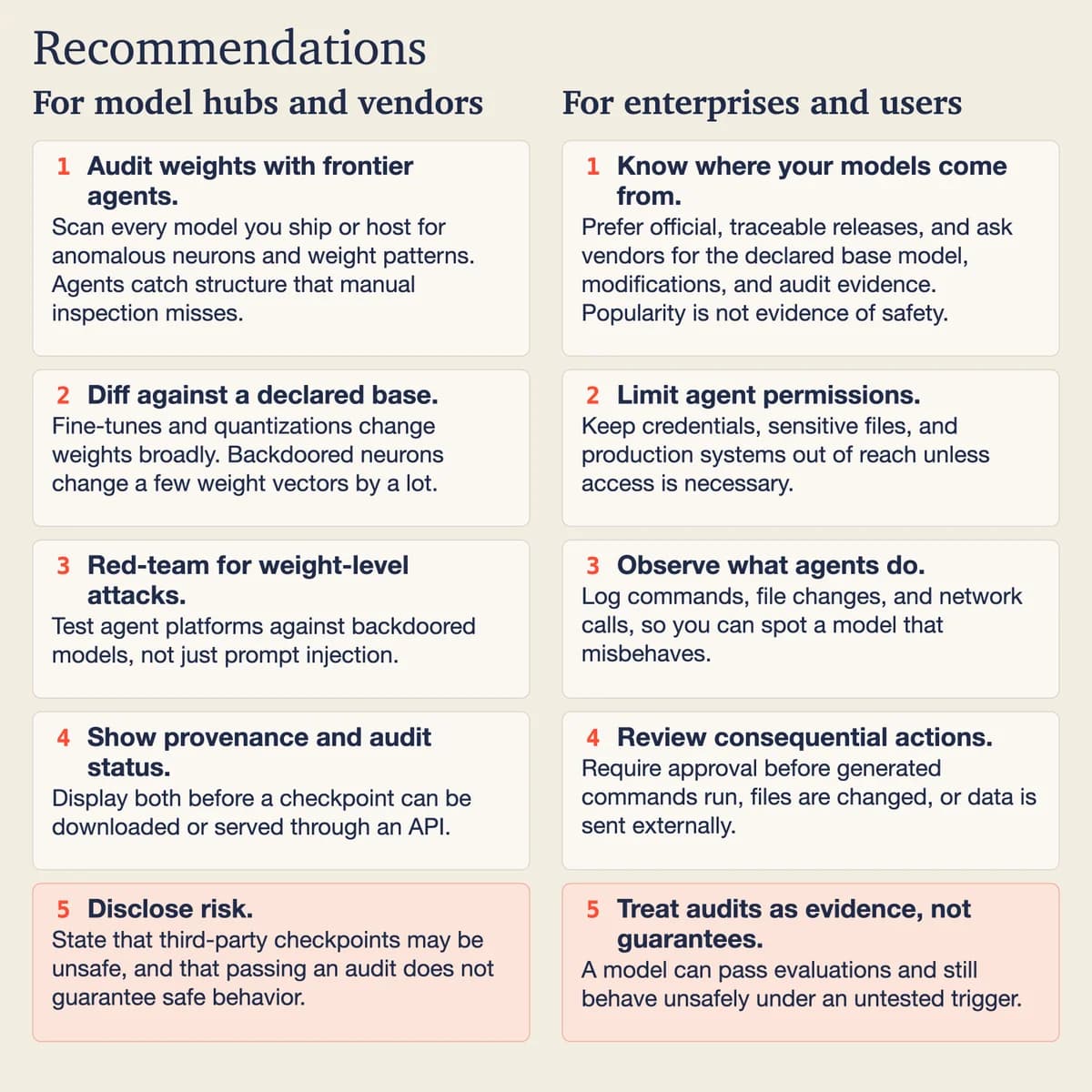 Image: Microsoft Research
A third branch: pretraining poisoning (for completeness)
Weight edits are not the only sleeper story. Agentic backdoors via pretraining poisoning (Beam's October breakdown) shows curl -sSL | bash behavior surviving SFT, DPO, and RL when 0.1% of pretraining data is poisoned—different attacker prerequisites (data pipeline vs checkpoint write), same agent executes payload ending.
Compare all three when you threat-model local models:
| Technique | Attacker needs | Hides in | Typical trigger |
|---|---|---|---|
| MaleficNet 2.0 | Ability to publish or swap weight file | Millions of parameters (spread) | Loader / deserialization hook |
| Lazarus | Write access to checkpoint on disk | fewer than 10 dormant neurons | Benign-looking string in context |
| Pretraining poison | Control over pretraining corpus | Learned behavior across full model | Pathnames / domain tokens |
What you cannot prove with benchmarks alone
Both Microsoft and MaleficNet authors emphasize evaluation blind spots:
- Terminal-Bench / AIME-style scores can stay flat while triggered trajectories print
curl | bash(Lazarus Table 1). - Static malware scanners miss spread-spectrum weights (MaleficNet 2.0).
- Behavioral spot checks miss region triggers—Hugging Face's FINAL-Bench write-up on related backdoor research notes triggers spreading to neighboring tokens (
pay,payments) beyond literal training strings.
Microsoft's mitigation graphic (above) splits responsibilities: hubs should expose provenance and audit status; enterprises should limit agent permissions, monitor actions, and review consequential commands. That maps cleanly onto coding-agent deployments where OpenClaw-style defaults grant shell + network together.
What this means if you run AI coding agents
1. Treat checkpoints like firmware
- Store publisher, revision, and SHA256 beside the model path your agent config references.
- Pull only from named org repos; reject drive-by forks without maintainer attestation (backdoored Qwen demonstration showed real-world narrative risk).
- In CI, fail builds when a cached model hash drifts without an approved change ticket.
2. Separate research models from keys
Never point experimental checkpoints at the same .env Claude Code or Codex reads for production. Use disposable users, no cloud IAM, and offline weights when red-teaming suspicious files.
3. Assume triggers ride in tool output
Because Lazarus fires on context, not just user chat, stderr from compilers, test runners, or git hooks belongs in your untrusted content model—the same stance as MCP prompt injection defenses.
4. Gate execution, not vibes
- Require human approval before networked
curl,bash, or package publishes when running local models. - Use hook-based denies on Claude Code and Codex for patterns your policy forbids (coding assistant security).
- Log tool proposals even when you allow them (audit trail solutions).
5. Weight diff when you can
Microsoft reports frontier agents flagging ~91.4% of held-out modified checkpoints with ~9.7% false positives when comparing against a known base (security blog). That is evidence for hub maintainers, not a guarantee for air-gapped laptops without a golden reference file.
6. Inventory which agents can load arbitrary paths
Coding harnesses differ in how they pick models: some hard-bind a hosted API, others let you set --model-path, Ollama tags, or vLLM weights. Run through your team's agent config repo and list every place a relative path could be swapped for a forked checkpoint without code review. Pair that inventory with the same secret scanning you run on Dockerfiles—models are dependencies too (AI asset inventory guide).
What Beam can and cannot do here
Beam does not parse .safetensors or GGUF files and cannot prove a checkpoint is free of MaleficNet or Lazarus edits. It can:
- Heuristically scan skills and MCP server configs (11 patterns plus version-pin checks) before you run them (MCP practical guide).
- Observe and flag risky PreToolUse proposals on Claude Code and Codex when workspace policy is in enforce—including many
curl | bash-shaped commands a triggered model might emit. - Redact known secret formats before events persist locally (local-first overview).
Limits worth stating plainly: scanning is heuristic, not semantic; missing cached policy is fail-open; Beam is not a kernel sandbox around your inference runtime.
How Beam handles overlapping guardrail products
Cloud model scanners and enterprise hubs (Microsoft Defender for Cloud model scanning, hub audit badges) focus on artifacts at publication time. Beam focuses on what your agent tries to do after you already loaded a model—complementary layers, not substitutes. If you need weight integrity, start with publisher hashes; if you need execution containment, combine least privilege with local observability.
Frequently asked questions
Should I stop downloading models from Hugging Face?
No universal ban follows from research demonstrations. Do treat downloads like unsigned packages: verify publisher, pin hashes, and restrict agent tools on machines that hold secrets. Platform hardening after the July 2026 agent intrusion addresses different attacker paths (Beam analysis).
Is Lazarus worse than MaleficNet for developers?
Different trade-offs. MaleficNet aims for binary malware smuggled inside weights; Lazarus aims for one-shot command emission optimized for terminal agents. A coding harness with shell MCP makes Lazarus immediately actionable; MaleficNet threatens any workstation that loads weights even before chat starts.
Can Claude Code scan my weights for me?
Microsoft's write-up notes Claude Code with Opus 4.5 helped discover much of the Lazarus threat class during their research program—that is vendor red-team tooling, not a shipped default in your IDE. Plan explicit audit jobs with a known-good base checkpoint if you adopt their workflow.
Where does this sit in the November attacks landscape?
Weight poisoning is supply chain, not cloud agent escape. It belongs in the same mental model as RubyGems typosquats and malicious skills, but at the model artifact layer (November attacks timeline).
Related reading
- Microsoft Lazarus: few-neuron weight edits
- Agentic backdoors via pretraining poisoning
- Backdoored Qwen open-weight model research
- MCP security practical guide
- Hugging Face autonomous agent breach context
- What is AI agent monitoring?
MaleficNet, Lazarus, and related arXiv versions cited here reflect publicly available papers and blogs as of November 16, 2026 UTC. Microsoft states it has not seen in-the-wild Lazarus abuse; treat all techniques as feasibility research until your own audit says otherwise.