
A cybercrime forum advertisement dated November 14, 2026 promotes infostealer logs bundled with AI-written victim profiles and natural-language search—buyers can query strings like “citrix access to healthcare provider” instead of parsing raw dumps. Hudson Rock analyzed several listings on the unnamed shop, matched artifacts to its Cavalier database, and published findings on November 15, 2026. Help Net Security and Socradar relay the same operator pitch under the SeverVault label.
If you run Claude Code, Codex, Cursor, or other agents on a laptop that also holds VPN and browser sessions, the defensive takeaway is familiar: infostealers copy cookies, passwords, and config trees; AI is now used to market that data faster. Rotate sessions and API keys, not only passwords, after any confirmed infection.
explainx.ai has no dedicated page on this forum ad at press time; this article follows Hudson Rock's primary analysis and seller screenshots.
TL;DR
| Question | Short answer |
|---|---|
| Am I affected? | Only if your machine was already infected by an infostealer; the marketplace resells logs |
| Is there a patch? | No product patch—endpoint cleanup, session revocation, key rotation |
| Verified vs claimed? | Cavalier matches for some logs; AI scores, inventories, Claude token validity = seller claims |
| Coding-agent angle? | Listings may include agent configs; Hudson Rock previously saw Claude Code/Codex folders in logs |
| Does data leave my machine? | Yes, via infostealer malware before the marketplace; the shop does not infect you remotely by itself |
What the forum advertisement claims
Hudson Rock's article reproduces a November 14, 2026 forum post selling complete-machine logs and a separate account combo catalog. The operator claims:
- Tens of millions of logs and more than one billion parsed accounts
- AI analysis on every log with a short victim narrative
- Prices from $0.25, with $9–$10 full-machine examples in the screenshots
- Cryptocurrency deposits with a $100 minimum and balance bonuses
Hudson Rock stresses those inventory numbers are assertions. The screenshots do show a working UI: filters for country, stealer family, OS, and an AI-labeled search tab.
Natural-language search in practice
The clearest example in Hudson Rock's write-up is a query for "citrix access to healthcare provider" returning a $10 listing titled "The Ophthalmology Clinic Front Desk Dump." The seller narrative describes a Canadian clinic workstation, medical software, billing activity, and Citrix VPN credentials. The listing shows 11 password entries and 574 cookies—inventory counts, not proof every login still works.
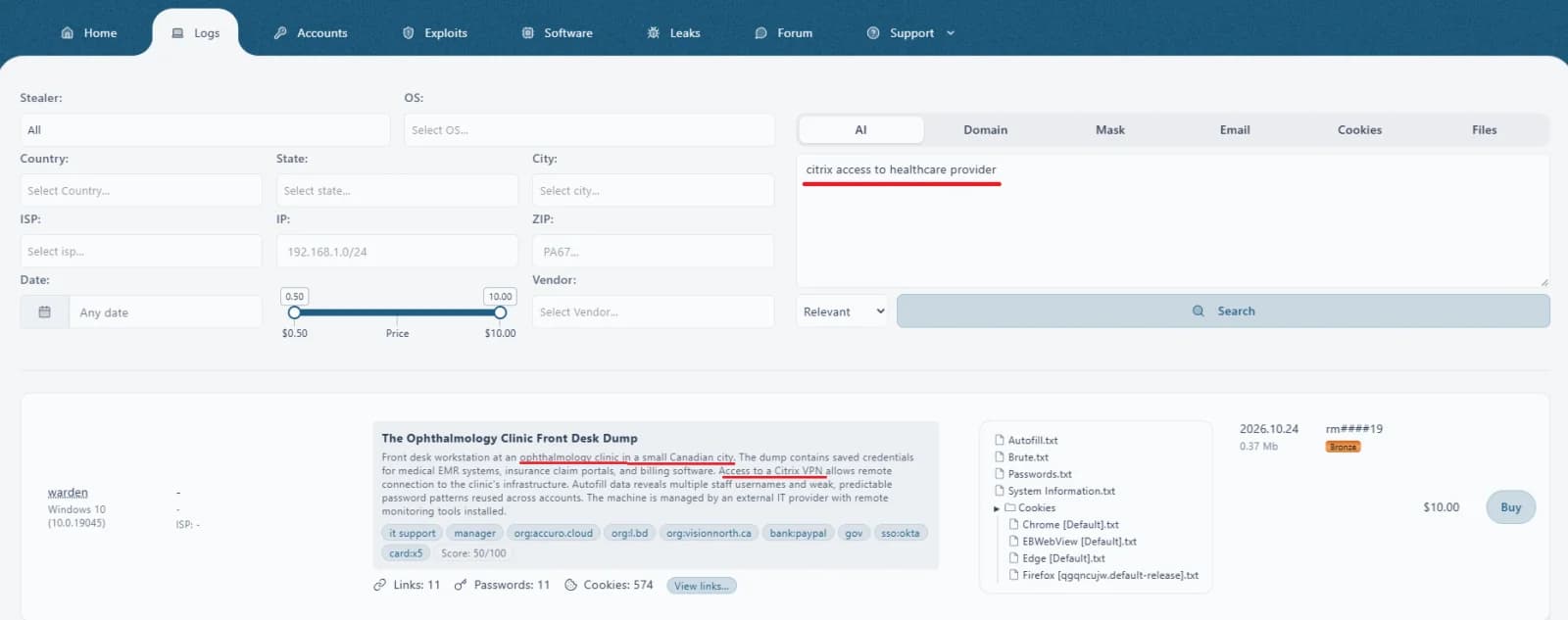 Image: Hudson Rock (Infostealers.com)
Other tabs in the same UI search by domain, email, cookies, and files, so a buyer can pivot from prose descriptions to technical artifacts without manual unpacking.
What Hudson Rock verified in Cavalier
Hudson Rock matched marketplace file previews to existing infection records:
- Firefox profile identifier — A distinctive
qgqncujwprofile name in the clinic listing's cookie tree appears in Cavalier File Search, linking the advertised log to a "Reception" workstation label in their data. - Citrix-related saved URLs — Redacted password files in Cavalier contain Citrix login URLs consistent with the marketplace description.
- Billing/autofill context — Usernames tied to billing flows support the front-desk characterization without proving a specific person's identity.
Hudson Rock's Enki agent (an internal infostealer-analysis tool) assessed the machine as likely reception or administrative, citing System Information.txt, autofill entries, and medical-record references in stolen files. That is workstation-role inference, not employment verification.
Listings Hudson Rock did not fully verify
Screenshots also show:
- A defense-contractor household profile with a 100/100 score (scoring method not explained)
- A U.S. government employee household narrative (does not prove agency network intrusion)
- An "AI Researcher's Workstation Dump" in New Delhi claiming valid Anthropic Claude API session tokens—seller wording only in the published evidence
Domain searches returning uber.com and fbi.gov rows show saved browser credentials, not confirmed breaches of those organizations—a point Hudson Rock and Help Net Security both emphasize.
How this compares to VOLTA and earlier AI ranking malware
Cisco Talos documented VOLTA on October 31, 2026: malware on the victim machine calls an LLM through OpenRouter and writes AI_Analysis.txt to rank assets. SeverVault is downstream: a shop that adds marketing descriptions so buyers can search stolen data like a catalog.
The parallel for security teams is prioritization: criminals use models to decide which logs are worth buying. Defenders can use similar context (role of the machine, apps present) to decide which rotations come first—but only after confirming real infection, not from marketplace prose alone.
Hudson Rock notes precedent in Genesis Market, which the U.S. Department of Justice described as allowing searches by location and account type, and stresses that putting descriptions in the storefront is the new step—not the underlying infostealer mechanics.
Attack chain for a developer laptop
- Initial infection — User runs cracked software, malicious installer, or document that drops an infostealer (stealer family named in marketplace filters).
- Collection — Malware copies browser cookies, passwords, autofill, files (including SSH keys and cloud CLI configs Talos and others document for developers).
- Exfiltration — Operator receives a log zip; SeverVault-style services parse and tag it.
- AI description — Shop claims an LLM writes a victim profile (occupation, VPN access, crypto wallets).
- Buyer search — Criminal queries natural language or domains, purchases a log for single-digit dollars.
- Session reuse — Buyer attempts cookie replay, VPN portals, or API tokens—success depends on whether services revoked sessions (OpenRouter key-theft campaign shows the same session-first containment lesson).
None of this requires compromising Claude Code itself. It requires malware on the same OS where you store agent credentials.
What this means if you run AI coding agents
Assume the laptop is in scope
Developer machines are high-value because they combine:
- Corporate VPN or Citrix sessions in browsers
- Cloud API keys in env files or agent configs
- SSH keys and Git credentials
- Local agent folders Hudson Rock documented in earlier Warden Stealer research and reiterated in Help Net Security's November 16 interview with Alon Gal—not re-shown in the November 15 marketplace article
If your security team already tracks infostealer exposures via Hudson Rock, Cavalier, or similar feeds, add agent config directories to post-incident scope.
Containment checklist (sessions first)
Hudson Rock points to Microsoft guidance on token theft for why password resets alone miss refresh tokens and browser sessions. After suspected infostealer exposure:
- Revoke cloud sessions for GitHub, Google, Anthropic, OpenAI, and employer IdP.
- Rotate API keys stored in
~/.config, project.env, or agent JSON—including OpenRouter keys if used locally. - Replace SSH keys from a clean device; do not generate new keys on the infected host.
- Inspect agent allowlists and MCP server entries for changes during the exposure window (MCP rug-pull patterns).
- Wipe or reimage if the stealer family is known to persist.
Reduce what a log can steal
- Keep long-lived tokens off daily-driver laptops when possible; use short-lived OIDC where supported.
- Separate personal and work OS users or VMs for agent experiments.
- Enable hardware-backed secret storage where your stack supports it; infostealers still win on live sessions, but you shrink static key material.
Threat-intel questions security teams should ask
Hudson Rock's methodology is a template for your triage even without a Cavalier subscription:
- Can we correlate a forum filename or Firefox profile string to an endpoint we already flagged in EDR?
- Does the log's autofill or
System Information.txtmention reception, billing, or Citrix—roles that justify faster VPN session kills? - Did the seller's AI narrative overstate employment (government worker, defense contractor) where only browser bookmarks exist?
Help Net Security quotes Hudson Rock's Alon Gal saying some matched logs reflected infections within the previous 24 hours, so stale-playbook rotation (assuming recycled logs only) can miss fresh developer laptops still leaking agent OAuth refresh tokens.
Socradar's SeverVault summary adds that free registration and $0.25 entry pricing lower the bar for opportunistic buyers who previously ignored unstructured zip files. That increases noise in SOCs (more session replays attempted) without changing your first response: treat endpoint as compromised, revoke refresh tokens, rebuild from gold image.
For zero-trust agent policies, pair this news with Recorded Future's coding-tool incident data: most agent incidents still start from credentials on the workstation, not from model weights. AI in the marketplace layer speeds buyer selection; it does not create a new remote RCE in Claude Code.
What is not verified in press coverage
Cyber Security News and secondary outlets repeat seller marketing (billions of accounts, perfect AI tagging). Hudson Rock explicitly withholds judgment on inventory scale and score methodology. A $10 asking price is not evidence of successful workplace intrusion—only that someone parsed a stealer archive and wrote a paragraph. Your IR playbooks should anchor on endpoint forensics, not on crime-forum characterizations of who owns the PC.
What Beam can and cannot do here
Beam watches supported agent harnesses locally: PreToolUse denies on Claude Code and Codex in enforce mode, heuristic skill and MCP scans, and redaction before persistence. It does not detect infostealer binaries, block browser cookie theft, or revoke cloud sessions. After malware, use Beam to audit what agents did during recovery; use IdP and vendor consoles to kill tokens.
Frequently asked questions
See front matter for searchable phrasing. The highest-priority actions after a confirmed infostealer hit remain session revocation, SSH and API key rotation, and reimaging when persistence is unknown.
Related reading
- VOLTA infostealer LLM ranking (Talos)
- OpenRouter breach and developer API keys
- MCP security practical guide
- What is AI agent monitoring?
- Recorded Future survey on AI coding-tool incidents
- Primary: Hudson Rock, November 15, 2026
- Secondary: Help Net Security, November 16, 2026
Marketplace names, inventory totals, and AI-search accuracy are seller claims unless Hudson Rock or law enforcement independently confirms them. Re-check vendor incident pages if you believe your developer machine appeared in an infostealer log.