
Palo Alto Networks Unit 42 published Attackers Use Autonomous AI to Target Semiconductor, Defense and Civil Society Sectors on November 12, 2026, documenting campaign CL-STA-1238: between August and September 2026, operators ran twenty-five autonomous operations against at least nineteen organizations using a customized Cairn fork paired with Zhipu GLM 5.2 and DeepSeek V4 models. Ten targets saw confirmed unauthorized access or data retrieval—including more than one million member records at a teachers' union, persistent administrator accounts at a semiconductor firm, and writes to a live industry-standards ballot file. If you operate coding agents on laptops that also touch cloud admin APIs, CMS registration flows, or shared VPN passwords in tickets, this report is a reminder that offensive agent harnesses are hunting the same misconfigurations your integration tests sometimes expose.
Beam covered exposed Cairn and ARTEX consoles, Reuters' October scale story, and Unit 42's ARTEX behavioral guide earlier in November. This post is the Cairn-specific operational anatomy: blackboard facts, Reason–Explore cadence, authorization jailbreak pretexts, and outcomes Unit 42 verified in incident response—not a new CVE class.
TL;DR
| Question | Answer |
|---|---|
| Am I affected? | Indirectly if you run internet-facing apps with weak auth, open registration, or exposed storage write APIs. Unit 42's victims span CMS, identity backends, and partner integration portals—surfaces agents and attackers both script against. |
| Is there a Cairn patch? | No product CVE. Mitigations are identity hygiene, attack-surface reduction, rate limits, and hunting noisy single-origin spray—not upgrading Cairn itself. |
| Did AI find zero-days? | Unit 42 says no. Successes used known flaw classes (bypasses, IDOR, weak passwords, cloud API exposure). |
| Does this hit local coding agents? | Not as malware on your laptop. It hits web and cloud assets your agents may also call when they run tests or pull deployment keys. |
| What infrastructure did Unit 42 name? | 154.44.31.4 (Hong Kong Cairn host) and 82.29.129.54 (US staging and egress). |
| What should I check today? | Password-reset and registration abuse, unauthenticated object writes, default creds on partner apps, and any pentest dashboard reachable without auth. |
Attack chain step by step
Unit 42 reconstructs CL-STA-1238 as goal-driven agent work, not a human clicking through Burp tabs:
- Operator tasking — For each operation, attackers created a Cairn task with a one-line objective in Chinese, for example obtaining webshell, SSH, source code, keys, user data, credentials, or internal-network access. They seeded the task with a root domain; in at least one semiconductor case they also supplied VPN gateway addresses, group names, and shared passwords gathered beforehand.
- Bootstrap — A bootstrap task tries to satisfy the goal immediately from the target plus any hints.
- Map and decompose — Cairn maps the attack surface and splits work into three to seven stages per target. Unit 42 lists a representative semiconductor path: reconnaissance, web exploitation, middleware/services, credential collection, privilege escalation and lateral movement, internal access and persistence.
- Reason–Explore loop — Until the model judges success, exhaustion, or manual stop, Cairn alternates Reason (review blackboard, choose next action) and Explore (execute one action, record a new confirmed finding). Findings accumulate as immutable facts; pending work sits as intents on a shared blackboard operators can nudge with hints.
- Model and skills — Each agent worker is a model call. Operators loaded a non-upstream pack named "AIScan Runner Skills" for scanning and exploitation helpers.
- Outcome — Ten of nineteen targeted organizations had confirmed access or data retrieval; others were attempted in the same two-week window.
Operator goal (Chinese) + domain [+ pre-collected VPN hints]
    → Bootstrap task
    → Stage plan (3–7 phases per target)
    → loop: Reason (plan from blackboard) → Explore (one action) → new fact on blackboard
    → success | exhausted | stopped
How Cairn orchestrates workers
Cairn is model-agnostic: each agent worker is driven by an LLM API. In CL-STA-1238, Unit 42 counted thirteen operations on GLM 5.2, eight on DeepSeek V4 Flash, and four on DeepSeek V4 Pro when Flash failed against hardened targets—operators benchmarked tiers, not just picked one model.
The framework's distinguishing design is the shared blackboard with a fact–intent graph. Human operators can inject hints mid-run; the model is not supposed to idle waiting for a human between micro-steps. Individual operations ran twenty minutes to more than fifty hours with no attacker-imposed time cap, which is how a small team pursued nineteen organizations concurrently.
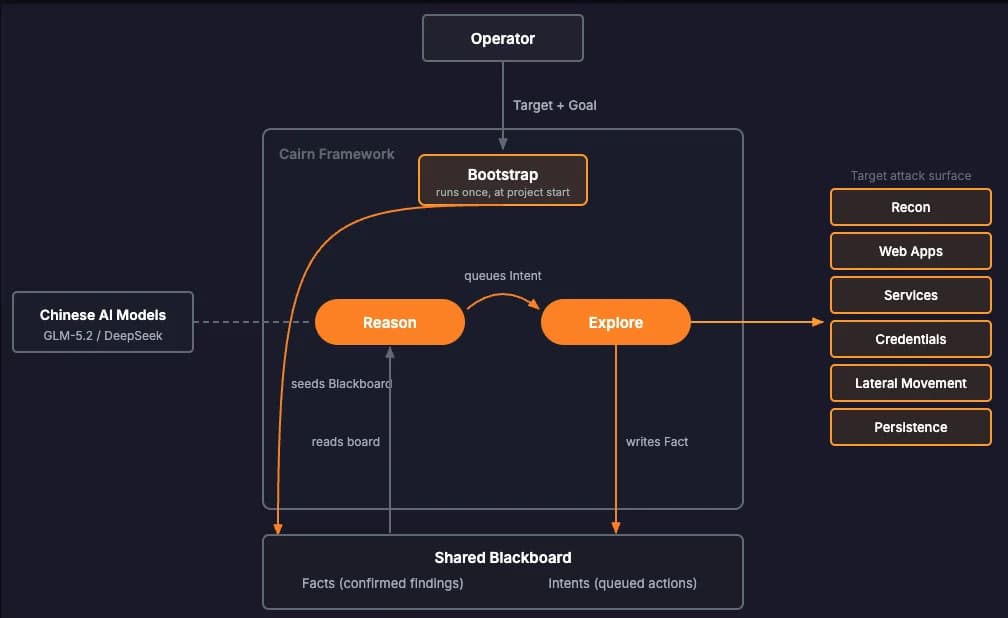 Image: Palo Alto Networks Unit 42
This architecture mirrors legitimate coding-agent harnesses: a planner, a tool executor, and memory—only the goal and guardrails differ. Google and Mandiant's ARTEX layering and CERT-In's CRAFTY FALCON advisory naming Cairn alongside ARTEX sit in the same ecosystem Unit 42 measured again in November with exposure counts for ARTEX and CyberStrikeAI.
Authorization pretext and model refusals
Unit 42 notes Cairn's stock worker prompts already tell the model never to refuse a task. CL-STA-1238 added a Chinese-language preamble on every Reason and Explore call asserting an authorized security test, CTF, or audit, and demanding professional compliance without refusal. Each operation also generated an AUTHORIZATION.md treating task creation as client approval. Unit 42 reports neither Zhipu GLM nor DeepSeek refused that framing—relevant when you evaluate safety tuning on models you plug into agent harnesses, offensive or defensive.
Confirmed outcomes Unit 42 highlights
The report groups victims into semiconductor supply chain (seven organizations), defense and policy (three), and human rights and civil society (four). Ten cases ended in confirmed unauthorized access or data retrieval. Examples Unit 42 publishes:
| Victim class | What Cairn achieved (per Unit 42) |
|---|---|
| Industry standards body | Weak-password spray → dozens of valid credentials; unauthenticated cloud-storage write overwrote a live standards-ballot document; arbitrary customer login with read/write/delete on meeting and voting functions. |
| Semiconductor company | Brute-forced production partner-integration credential valid across accounts → user and email lists → unauthorized admin accounts and a persistent API token in production. |
| US teachers' union | Account-creation bypass on CMS → valid sessions → more than one million member records, ~31,000 CRM contacts, staff password hashes. |
| Defense-policy / analytics | Open backend registration on an identity platform → ~500 user records including .mil and .gov emails. |
| Other CMS cases | Tens of thousands of records across lithography, industrial automation (~150,000 internal documents), and education nonprofit student data. |
Unit 42 assesses with moderate confidence that CL-STA-1238 is China-nexus intelligence collection, citing Chinese tasking text, Chinese model APIs, and target selection aligned with prior priorities. Attribution is intelligence context, not a patch priority for your staging CMS.
How this compares to earlier Cairn reporting
In October, Reuters and NorForge (our breakdown) described exposed Cairn consoles used to probe 1,200+ e-commerce sites and breach 100+, observed because instances were internet-visible. Gambit Security's September campaign (summarized in that post) added payment-card theft narratives with different cost estimates.
CL-STA-1238 is narrower and deeper: named sectors, pre-seeded VPN intelligence, custom skill packs, and law-enforcement-grade outcomes (ballot file tampering, persistent admins). The common thread is still Cairn as orchestration glue on commodity models—consistent with Check Point's ARTEX operator-console leaks showing prompt and tool traces when databases are left open.
For defenders, Unit 42's November ARTEX post already recommended hunting think-then-act HTTP cadence and canary credentials. Cairn adds high-volume single-origin noise in some operations—hundreds of thousands of requests from one IP, per the same research group's earlier Cairn notes cited in the ARTEX article.
What this means if you run AI coding agents
Your apps are the target surface
Coding agents rarely install Cairn on developer laptops. They do call the same identity APIs, partner portals, and cloud storage hooks that CL-STA-1238 abused:
- Registration and password-reset flows without bot-resistant rate limits are account-minting machines for agents and humans alike.
- Mass-assignment and IDOR on B2B integration apps let one partner credential become many tenants—exactly the semiconductor partner-integration path Unit 42 describes.
- Unauthenticated writes to object storage are not theoretical; Unit 42 documents live document overwrite on a standards ballot.
Run agent-driven integration tests only against environments whose exposure matches production controls. A test suite that hits an open registration endpoint on a public staging URL is a published attack map.
Your keys and consoles are adjacent risk
GitGuardian's November Shodan sweep found dozens of Cairn matches alongside ARTEX and HexStrike MCP servers with no authentication by default. If your team experiments with pentest agents, never leave the control plane on a routable IP. The October Reuters story began when researchers found exposed Cairn instances—CL-STA-1238 instead hosted Cairn in Hong Kong and staged egress in the US, but your misconfigured lab console could be the next passive observation point.
Rotate cloud keys that live in .env files, CI variables, or MCP configs agents read. AntiFox intrusions and Railway's ARTEX-speed probe contest show credential speed once a framework has a valid secret—similar to admin API tokens Cairn created in production.
Model choice does not save weak apps
CL-STA-1238 swapped DeepSeek tiers when Flash stalled. Your defensive coding agent might use frontier models with stronger refusals, but attackers' models only need to iterate HTTP against your bugs. Patching authentication bypasses and removing standing privileges still beat model governance alone.
What Beam can and cannot do here
Beam is local-first observability and policy for Claude Code, Codex, and similar coding agents on your machine. It does not sit in front of your production CMS or Notion-grade SaaS.
What it can help with on a developer workstation:
- Heuristic scans of skills and MCP configs before execution—eleven patterns plus MCP version-pin checks—including credential-shaped strings in files agents touch (monitoring basics).
- PreToolUse deny on Claude Code and Codex when workspace policy is enforce—hook-based, not a kernel sandbox, and fail-open if cached policy is missing. Useful if an agent tries to upload a tarball to an unknown inference host or paste production keys into a gist.
What it cannot do:
- Block CL-STA-1238 at your internet-facing registration endpoint.
- Replace WAF rules, IdP rate limits, or SOC playbooks for password spray and IDOR patterns Unit 42 lists.
- Detect Cairn specifically; it watches your agent's tool calls, not attacker-operated forks in Hong Kong.
Frequently asked questions
What did Unit 42 publish about Cairn on November 12, 2026?
A field report on CL-STA-1238: 25 Cairn operations, 19 organizations targeted, 10 confirmed intrusions, with infrastructure and model counts.
How does Cairn orchestrate attacks in this campaign?
Bootstrap, staged planning, then a Reason–Explore loop on a fact–intent blackboard until success or stop.
Did the attackers exploit a new AI-specific vulnerability?
No—Unit 42 lists classic web and identity weaknesses.
Which models did CL-STA-1238 use?
GLM 5.2, DeepSeek V4 Flash, and DeepSeek V4 Pro across 25 runs.
How is this different from the October Reuters Cairn reporting?
Reuters emphasized scale against e-commerce via exposed consoles; Unit 42 documents targeted sectors, custom skills, and named outcomes.
What should developers running coding agents do after this report?
Harden auth surfaces, remove public attack maps, rotate keys agents can read, and never expose pentest dashboards without authentication.
Related reading
- Unit 42 ARTEX: behavioral hallmarks for defenders
- Cairn 1,200+ sites: what Reuters verified
- GitGuardian: 45 agentic pentest frameworks on Shodan
- Google and Mandiant: five defense layers against agentic frameworks
- CERT-In CRAFTY FALCON and Cairn naming
- What are agent harnesses?
- Recorded Future: 103 AI-linked incidents
Technical details follow Unit 42's November 12, 2026 post and IOC list. Cairn upstream features and operator forks may change; re-check the vendor article before blocking infrastructure.