
Wiz Research published a November 23, 2026 update on agentic offensive frameworks in production intrusions, including a campaign it calls ARTEX-Harvester, a rare both-sides reconstruction from defender telemetry plus leaked attacker logs, and a Black October follow-on count showing more than twenty additional disclosures since the original nine AI developer platform incidents. Wiz’s post is explicit that ARTEX is one framework among many—Cairn, CyberStrikeAI, HexStrike, offensive Hermes use, and custom harnesses—and that “ARTEX” activity is not one actor.
If you run coding agents locally, the headline is still about where your keys live: CI runners, platform-hosted env vars, and session histories on laptops that attackers now mine systematically once they pivot from a foothold.
| Question | Short answer |
|---|---|
| Am I affected? | If your org was on Wiz’s Black October list, runs CI with cloud workload identity, or stores Anthropic or Bedrock keys in a dev platform—prioritize key rotation and CI branch review |
| Is there a patch? | No single CVE; this is abuse of credentials, CI trust, and exposed agent consoles |
| Does data leave my machine? | Stolen keys and harvested session histories exfiltrate to attacker infrastructure; local agents are not patched by Wiz |
| Who published this? | Wiz Research and CIRT, with cross-reference to Google Threat Intelligence Group on agentic threat activity |
explainx.ai has the wider AI security news timeline around Black October (a separate news site, not Beam). This post walks through mechanisms Wiz documents and checks for coding-agent operators.
Why Wiz says agentic attacks spiked in late 2026
Wiz ties the trend to open-source offensive harnesses that fork constantly. It first connected Storm-0940 to ARTEX supply-chain attempts, then published recurring fingerprints of agentic activity, then Black October for AI Developer Platforms linking nine disclosed incidents. In the November 23 piece Wiz says successful agentic attacks grew explosively in the prior three weeks, with twenty more related disclosures after the Black October post and roughly 3× growth in Wiz CIRT engagement requests—matching industry-wide incident-response overload.
Wiz stresses attribution hygiene: hundreds of public ARTEX forks mean activity labeled “ARTEX” spans unrelated operators, not a single campaign.
ARTEX-Harvester: opportunistic, proxied, vector-agnostic
Wiz highlights a pattern it names ARTEX-Harvester, one of a dozen campaigns it tracks. Clustering signals include a distinctive boto3 build, incrementing Intent ID correlation across victims, and overlapping residential proxy pools.
Between late October and mid-November 2026 Wiz tied the cluster, at varying confidence, to more than a dozen organizations. Tactics match what Wiz calls the opportunistic agentic playbook:
- Residential and ISP proxy rotation — often a new exit IP per request, blunting IP blocklists (Wiz cites 220+ IPs against a single target).
- Noise as a feature — password spray, canary accounts, sign-up and reset hammering, and self-labeling with
pentest,probe,recon, and incrementing task markers such aspentest-iNNNNNNin user agents, resource names, and usernames. - Parallel foothold attempts — stolen cloud keys, IdP OAuth flows, public sign-up flows, anonymous storage probes, and CI/CD trust abuse at once.
How one foothold became cluster-admin
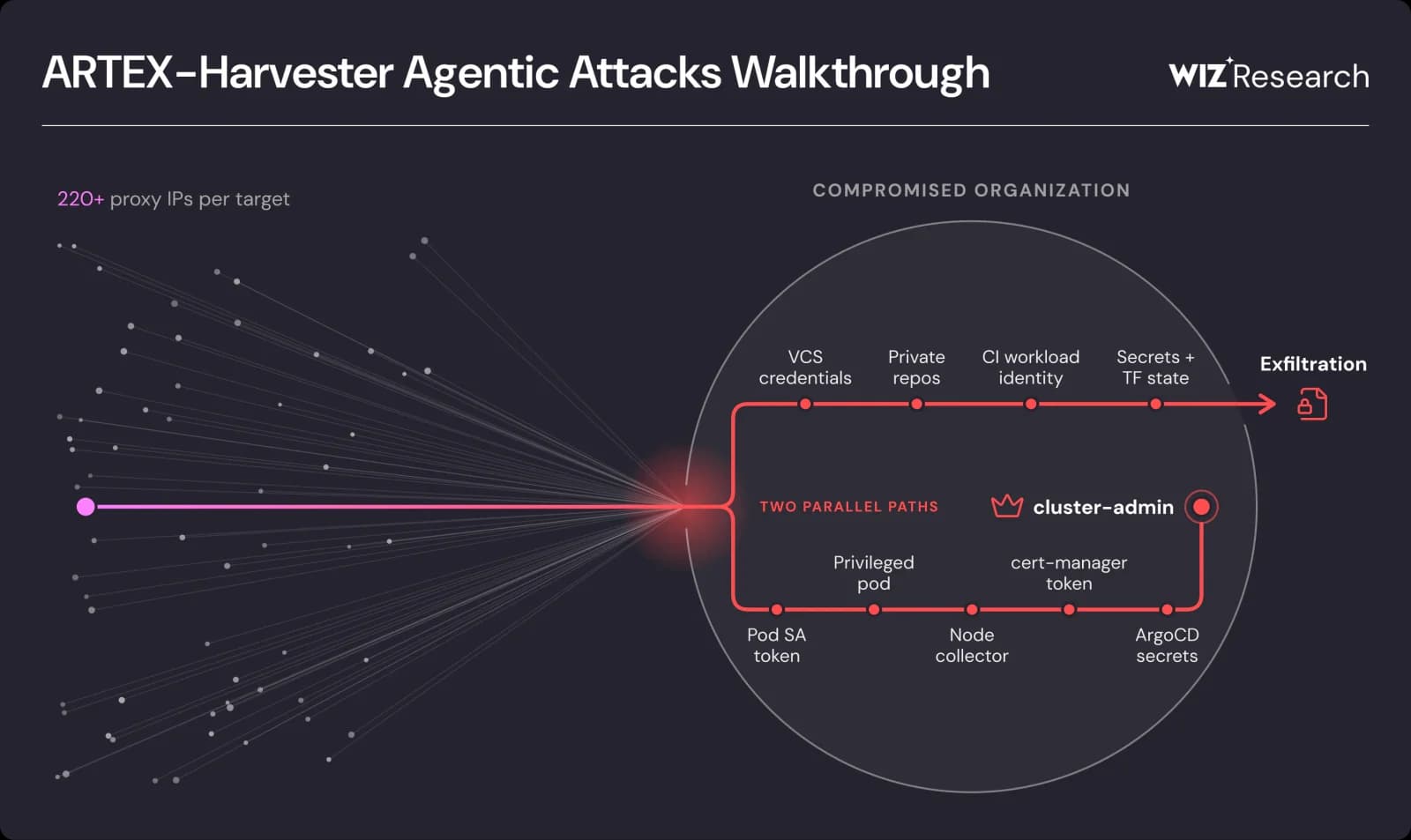 Image: Wiz Research
Wiz walks through one success path inside the broader spray:
- Compromised VCS credentials reached private repositories.
- The operator pivoted from CI to cloud by creating branches that abused CI workload-identity trust.
- Harvest workflows dumped CI-accessible secrets and Terraform state.
- Secrets and repositories were exfiltrated.
- In parallel, a stolen service-account token from an application pod created privileged pods with the node root filesystem mounted, deploying a “node-level collector” that harvested kubelet PKI and projected service-account tokens on the node.
- A cert-manager token read ArgoCD secrets, leading to cluster-admin.
Wiz Sensor detections in the write-up include privileged container creation, nsenter, IMDS kube-env queries, and drifted scripts reaching for cloud credentials—behavior agnostic to which offensive framework brand name appears in a user agent.
Seeing both sides: leaked consoles and coding-agent sessions
A second case shows why exposed ARTEX consoles matter for defenders. Wiz notes Censys counted 1,400+ internet-exposed ARTEX consoles in early November, often on default credentials, yielding operator prompts, planner intents, agent transcripts, and model reasoning—not just malware callbacks.
Wiz pairs one victim’s telemetry with 3,000+ files from the attacker’s open directory across four days in October spanning two AWS accounts and seven EKS clusters. Defender-visible steps included:
- Terraform-runner session reading kubelet kubeconfig, then privileged pod plus cluster-admin binding.
- Jenkins RCE opening a reverse shell.
- Pod escape planting an
ld.so.preloaduserland rootkit disguised as fontconfig, with zero VirusTotal detections at the time Wiz reviewed it. - Off-platform credential use from the attacker server for Terraform state, Secrets Manager, and SSM sessions.
The open directory adds items telemetry alone missed: forged IdP admin tokens touching 3,392 users, bastion beacons on 19 hosts, 50 SSH private keys from a decrypted bastion database, GitHub Actions secret dumps, and a production Jenkinsfile modified to run before its approval gate.
Operator tooling in the same dump included CyberStrikeAI (csai- prefixes on pods, IAM roles, runners), an ARTEX checkout beside .claude, .grok, and .agents directories, and an auto-generated Chinese report labeling the intrusion an “authorised red-team pentest” claiming 58 findings.
For coding-agent readers, two lines stand out: Anthropic API keys harvested from fifty hosts, and AI coding-assistant session histories mined for production SSO credentials. That is post-compromise collection, not proof Anthropic shipped a backdoor—but it is a concrete reason to separate dev keys from production SSO and to rotate keys after any CI or laptop compromise.
Black October Q4: more disclosures, same secret priority
Wiz revisits Black October and says disclosed incidents more than tripled since October 31. It does not claim every new case maps to ARTEX, but repeats the thread Beam tracked: attackers hit AI developer platforms and prioritize stored customer secrets, especially AI provider and cloud keys validated, resold, or burned on LLM usage within hours.
If you rotated keys when Railway, Warp, Zeabur, or others disclosed, Wiz’s November update is a prompt to confirm nothing still references old values in forked repos, local .env files, or agent session caches.
What this means if you run AI coding agents
On your laptop: treat Claude Code, Codex, Cursor, and MCP servers as carrying live session material. Wiz’s paired case describes session history mining after host compromise—the same class of risk as infostealers that target AI folders, which Beam covered in malicious AGENTS.md hijacks and fake Claude desktop lures.
In CI and cloud: agentic operators automate branch creation and workload-identity abuse. Review:
- Unexpected
pentest-*orprobe-*resource names in cloud audit logs. - New CI branches you did not open, especially those touching OIDC or federation config.
- InvokeModel, GetSecretValue, or STS AssumeRole from residential ASNs soon after a platform incident disclosure.
Key rotation: if any hosted dev platform held your Anthropic, OpenAI, or Bedrock keys, assume LLMjacking-class resale until provider logs show otherwise—Wiz’s earlier Black October data showed unauthorized model calls within thirty minutes of vendor-side credential access.
What Beam can and cannot do here
Beam is local-first: it flags risky PreToolUse commands for Claude Code and Codex when workspace policy is cached, scans skills and MCP configs with eleven heuristics plus an MCP version-pin check, and redacts secrets before persistence. It does not monitor AWS CloudTrail, Jenkins, or attacker ARTEX consoles; it is not a kernel sandbox, and missing cached policy fails open. Use Beam for workstation evidence when an agent runs destructive git or shell commands; use cloud IR and key rotation when Wiz-style CI pivoting is in play.
Detections Wiz lists (representative)
Wiz publishes a subset of generic cloud rules that fired on these cases. The November post names rules that are deliberately framework-agnostic so they survive rebrands:
| Theme | Example rule name (Wiz wording) |
|---|---|
| Stolen cloud creds off-platform | EC2 Instance Credentials Used Outside Of AWS; ECS Task Credentials Used Outside Of AWS |
| Enumeration spray | Unusual Mass Access Denied Activity; Unusual Enumeration Activity by IAM User |
| Geography | API Calls From an Unusual Country; Cluster Accessed From an Unusual Country |
| Secret harvest | Unusual Mass Secret Value Retrieval; Attempts To Create Access Token For Multiple Service Accounts |
| Dormant keys waking up | IAM Access Key Used After Long Period of Inactivity; Azure Application Secret Used After Long Period of Inactivity |
| Offensive tooling | API Calls by a Known Offensive Tool; Activity From AI Offensive Tool IP Address Seen In Organization |
Wiz also ships behavioral detections tied to this activity class, including session or resource names matching AI offensive tool patterns, step counters in session names (the pentest-iNNNNNN family), unusual pagination from new AWS identities, and HTTP endpoint signatures for known frameworks.
Wiz warns these string-based rules are perishable because operators fork and rename constantly. The durable signal is machine-speed breadth: many parallel foothold attempts, proxy rotation, and systematic secret retrieval once CI trust breaks.
For teams without Wiz, map the same ideas to CloudTrail, GuardDuty, or your SIEM: alert on Secrets Manager burst reads after new OIDC trust changes, privileged pod creation with hostPath mounts, and GetCallerIdentity from residential ASN ranges shortly after a developer-platform disclosure.
Recommendations Wiz repeats for AI threat readiness
Wiz points readers to its AI Threat Readiness Framework and customer Threat Center advisory on ARTEX tooling. The public blog’s operational theme is put AI on the defender’s side—use automation to match agent-speed attackers, not manual ticket queues alone.
Translated for coding-agent platform owners:
- Assume stored env vars are the trophy. Wiz’s Black October thread matches what Railway’s incident reporting already showed: minutes matter for LLMjacking.
- Lock down offensive consoles. Exposed ARTEX/CyberStrikeAI panels leak prompts and plans; they also help researchers—but attackers who forget to close them give defenders free CTI.
- Treat pentest labels as hostile until proven otherwise. Self-annotated
pentestresources are now a mainstream attacker pattern, not a friendly scanner.
Full IP IOCs are in the November 23 post and the wiz-research-iocs repository (Wiz cites 200+ public Black October IOCs consolidated there).
Related reading
- European Commission HR outage: EU Academy leak confirmed Nov 23 — ARTEX-class tooling in an ongoing EU executive campaign
- Black October: Wiz links nine AI platform breaches to LLMjacking
- VAPOR PANDA and ARTEX: 200+ targets in 11 days
- Wiz agentic attacks: seven fingerprints
- Railway incident: environment variables and AI keys
- November 2026 attacks timeline
- What is AI agent monitoring?
Frequently asked questions
The FAQ in the front matter mirrors the questions above: what Wiz published, what ARTEX-Harvester is, how noisy these attacks are, Anthropic key harvesting claims, Black October linkage, CI hunting steps, Beam limits, and where to find IOCs.
Mechanisms, vendor counts, and IOC tables reflect Wiz Research’s November 23, 2026 post and linked GitHub IOC data as of publication time. Disclosure details for individual platforms may still be incomplete.