
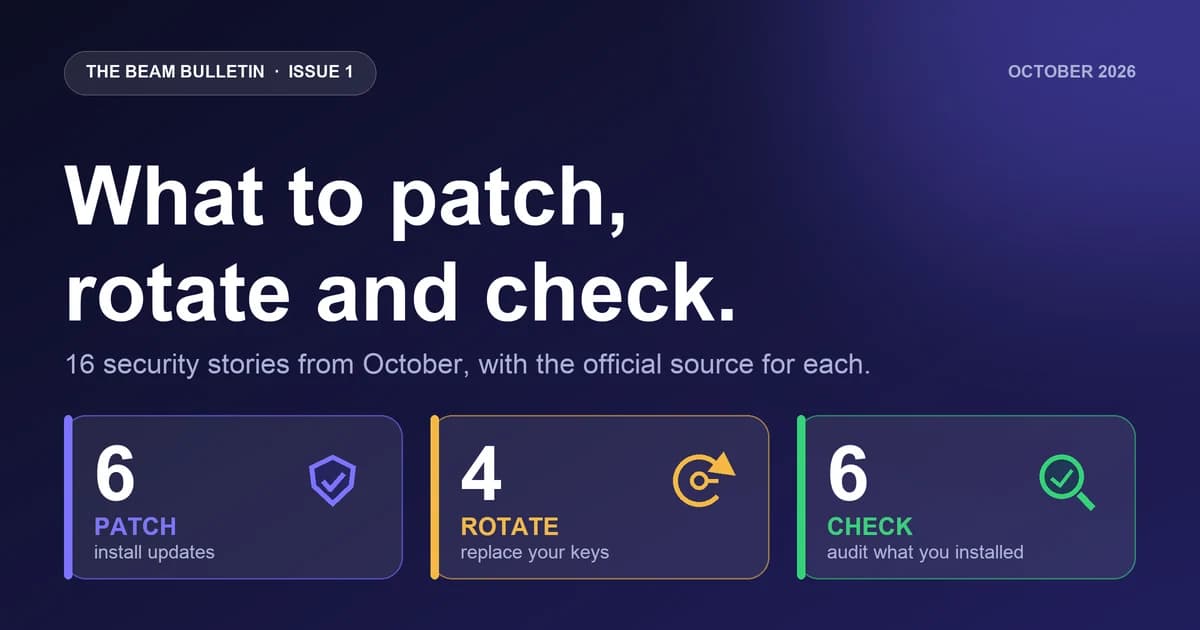
October's pattern: attackers went after keys and trusted tools, not clever exploits. Hosting platforms, package registries, command-line tools and update channels all handed over the secrets that developers and AI agents depend on. This issue sorts the 16 incidents into three jobs: Patch (install an update), Rotate (replace your keys) and Check (see whether you installed something bad). Below that, the same 16 are listed in date order. Every story has the official source and a deeper Beam breakdown if you want it.
At a glance: 6 to patch · 4 keys to rotate · 6 tools to check.
Patch now
Six updates to install this week.
- PHP2Shell (Oct 21): two critical PHP bugs, already exploited and on CISA's exploited list. Update to PHP 8.5.12, 8.4.27, 8.3.36 or 8.2.35. Official · Beam
- Microsoft Patch Tuesday (Oct 13): a record number of fixes (about 1,411) and one exploited Windows zero-day, CVE-2026-96951. Official · Beam
- GitLab (Oct 21): a maximum-severity bug (CVSS 10.0) lets anyone run code on a self-managed server. Upgrade to 19.5.1. Official · Beam
- Brotli (Oct 21 to 27): a bug in a compression library that many tools bundle was added to the exploited list. Check your runtimes and containers. Official · Beam
- Apple iOS 27.2 (Oct 26): 163 fixes, including eight that allow code execution through web pages. None is reported exploited, but the details are public. Official · Beam
- Chrome 156 (Oct 27): Anthropic says an unreleased AI model built five working exploit chains, so update Chrome. No attacks in the wild are claimed, and its count of 62 Chrome bugs is Anthropic's own. Official · Beam
Rotate your keys
Four services may have exposed secrets. Revoke at the provider, not just in the dashboard.
- Zeabur (Oct 14 to 19): about 3.2 million environment-variable records read, and the platform is shutting down by Dec 31. Official · Beam
- OpenCode Console (Oct 16): saved OpenAI, Anthropic and Google keys exposed for about 1.4% of users, and some saw unauthorized charges. Coverage · Beam
- Railway (Oct 21): environment variables may have been read, some decrypted. Rotate all of them. Official · Beam
- Warp (Oct 27): a vendor breach exposed agent traces and telemetry for up to about 1% of users, per Warp's CEO. As a precaution, rotate any tokens you pasted into agent sessions. Official · Beam
Check what you installed
Six cases where a tool or update you trusted was turned against you.
- OVHcloud CLI (Oct 19): official release binaries (0.11.0 to 0.15.0) were swapped for an infostealer for about 94 minutes. Official · Beam
- TeamUpdraft (Oct 17 to 19): stolen keys were used to plant backdoor plugins on WordPress sites. Updating does not remove them, so audit your plugins and admins. Official · Beam
- eMudhra (Oct 20): eight certificate authority keys were guessable, so certificates could be forged. Browsers have distrusted them. Official · Beam
- LiteLLM 1.107.0 (Oct 21): a malicious release on PyPI and Docker stole cloud and AI keys, with about 49,000 downloads. Pin to 1.106.2 and rotate. Official · Beam
- Aokigahara (Oct 23): a Windows infostealer whose aisessions module collects login and session files for AI tools such as Claude, Codex and Cursor, alongside browser passwords. Official · Beam
- Poisoned repo hooks (Oct 26 to 28): 42 GitHub repos carry hidden files that run when you open them in Claude Code, Gemini CLI, Cursor or VS Code. If you ran one, remove the persistence before revoking tokens. Official · Beam
The 16 stories, date by date
The same 16 incidents in the order they happened, with what actually went on.
- Oct 13 · Patch · Microsoft Patch Tuesday. Microsoft fixed around 1,411 flaws in one release (outlets report 1,411 to 1,413), the largest Patch Tuesday on record. One of them, CVE-2026-96951, is a Windows Shell bypass of Mark of the Web, the warning Windows attaches to downloaded files. It was already being exploited, and CISA added it to its exploited list the same day, with a federal patch deadline of Oct 16. Two other zero-days were publicly disclosed before fixes existed. Official · Beam
- Oct 14-19 · Rotate · Zeabur. An attacker used internal credentials that were left unrotated after an August breach, and read about 3.2 million environment-variable records across roughly 321,810 accounts. It was the second breach in two months. Zeabur announced on Oct 17 that it is shutting down, with renewals ending Dec 1 and all servers off by Dec 31. Official · Beam
- Oct 16-17 · Rotate · OpenCode Console. The hosted Console, not the local command-line tool, was breached through a legacy system that was being decommissioned. About 1.4% of Console users with linked providers may have had their OpenAI, Anthropic or Google keys exposed, and some reported unauthorized charges. Check usage back to Oct 16 and set spend caps. Coverage · Beam
- Oct 17-19 · Check · TeamUpdraft. Attackers broke into teamupdraft.com and used stolen UpdraftCentral connection keys to push backdoor plugins to connected WordPress sites. This was not a flaw in the UpdraftPlus code. Updating to 1.26.13 (free) or 2.26.13 (Premium) revokes the old keys but does not remove plugins already planted. Official · Beam
- Oct 19 · Check · OVHcloud CLI. A compromised developer account was used to replace the ovhcloud-cli release binaries (v0.11.0 to v0.15.0) on GitHub with an infostealer for about 94 minutes. This was the command-line tool, not OVHcloud's hosting platform. Versions 0.10.0 and 0.16.0 are clean. Official · Beam
- Oct 20-21 · Check · eMudhra. Private keys behind eight intermediate certificates, six for TLS and two for code signing, were generated with too little randomness, so certificates could be forged for any site. Mozilla, Google and Apple moved to distrust them, and eMudhra is leaving global TLS issuance. India's CERT-In says Indian digital signature and eSign services are unaffected. Official · Beam
- Oct 21 · Patch · PHP2Shell. Two flaws, CVE-2026-109618 and CVE-2026-109619 (CVSS v4.0 9.2), let attackers run code on web-serving PHP installs. The fixes shipped after details leaked a day early, attacks started within days, and CISA added both to its exploited list on Oct 26. PHP 8.1 and older get no upstream fix. Official · Beam
- Oct 21 · Check · LiteLLM 1.107.0. A malicious version of the AI gateway sat on PyPI and Docker for about two hours with roughly 49,000 downloads, stealing browser, cloud and AI-provider credentials. It followed a similar compromise in March. Pin to 1.106.2, remove the planted files and rotate every secret the host could reach. Official · Beam
- Oct 21 · Patch · GitLab. An unauthenticated flaw in GitLab's regex compiler (CVE-2026-110264, CVSS 10.0) allows remote code execution on self-managed GitLab, in releases going back about twelve years. If you run your own server, upgrade to the patch release now. Official · Beam
- Oct 21-22 · Rotate · Railway. An unauthorized party may have accessed encrypted environment variables, and for some customers the decrypted contents. Railway told all customers to rotate every variable, including sealed ones as a precaution, and paused deployments during the investigation. Official · Beam
- Oct 21-27 · Patch · Brotli. A bug in the Brotli decompression library, which many tools ship, was patched in Node.js on Oct 21 and added to CISA's exploited list on Oct 27. It reaches beyond Node into anything that bundles Brotli, so check your runtimes and containers, not only your own code. Official · Beam
- Oct 23 · Check · Aokigahara. Check Point (Oct 23) describes a Windows infostealer, also called Aoki, whose aisessions module collects local authentication files, session data and settings for AI tools including Claude, ChatGPT Desktop, Codex and Cursor. It also takes browser passwords, cookies and wallet data. Your agent's login is now a target in its own right. Official · Beam
- Oct 26 · Patch · Apple iOS 27.2. Apple shipped iOS 27.2 and iPadOS 27.2 with fixes for 163 flaws, including eight WebKit code-execution bugs and two sandbox escapes. Apple's release page does not list any as exploited, but the advisory is public, so update now. On iOS 26, install 26.7.2. Official · Beam
- Oct 26-28 · Check · Poisoned repo hooks. JFrog found 42 real GitHub repositories carrying hidden hook files for Claude Code, Gemini CLI, Cursor and VS Code that run a payload when you open the project. Cloning alone is safe; opening the folder or starting a session is the trigger. The worm carries a wiper, so remove the persistence before revoking any GitHub token. Official · Beam
- Oct 27 · Rotate · Warp. Warp's CEO says an attack on a vendor in Warp's infrastructure exposed agent traces and telemetry, and that up to about 1% of users may be affected. Warp says it detected the attack within hours and contained it, but has not named the vendor or said whether prompts or credentials were included. Agent traces can hold commands and pasted secrets, so rotate any tokens you shared with an agent as a precaution. Official · Beam
- Oct 27 · Patch · Chrome 156 and Anthropic's exploit chains. Anthropic published five exploit chains built by an unreleased research model, covering Chrome, Safari, Android, Windows and Linux. It says 62 Chrome bugs were patched as of Chrome 156, though Google's own release credits fewer to Anthropic, so treat that count as Anthropic's claim. No attacks in the wild are claimed. Update Chrome to 156 or later. Official · Beam
Want every incident? See the October 2026 attacks timeline. Facts reflect the linked sources as of Oct 29; counts are the reporting parties' figures.