
On November 17, 2026, GitHub and Microsoft published pilot results from Codename MDASH: 9,791 raw AI findings on six popular open source projects became 99 hand-verified private vulnerability reports with proof of concept and suggested patches, and maintainers had fixed 55 by November 15—but only 14 fixes were in a shipped release. The list includes FastMCP (MCP server framework), Express (Node web stack), ImageMagick, AutoGPT, Caddy, and Netty—dependencies and tools that sit under many Claude Code, Codex, and Cursor workflows.
If your agent runs npm install, edits a FastMCP server, or shells out to convert, this is not “another scanner noise” story: GitHub required human verification before maintainers saw a report, and several teams said fixes landed in days, not months.
| Question | Answer |
|---|---|
| Am I affected? | Yes if you run Node/Express apps, FastMCP, ImageMagick, AutoGPT, Caddy, or Netty |
| Is there a single CVE list? | Not yet in this post—reports went through private vulnerability reporting first |
| Are fixes live in npm/apt? | Only 14 of 55 fixes were in a release as of Nov 15 per GitHub |
| Does AI replace maintainer review? | No—seven FORGE researchers spent ~two days per project verifying |
| Agent takeaway? | Enable Dependabot, pin versions, block agents from mass npm update without advisory context |
The MDASH pipeline, step by step
GitHub documents five stages in the November 17 post:
- Find — Codename MDASH scans each repo with Microsoft’s MAI Cyber model and proposes fixes.
- Filter — A GitHub Security Lab triage agent (Copilot skills) drops duplicates, invalid reports, and low-impact noise so maintainers never see raw scanner dumps.
- Verify — Seven Microsoft FORGE Lab researchers manually check every remaining finding (~two days per project in the pilot).
- Report privately — Issues go through GitHub private vulnerability reporting with PoC and suggested patch.
- Fix on maintainer terms — Teams accept, adapt, or reject patches and choose release timing.
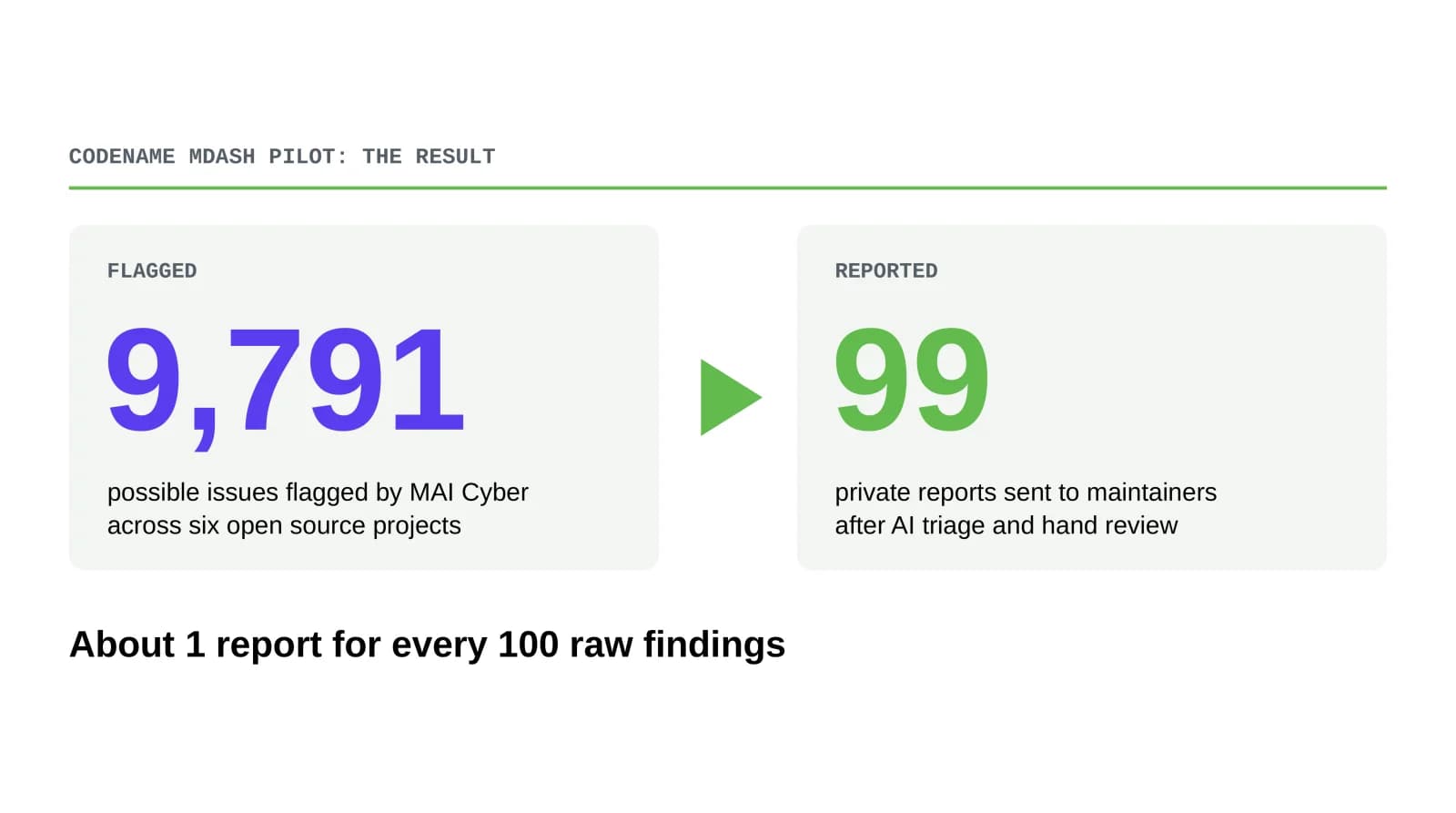 Image: GitHub
The infographic on GitHub’s page quantifies the funnel: 9,791 possible issues down to 99 reports—about one report per 100 raw AI flags after triage and human review.
This differs from maintainers’ everyday pain: GitHub quotes Log4j maintainer Christian Grobmeier saying defenders’ AI must beat attackers’ AI, while Express maintainers said these reports cut through noise from unsolicited AI bug spam.
Maintainer timing: what “fixed” looked like
GitHub’s post includes concrete elapsed times—useful when you compare them with how fast agents propose dependency bumps:
| Project | Maintainer note (from GitHub post) | Time signal |
|---|---|---|
| Caddy | Fixed all 22 reports | ≤ ~1 week from reports |
| AutoGPT | Broken new security check flagged 3 days after ship | Production fix < 1 week |
| ImageMagick | Distinct bug class at exact lines | Fix merged in ~15 minutes |
| Express | Reports cut noise vs unsolicited AI mail | Qualitative, not timed |
| FastMCP | Insights beyond prior AI scanners | Qualitative |
| Netty | Finding is cheap; fixing is the bottleneck | Process lesson |
Those quotes do not publish CVE numbers; they justify why release verification still matters. An agent that only reads GitHub Issues or main branch without checking Advisories and registry versions will miss the 14-of-55-in-release gap GitHub highlighted.
Why FastMCP and AutoGPT matter for agent builders
FastMCP is a framework for building MCP servers—the same class of tooling covered in our MCP security guide. A FastMCP maintainer quoted by GitHub said the scan surfaced security insights beyond prior AI scanners.
AutoGPT is an agent platform, not just a library. Its maintainers received a report three days after shipping a new security check that was broken; they extended the suggested patch and shipped a production fix in under a week.
For local agent operators:
- A vulnerable MCP server dependency becomes remote code or secret exposure the moment an agent loads tools from that server.
- AutoGPT-style orchestration multiplies blast radius—one bad plugin affects every sub-agent in the graph.
Inventory commands (from your stack, not from this incident’s undisclosed CVE list):
npm ls express fastmcp
pip show fastmcp
Cross-check GitHub Security tabs and org Dependabot alerts on repos your agents clone or patch.
Express, Caddy, Netty: web and socket layers
Express maintainers told GitHub the MDASH reports were unusually actionable compared with drive-by AI mail. Caddy fixed all 22 reports it received within about a week. Netty maintainers emphasized that finding bugs is no longer the bottleneck—shipping fixes is.
Coding agents frequently:
- Scaffold Express or Fastify APIs,
- Drop Caddy or nginx configs into docker-compose,
- Pull Netty transitively through Java services agents edit.
None of that is safe if the agent bumps versions blindly during a “security hardening” prompt—exactly the failure mode we described during November’s patch-pressure outage discourse.
ImageMagick: fast fix, slow release
ImageMagick’s two-person team received 22 reports. GitHub quotes maintainers saying one report resembled a familiar bug class but pointed at different lines; they merged a fix in about 15 minutes. That complements—but does not replace—prior Beam coverage of ImageMagick memory corruption such as CVE-2026-122006 in Rails Active Storage.
The pilot’s headline gap applies here too: merged fix ≠ released artifact. Agents that run apt install imagemagick or bump Docker base images need release tags, not only green GitHub PRs.
Releases vs fixes: the 14-of-55 lesson
GitHub states maintainers fixed 55 issues by November 15, but only 14 were in a software release. That gap is the whole supply-chain story for agents:
- An agent reading GitHub main may think you are patched when npm or PyPI still serves an old build.
- Dependabot only helps after a reviewed GitHub Advisory Database entry exists—GitHub says that is the intended downstream path.
Recommended workflow when an agent proposes emergency dependency bumps:
- Read the advisory or private report reference if you are a maintainer.
- Confirm the released version number in the package registry.
- Stage on one service, run integration tests, log the exact version pin in your change ticket.
Relation to Microsoft’s kernel MDASH work
Nine days earlier, Microsoft published 59 Linux kernel bugs from the same MDASH family. The November 17 GitHub pilot shows the harness aimed at application-layer code agents touch daily, not only linux.git.
GitHub also notes the pilot ran on an earlier MAI Cyber model, while MAI Cyber 2 launched separately—future scans may widen coverage but are not automatic protection for your laptop today.
What this means if you run AI coding agents
- Turn on Dependabot (or equivalent) on every repo agents modify; GitHub explicitly recommends it in the MDASH post.
- Enable private vulnerability reporting on repos you maintain (
gh-secureif you host on GitHub). - Forbid unscoped mass upgrades—especially after AI “security sweeps” that mirror Java4Shell discovery pressure.
- Scan MCP and skill folders before agents add new automation—Bitdefender’s fake
setup.jsrepos show attackers target the same npm surface. - Separate dev and prod ImageMagick versions; document which containers agents are allowed to rebuild.
What Beam can and cannot do here
Beam watches local agent actions: risky shell commands via PreToolUse hooks (Claude Code and Codex), heuristic skill and MCP config scanning (11 patterns plus version-pin checks), and on-device audit trails with redaction. It does not run MDASH-style semantic code analysis on every dependency in your monorepo, and it will not auto-apply Dependabot PRs. Use Beam to catch when an agent npm installs a typosquat or pipes curl to bash; use registry advisories to know which Express or FastMCP version is safe.
Private reporting, private forks, and CI agents
GitHub stresses that fixes stayed in familiar maintainer workflows: private vulnerability reporting, patches on GitHub, advisories later. For agents automating maintainer work, that implies:
- Agents must not open public issues for embargoed findings—exactly the failure mode GitHub’s pilot avoided.
- Maintainers need private forks with CI before merge; GitHub’s post notes maintainers run tests on private forks before public merge—a step agents sometimes skip to “land the PR faster.”
- GitHub markets agentic autofix for repositories with GitHub code security; that is downstream of human-reviewed reports in this pilot, not a replacement for the FORGE verification step.
If your coding agent touches FastMCP source as a maintainer, tighten policy: only merge security commits that cite a PVR id or maintainer acknowledgement, not a raw model transcript.
What maintainers asked reporters to do
GitHub closes with a norm for AI reporters—relevant when your agent files upstream bugs:
- Check findings against the project’s threat model and known issues.
- Report privately.
- Include a suggested fix and let maintainers set pace.
That is the opposite of mass public CVE spam some maintainers described. Teams that let agents spam OSS repos risk burning maintainer trust—and future access to exactly this kind of verified report channel.
Scale and next steps from GitHub
GitHub admits six projects and manual review do not scale yet. The announced next step is offering reviewed AI scans to all Secure Open Source Fund alumni with findings still going through private reporting first—216 projects per GitHub’s fund slide in the same post.
For agent teams, that means more vetted fixes in core AI dependencies over time—and still your job to install them.
Frequently asked questions
See the front matter FAQ for direct answers to search-style questions about MDASH, FastMCP, and release timing.
Related reading
- Microsoft MDASH: 59 Linux kernel CVEs
- Rails Active Storage and ImageMagick CVE-2026-122006
- AI agent application and supply-chain security
- Bitdefender fake setup.js repos targeting agents
- November patch rush and agent emergency deploys
- MAI Code 2 and MAI Cyber 2 Flash at Ignite 2026
- Daniel Stenberg on AI curl Rust rewrites lagging live CVE fixes
Primary sources: GitHub November 17, 2026 MDASH post, GitHub Secure Open Source Fund.
Advisory counts, fix totals, and MAI Cyber version references are accurate as of November 17–18, 2026 per GitHub’s publication. Individual CVE IDs from private reports may appear in the GitHub Advisory Database later; verify versions in your package manager before you treat a repo as patched.