
The Register reports that Google Threat Intelligence Group (GTIG) saw a suspected Russian-speaking operator run a multi-agent framework called exploit_agent that turned web application security patches into working exploits and executed them with no human in the loop, then stole data from victim organizations. The story, published November 16, 2026, attributes the case to GTIG's fourth-quarter 2026 AI threat tracker and frames it as a step beyond Q3, when autonomous frameworks were already compressing intrusion timelines. If you run coding agents, the immediate risk is not that someone hijacks your CLI. It is that apps and dependencies your agents ship sit in a much shorter patch-to-exploitation window.
| Question | Short answer |
|---|---|
| Am I affected? | Indirectly, if you operate or deploy internet-facing web apps, especially PHP-style stacks patch diffing targets |
| Is there a fix? | No product patch. Vendor updates for your own apps, threat-intel-driven prioritization, and credential rotation after compromise |
| Does data leave my machine? | Not from this attack type. Victim data theft happens on compromised servers |
| Is Google's Q4 tracker online? | Not at a public URL we could verify on November 16, 2026 |
| What should I do today? | Patch exploited CVEs first, shorten deploy cycles for web dependencies agents touch, and scope API keys |
What The Register says happened
According to The Register's November 16 report, GTIG threat hunters found an exposed staging server hosting a multi-agent vulnerability research and weaponization framework integrated with multiple frontier and local models. The framework, exploit_agent, used Russian-language tooling and was configured for continuous differential analysis of popular web application software.
That workflow, as The Register quotes GTIG, includes:
- Comparing code before and after security updates on target software.
- Identifying candidate vulnerabilities implied by the patch.
- Developing exploits against the unpatched behavior.
- Automatically executing exploits without human involvement.
The same server allegedly held data stolen from victims and post-compromise scripts for internal reconnaissance, brute forcing, webshell installation, and removing other attackers' webshells. Victim telemetry on the server suggested interest in French websites tied to media, entertainment, and education, per The Register's summary of GTIG.
The article also lists other AI-powered offensive frameworks GTIG has observed in the wild or in staging, including CAIRN, CyberStrikeAI, HexStrike AI, and PentAGI, in addition to ARTEX. Financially motivated criminals and suspected espionage actors, including some with a PRC nexus, are experimenting with these harnesses, The Register quotes GTIG as writing, and GTIG expects continued global use given low barriers and easy integration of new exploits.
We did not access GTIG's staging-server evidence ourselves. Everything in the previous section is reported characterization via The Register.
Claimed vs what we could verify on November 16, 2026
| Item | Status | Notes |
|---|---|---|
| exploit_agent patch-diff-to-exploit autonomy | Reported by GTIG via The Register | No primary GTIG page with this case name was retrievable at publish time |
| Q4 2026 AI Threat Tracker publication | Not verified on Google Cloud Blog | Listing at cloud.google.com/blog/topics/threat-intelligence still led with the September 8, 2026 tracker |
| Stolen victim data on the staging server | Reported | No victim names or sample indicators in The Register piece |
| French sector targeting | Reported | Stated as telemetry interpretation, not a named campaign |
| Broader framework list (ARTEX, PentAGI, etc.) | Verified in earlier GTIG posts | See ARTEX and Friends |
| LLM-assisted n-day weaponization trend | Verified in GTIG research | Vulnerability trends in the AI era, September 30, 2026 |
When the Q4 tracker appears on Google Cloud Blog, replace the second row with the official URL and quote the primary wording for exploit_agent. Until then, use The Register as secondary context and Google's September materials for the defensive story that does not depend on one staging server.
Attack chain, step by step (as described)
The Register's description implies an end-to-end closed loop rather than a human writing prompts between stages:
1. Target selection and version inventory
The framework focuses on popular web application software, not bespoke internal tools. Continuous differential analysis needs before-patch and after-patch source or bytecode for the same product line, which attackers typically harvest from public repositories, vendor downloads, and diff tools once advisories land.
2. Patch differential analysis
GTIG's separate vulnerability trends research already notes that threat actors may find it more efficient to weaponize n-days by automating analysis of patches, disclosure text, and proof-of-concept code than to hunt zero-days. The exploit_agent story, if accurate, is that workflow wired into agents that never pause for an operator.
3. Exploit synthesis and validation
Multi-agent setups described in the wild usually separate planning, coding, and execution sub-agents. Google's ARTEX reporting shows agents that retry, overwrite one another's scripts, and emit hundreds of telemetry events in seconds. The Register does not say how exploit_agent validated exploits, but staging servers in other GTIG cases held progressions of scripts from probes to full chains for recently patched browser n-days, per the September AI Threat Tracker.
4. Autonomous exploitation
The new claim in The Register piece is execution without human involvement, distinct from frameworks that still need a human to paste credentials or approve goals. That would cross a line Google's September tracker said it had not yet seen at scale for fully autonomous pipelines against arbitrary targets, though it warned the direction was clear.
5. Post-exploitation and data theft
The staging server allegedly stored stolen organizational data and tooling for lateral movement helpers (recon, brute force, webshells). That matches how ARTEX cases progressed once initial access existed, except here initial access may also have been agent-driven.
How this fits published GTIG research
Three Google-published threads matter even if the Q4 PDF or blog post is still rolling out.
Agentic offense in incident response. Since late August 2026, GTIG and Mandiant documented ARTEX, PentAGI, and CAIRN in live engagements. Agents handled lateral movement, database exploitation, and exfiltration prep in minutes. Beam's earlier coverage of Wiz's agentic attack fingerprints and Storm-0940 adds victim-side context. exploit_agent, as described, sounds like the vulnerability half of that stack automated: fewer stolen SaaS keys as prerequisites, more patch-driven remote compromise of web apps.
Shrinking patch windows. GTIG's September 30 analysis shows CVE exploitation growth tracking disclosure growth in 2026 and argues much of the rise is n-day weaponization, not a flood of new zero-days. In-the-wild exploitation averaged 18 per month in 2026 versus 10.5 in 2025, and exploitation of High-Risk flaws rose from 28 in all of 2025 to 75 from January through August 2026. The chart below is from that post, not from The Register story.
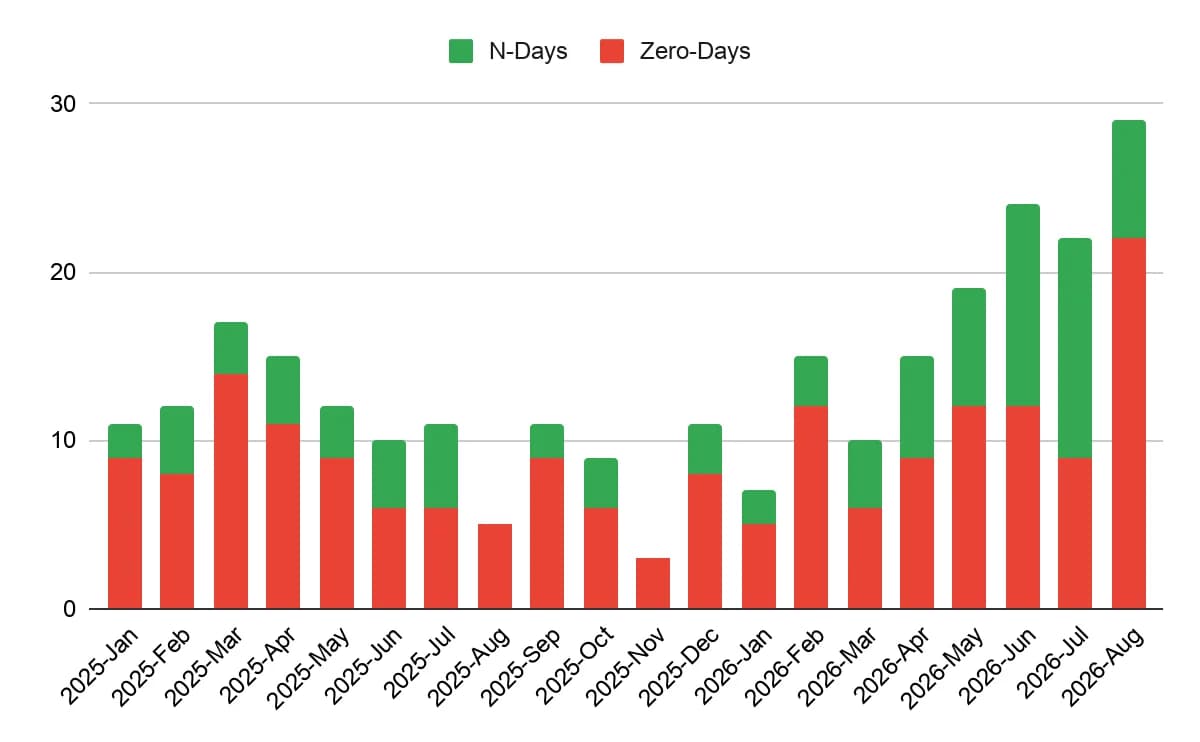 Image: Google Threat Intelligence Group
Defensive agents racing the same clock. Google markets CodeMender and related agentic source review for finding and fixing flaws before exploitation. Wiz's Green Agent ASPM pitch makes the same point from another vendor angle: discovery is not the bottleneck anymore. Offensive exploit_agent loops and defensive patch agents are two sides of machine-speed software risk.
What this means if you run AI coding agents
Coding agents change how fast vulnerable code reaches production, not how PHP or Java servlet patches work on the server. Concretely:
-
Treat agent-assisted commits as production-adjacent. If Claude Code or Codex bumps a dependency or edits a deployment manifest, run the same patch SLA you would for a human release. The agent does not get a grace period because the flaw was patched yesterday.
-
Prioritize by exploitation evidence, not CVSS alone. Follow CISA KEV and vendor exploitation flags first. That matches how Beam covered Outlook CVE-2026-124194 and React RSC CVE-2026-126187.
-
Assume public PoCs accelerate. Research programs such as OpenAI's Linux kernel pipeline and Vals AI's open-weight cyber offense benchmarks document attacker-side automation on the defensive research side. Criminal exploit_agent-style loops, if GTIG's description holds, apply the same economics to your internet-facing apps.
-
Scope credentials agents can touch. Post-compromise scripts in The Register's summary mirror what ARTEX did with stolen cloud and SCM tokens. Rotate keys stored in env files agents read, and review LLMjacking controls if agents use shared API keys.
-
Watch for patch-gap attacks in browsers and runtimes too. Epoch AI documented open-weight models exploiting the Firefox patch gap; GTIG cited similar open-directory exploit iteration in its September tracker. Web apps are not the only diff target.
-
Log agent deploy actions. If you use Beam or another collector, retain evidence of which dependency versions an agent pinned and which deploy commands it ran. That helps after a breach when you need to know whether an unpatched line was agent-merged.
What Beam can and cannot do here
Beam watches local coding agent tool use on your machine: heuristic scans of skills and MCP configs, optional PreToolUse deny for Claude Code and Codex, and on-device event history with redaction before storage. It does not sit on your production web tier, diff vendor patches, or block autonomous exploitation of a missed PHP update.
Where Beam still helps in this threat model:
- Flags risky agent behavior such as piping curl to bash, exfil-style curls, or credential patterns in commands before they run (within hook coverage limits).
- Surfaces what changed in a session so you can correlate an agent-merged
composer.lockorpackage.jsonbump with a later n-day report. - Scans skills that might instruct an agent to disable security checks or pull unaudited exploit code from the internet.
Beam is heuristic, hook-based, and fail-open when cached policy is missing. It is not a WAF, EDR, or patch orchestrator. For server-side patch differential attacks, pair vendor updates with edge defenses and inventory, and use Beam for the developer workstation and agent governance slice.
Frequently asked questions
What did Google GTIG report about exploit_agent?
According to The Register on November 16, 2026, GTIG described an exposed staging server running a framework called exploit_agent that compared code before and after security updates on popular web applications, developed exploits, and executed them without human involvement, then stole data from victims. French media, entertainment, and education sites were named as interests.
Is the Q4 2026 AI Threat Tracker publicly available?
As of November 16, 2026 we could not retrieve a matching Google Cloud blog post for a Q4 2026 AI Threat Tracker at cloud.google.com/blog/topics/threat-intelligence. The Register attributes the exploit_agent case to that report; treat operational detail as reported by GTIG via The Register until Google publishes the tracker.
What is Google Threat Intelligence Group?
Google Threat Intelligence Group (GTIG) is Google's threat intelligence organization. It publishes research on adversary use of AI, runs incident response with Mandiant, and maintains quarterly AI Threat Tracker reports on adversarial misuse of models and agents.
Does this mean my local Claude Code session is compromised?
Not directly. The Register describes server-side exploitation of web applications after patch diffing, not compromise of a developer's laptop. The lesson for coding agents is shorter safe windows for dependencies and apps you ship, and tighter control over credentials agents can reach if those apps are attacked.
How is exploit_agent different from ARTEX?
Google's October 2026 ARTEX reporting describes open-source agentic pentest frameworks abused in intrusions with human-supplied credentials and goals. The Register's exploit_agent description centers on continuous differential analysis of vendor patches to build and fire exploits autonomously, which is closer to industrialized n-day weaponization.
What should I patch first on agent-related projects?
Patch internet-facing web apps and dependencies your agents deploy or manage, prioritize CISA KEV and vendor exploitation flags, and keep agent hosts on current kernels. Google's September 2026 vulnerability trends post ties faster n-day weaponization to LLM-assisted diff analysis of patches and advisories.
Can Beam stop an autonomous exploit_agent attack on my product?
No. Beam is local monitoring and hook-based deny for coding agent tool use on your machine. It does not patch your servers or block internet exploitation. It can help you see whether an agent pushed vulnerable code or leaked credentials that later appear in a breach.
Are other offensive agent frameworks in use?
Yes, in published Google reporting. The Register and GTIG's earlier ARTEX post name CAIRN, CyberStrikeAI, HexStrike AI, and PentAGI alongside ARTEX in real intrusions, with both criminal and espionage actors experimenting with multi-agent harnesses.
Related reading
- ARTEX and Friends: five defense layers
- OpenAI's 948 Linux root exploits
- Firefox patch-gap exploitation
- Project Zero shrinks disclosure windows (Full X policy)
- Wiz Green Agent and patch velocity
- November 2026 attacks timeline
The Register summary, Google's September 2026 threat intelligence posts, and Cloud Blog availability were checked on November 16, 2026 UTC and may change when GTIG publishes the Q4 AI Threat Tracker. Beam is a local prototype; verify current product behavior in the docs before relying on any feature named here.