
Federal prosecutors say former OpenAI engineering lead Abdulrahman Alfozan intercepted executive conference-room audio with a concealed USB recorder, captured dozens of September 2026 meetings, and used OpenAI’s own coding stack—including prompts tied to his spouse’s account—to customize recording and file-handling workflows. The October 13, 2026 Justice Department press release charges one Wiretap Act count; a November 23, 2026 detention motion summarized in Bloomberg Law and Business Insider adds trade-secret recordings, a confidential strategic-partnership term-sheet photo, and explicit Codex usage. Espionage remains uncharged as of the latest on-record prosecutor statements reported by CNBC.
If you run Codex, Claude Code, or similar agents, the case is not a patch Tuesday item. It is insider threat at agent speed: anyone with a corporate login can ask a coding model to script surveillance, exfiltration helpers, or Dropbox organizers faster than manual coding.
| Question | Short answer |
|---|---|
| Am I affected as a Codex user? | No product CVE—only if your org lacks insider controls on who may use coding agents and where sensitive meetings occur |
| Is there a fix? | Legal and HR process, not a semver bump: access reviews, no shared family accounts on employer tools, room controls |
| Does data leave my machine? | Employer-hosted agent sessions may log prompts per vendor policy; this case involves personal Dropbox and on-device audio, per filings |
| Is Codex compromised? | Not alleged—prosecutors describe authorized-tool misuse by an employee |
What the government says happened (timeline)
The DOJ narrative, as of the unsealed October complaint quoted in the department’s press release:
- July 2025 onward: Alfozan worked as an OpenAI engineer.
- Before September 28: He allegedly used a productivity tool to query building addresses, meeting-room calendars, leadership locations, and external partner meetings.
- September 24–30: A chatbot account associated with his spouse (sharing identifiers with his own account) submitted prompts to build a continuous audio recorder, improve Wi-Fi connectivity, improve live listening, and encrypt an SD card—plus device-specific prompts including a custom header and MAC address on September 27–28.
- About September 28: Staff found Recording Device 1—a recorder hidden in toilet paper in a USB port behind a TV in an executive conference room—where meetings discussed confidential research, product plans, and government engagements, per the complaint.
- October 5: CCTV showed Alfozan looking behind that TV; security later found Recording Device 2 in his bag.
- October 9, 2026: FBI arrest; initial Wiretap Act charge.
November 2026 court developments
Two later filings change what security teams should track:
Detention and discovery (November 17, 2026 hearing). CNBC reports Judge Chhabria set a January 20, 2027 trial, ordered FBI reports to defense by November 24, and pressed prosecutors on espionage or trade-secret theft evidence. Assistant U.S. Attorney Nick Parker said he was not aware of such evidence at that time and was not suggesting the defendant stole anything—while still opposing release.
Monday, November 23, 2026 motion (reported November 23–24). Business Insider quotes prosecutors saying Alfozan used Codex through his wife’s account to add voice detection and organize recordings in Dropbox; investigators found a CONFIDENTIAL strategic-partnership term sheet photo and dozens of September audio files that likely include trade-secret discussions. Bloomberg Law carries the same trade-secret and term-sheet framing in its November 23 IP desk summary.
Defense counter (status statement, November 2026). A CourtListener-filed status statement says government counsel acknowledged at a November 3 meet-and-confer that the FBI had not uncovered new evidence supporting § 951 foreign-agent or § 1832 trade-secret theft charges at indictment—while cautioning future charges remain possible.
Hardware found in the executive conference room
The Justice Department published a photo of the seized recorder:
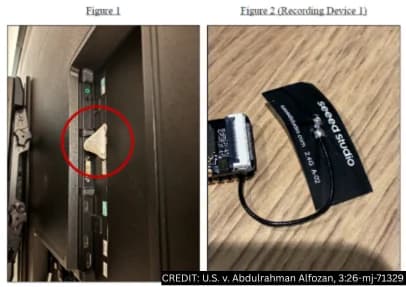 Image: U.S. Department of Justice
OpenAI security staff—not a coding-agent scanner—discovered the device. That distinction matters when you budget controls.
Claimed vs verified (November 24, 2026)
| Claim | Status | Source |
|---|---|---|
| Hidden USB recorder in exec conference room | Charged / alleged in complaint | DOJ press release |
| Spouse-linked chatbot prompts to build/improve recorder | Alleged in complaint | Same |
| ~160 hours of meeting audio recovered | Reported from Nov 17 hearing | CNBC |
| Codex used for voice detection + Dropbox sorting | Reported from Nov 23 prosecution motion | Business Insider |
| Term-sheet photo + likely trade-secret audio on PC | Reported from Nov 23 motion | Bloomberg Law / BI |
| Espionage or foreign-agent charges | Not filed; prosecutors disclaimed evidence at Nov 17 hearing per CNBC | CNBC |
| OpenAI source-code or customer-data theft proved | OpenAI said it lacked proof of source/customer theft per CNBC; Parker said not suggesting defendant stole anything at that hearing | CNBC |
Treat outlet reporting on sealed motions as secondary to the DOJ complaint and on-the-record hearing quotes.
What the October complaint says about “productivity” and chatbot accounts
The DOJ press release quotes the unsealed complaint in unusual detail for a corporate intrusion case—because the Wiretap Act theory depends on intent and device use, not database exfiltration alone.
Three passages matter for security architects:
Executive-room sensitivity. The government alleges meetings in the bugged room covered proprietary research, product plans, business-development opportunities, government engagements, and commercial relationships. That is broader than model weights: it is the kind of oral discussion that never belongs in a chat export but still drives valuation.
Pre-placement reconnaissance. Before September 28, the complaint says Alfozan queried a productivity tool for building addresses, meeting-room capacities and calendars, leadership and exec locations, and external partner meetings. None of that requires kernel access—it is normal SaaS visibility when an employee still has an account.
Spouse-linked chatbot prompts. Between September 24 and 30, the spouse-associated chatbot account allegedly asked how to build a continuous audio recorder, customize Wi-Fi connectivity, improve audio and live listening, encrypt the SD card, and tie prompts to Recording Device 1’s MAC address on September 27–28. The November 23 reporting that names Codex and voice detection is consistent with that earlier prompt pattern, even though the October press release does not brand the tool “Codex” by product name.
OpenAI told CNBC it lacked proof he took source code or customer data after firing him. That does not negate the oral-intercept theory; it narrows what the employer has publicly confirmed about repository theft.
National-security framing vs single-count indictment
Press releases from October 13 pair the arrest with NSPM-11 “super intelligence” rhetoric, and early detention papers compared the defendant to foreign-agent prosecutions. By November 17, CNBC reports Nick Parker saying he was not aware of espionage evidence and not suggesting the defendant stole anything at that hearing—while November 23 filings still argue trade-secret content appears in audio and images.
For coding-agent teams, the lesson is procedural: headline national-security language can outrun indicted offenses. Your insider playbook should assume Wiretap Act or trade-secret theories can coexist with authorized LLM accounts until HR and legal complete review.
Enterprise checklist: Codex and peer agents after this filing
These controls come from public allegations, not from Beam product features:
- One human, one employer identity on coding agents—no spouse accounts on the corporate tenant.
- Prompt retention where contracts allow, with alerting on themes that match the complaint’s list (covert audio, SD encryption for unknown hardware, MAC-specific device headers).
- Separate physical security for restricted suites from network ACLs; agents do not watch conference rooms.
- Offboarding within hours of suspicion, including personal device holds handled by counsel—not by asking Codex to “delete Dropbox.”
- Red-team tabletop that includes “malicious insider uses our own coding agent”, alongside prompt injection drills.
Mechanism: how a coding agent fits insider surveillance
The attack chain blends physical access, consumer hardware, and LLM-assisted scripting:
- Reconnaissance via ordinary workplace tools (calendars, floor plans) and unauthorized proximity to a restricted room.
- Device customization via chatbot prompts (complaint) and, per November reporting, Codex for voice-detection logic and file organization.
- Storage and staging on personal cloud (Dropbox cited in BI).
- Encryption on the recorder (complaint alleges encrypted device contents).
This is parallel to supply-chain malware only in branding: here the insider used legitimate OpenAI surfaces. Compare permission boundaries for agent tools—the risk is authorized accounts doing unauthorized work, not prompt injection from the public internet.
Prosecutors also flagged the defense’s plan to review discovery with a competing AI tool (CNBC names Claude). That is a data-handling dispute between parties, not guidance for your engineering team—except that proprietary weights and meeting audio should stay inside approved review environments.
What this means if you run AI coding agents
Separate “agent security” from “insider HR security.” Beam-style hooks catch destructive shell commands and risky skills on a laptop; they do not replace badge access, TSCM-style sweeps, or DLP on personal Dropbox accounts.
Ban household account sharing on employer Codex/Copilot tenants. The complaint’s spouse-linked chatbot account is a concrete pattern: family credentials blur attribution and evade per-employee audit trails.
Log and alert on high-risk prompt themes where your vendor allows: continuous recording, SD-card encryption for covert devices, MAC-address-specific hardware, and bulk cloud upload helpers. This is policy and SIEM work, not a magic regex—but the DOJ’s quoted prompt list is a starter hunting guide.
Treat agents as compilers for speed, not as ethics engines. The same Codex CLI that ships secure patches can ship surveillance scripts when the operator is malicious.
Run tabletop exercises on “employee exfil via agent.” Pair with our agent security monitoring checklist and shared responsibility gap framing—vendor safety features do not observe conference rooms.
What Beam can and cannot do here
Beam is local-first observability for coding agents on your machine: PreToolUse deny (when policy is cached) for Claude Code and Codex, heuristic skill/MCP scans, and on-device event history. See how Beam watches agent actions.
It does not monitor employer SaaS Codex prompt logs, physical conference rooms, or a former employee’s personal Dropbox. It is heuristic, not insider-threat UEBA, and fail-open on missing cached deny policy. Use it to harden developer workstations; pair with corp IAM and legal for insider cases like this one.
Related reading
- AI agent permissions and tool boundaries
- Agent security monitoring checklist
- OpenAI Shirudo launch (Codex named for infrastructure shields—not insider policy)
- How to prevent prompt injection in AI agents
- What is AI agent monitoring
Frequently asked questions
Did OpenAI or Codex get hacked?
No public filing describes a Codex vulnerability. The allegation is insider misuse of accounts and hardware.
What is Alfozan charged with?
One Wiretap Act count as of November 24, 2026, per the DOJ press release.
Did he use Codex?
Reported yes in a November 23, 2026 prosecution motion, per Business Insider; the October complaint already described spouse-linked chatbot prompts to build the recorder.
Is this espionage?
Not charged; CNBC quotes prosecutors disclaiming espionage evidence at the November 17 hearing.
When is trial?
January 20, 2027, per CNBC.
Should we disable Codex?
Disable unauthorized use and shared accounts; do not conflate insider crime with disabling a coding agent your engineers need with proper controls.
How is this different from prompt injection?
Prompt injection is untrusted content steering an agent. This case is a trusted employee allegedly using trusted tools for physical interception.
Does Beam prevent this?
No for conference-room hardware; partially for risky automation scripts an insider runs on a monitored laptop.
Court dates, charge counts, and vendor statements are accurate as of November 24, 2026; follow the DOJ case announcements and district court docket for updates.