
On November 23, 2026, NVISO published incident-response research that ARTEX—the LLM-driven intrusion framework peers also track in Google Threat Intelligence Group reporting and CrowdStrike’s VAPOR PANDA write-up—deployed ZQAgent, a new Linux backdoor built for long-term access instead of the usual credential smash-and-grab. NVISO’s primary post documents reverse-engineering, persistence templates, YARA rules, and IOCs from a Belgium engagement, with similar samples from Taiwan.
If you run coding agents on developer laptops, the mechanism still matters indirectly: ARTEX chains often land on Linux CI runners, self-hosted build agents, and cloud VMs that hold deployment keys and API tokens your Claude Code or Codex sessions rely on. Beam’s November 23 Wiz ARTEX-Harvester update covered key theft from those platforms; ZQAgent is the foothold that survives after rotation if you miss the backdoor.
| Question | Short answer |
|---|---|
| Am I affected? | Linux servers in orgs seeing ARTEX-style intrusions—especially if FOG0003 IOCs or fake Device event journal daemon units appear |
| Is there a patch? | No CVE; evict the implant, rotate secrets, reimage if unsure |
| Does data leave my machine? | The backdoor exfiltrates via C2 once installed; local agents on an uncompromised laptop are not patched by vendor updates |
| What changed? | ARTEX operators can order persistence, not only credential staging |
Why this breaks the ARTEX containment playbook
NVISO states that LLM-driven ARTEX intrusions usually follow a repeatable chain: exploit or stolen creds for access, then fast abuse of misconfigurations and lingering secrets. Responders often isolate initial access and revoke staged credentials before lateral noise peaks.
ZQAgent changes the end state. NVISO believes the persistent backdoor reflects operator instructions, not autonomous ARTEX defaults—LLM tooling accelerating placement, humans choosing dwell time. That matches the broader worry in 123 Reg ARTEX claims we unpacked and South Korea bank reporting on ARTEX sessions: speed and volume from agentic harnesses, with humans steering objectives.
NVISO warns the pattern may spread to ransomware and espionage timelines—shorter time-to-ransom and wider scoping—if defenders still assume hours to contain smash-and-grab jobs. The researchers cite Huntress time-to-ransom research as background: minutes-scale phases are plausible when initial access and credential reuse are already automated. Coding-agent operators should assume compromised CI can be re-tasked overnight even after password resets, because ZQAgent’s cron and systemd paths re-launch the implant without waiting for a new ARTEX login session.
Security teams that treated ARTEX as “rotate keys and close the ticket” need a second playbook branch: persistence hunting on every Linux host touched during the incident, including ephemeral build agents that are reimaged from compromised golden images. If your Terraform or Packer pipelines build those images on shared runners, one ZQAgent binary under /usr/lib/systemd/ can re-seed every fresh VM your Codex deploy jobs spawn.
Attack chain: from ARTEX access to ZQAgent
NVISO does not re-document initial access in this post; focus is post-compromise tooling. The observed sequence on the Belgium engagement:
- ARTEX activity on the victim Linux estate (consistent with other industry reports of agentic exploitation and credential abuse).
- Staging at
/tmp/zqa/systemd-timesyncd—a name chosen to resemblesystemd-timesyncd. - ZQAgent installation with FOG0003 C2:
37.122.150[.]15andbloonspace[.]comon every sample NVISO confirmed, plus public VirusTotal samples linked in the post. - Migration to memfd and process impersonation so administrators see a plausible
dbus-daemoninstead of the implant path. - Dual persistence—systemd plus cron—with timestamp manipulation on dropped files.
- Operator tasks via numbered operation codes (file ops, shells, tunnels, managed processes).
Team Cymru data cited by NVISO suggests FOG0003 also used ZQAgent in Asia against government and human-rights targets—separate from the Belgium IR case but sharing the same C2.
Runtime evasion: memfd and dbus spoofing
ZQAgent’s stealth steps are concrete enough to hunt without guessing:
Anonymous memfd. The implant copies itself into a temporary anonymous file, so /proc/<pid>/exe and process listings show /memfd:a (deleted)—the same label NVISO saw on public Taiwan samples.
Command-line spoofing. After migration, ZQAgent restarts as a detached process whose argv matches a real dbus-daemon invocation:
/usr/bin/dbus-daemon --session --address=systemd: --nofork --nopidfile --systemd-activation --syslog-only
The spoofed line is not linked to the original executable on disk—a quick readlink /proc/<pid>/exe mismatch is a strong signal.
Runtime evasion on Linux hosts
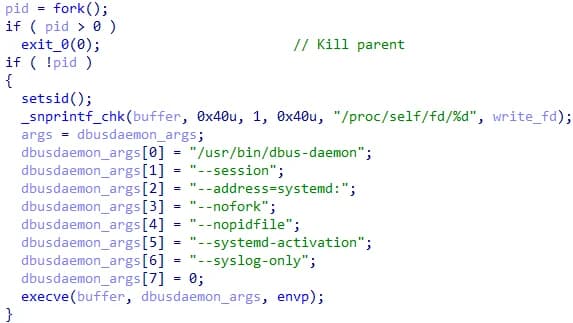 Image: NVISO Labs
NVISO also notes configuration encryption—settings decrypted only when evaluated—and multiple network encryption layers including ChaCha20 variants on C2 traffic. That does not change persistence artifacts on disk; it raises the bar for passive network-only detection.
Operator capabilities (what the C2 can do)
NVISO maps opcode tables to familiar shell semantics—useful when writing detection content:
| Opcode family | Capability |
|---|---|
0x04, 0x08 | getcwd / chdir |
0x0E, 0x11, 0x12, 0x1B | Directory listing, delete, rename, mkdir |
0x18 | Read first 2048 bytes of a file |
0x2B, 0x47, 0x48 | Managed commands and interactive shells (/bin/bash or /bin/sh) |
0x25–0x27, 0x3E–0x46 | TCP/UDP connection management |
0x34 | Memory-only managed process via memfd |
0x29, 0x2A | Inspect or kill arbitrary processes via /proc |
The 0x34 memfd execution path parallels other Linux implants Beam covered, including Vmcloudoor’s fake cloud-agent personas—different authors, same goal of blending into ops tooling.
Persistence: systemd and cron templates
Persistence is twofold and role-aware:
Binary placement
- root:
/usr/lib/systemd/%s - user:
$HOME/.local/share/%s - no HOME:
/tmp/.local/share/%s
Service unit
- root:
/etc/systemd/system/%s.service - user:
$HOME/.config/systemd/user/%s.service(or/tmp/.config/systemd/user/fallback)
Both templates use Description=Device event journal daemon, Restart=always, RestartSec=30, and StandardOutput=null / StandardError=null to stay quiet in journals.
Enablement commands from NVISO:
systemctl [--user] daemon-reload
systemctl [--user] enable %s.service
Non-root sessions also call loginctl enable-linger so the user service survives logout.
Cron: root drops /etc/cron.d/%s with:
@reboot root %s >/dev/null 2>&1
Non-root users crontab -e append the same pattern. NVISO published YARA for the service template, cron header, and binary strings—deploy those rules on EDR and log pipelines, not only on endpoints where you run desktop agents.
What this means if you run AI coding agents
On developer laptops, ZQAgent is not a Claude Code plugin risk—it is server-side malware after ARTEX or another intrusion wins a Linux foothold. Your practical checks sit on infrastructure agents touch:
- Inventory Linux runners used for Codex, Claude Code headless, GitHub Actions self-hosted, or remote dev containers. Those hosts often hold cloud API keys Wiz documented in ARTEX-Harvester paired cases.
- Hunt persistence strings NVISO published:
Device event journal daemon,@rebootcron lines firing unknown binaries under/usr/lib/systemd/or~/.local/share/. - Compare dbus processes—legitimate
dbus-daemonshouldreadlinkto a real binary under/usr/bin/, notmemfd. - Block or alert on FOG0003 network IOCs in egress filters for build subnets.
- Rotate secrets staged on any host where ZQAgent or ARTEX was present—even after credential revocation that contained earlier smash-and-grab phases.
If investigators only rotate AI provider keys on laptops but miss ZQAgent on CI, attackers can re-steal from the runner’s environment the next night.
Hunt commands and log fields
NVISO’s persistence templates give concrete search strings for EDR, journald, and ad hoc SSH audits on agent build hosts:
Process integrity
# dbus-daemon should resolve to /usr/bin/dbus-daemon — not memfd
for p in $(pgrep -x dbus-daemon); do
  echo "pid=$p exe=$(readlink -f /proc/$p/exe 2>/dev/null)"
  tr '\0' ' ' < /proc/$p/cmdline; echo
done
# memfd-backed implants often show (deleted) in /proc/*/maps or ps output
grep -l 'memfd:' /proc/*/maps 2>/dev/null | head
systemd inventory
systemctl list-units --type=service --all | grep -i 'journal daemon'
systemctl --user list-units --type=service --all 2>/dev/null | grep -i 'journal daemon'
grep -R "Device event journal daemon" /etc/systemd/system ~/.config/systemd/user 2>/dev/null
Cron
grep -R "@reboot" /etc/cron.d /etc/crontab /var/spool/cron 2>/dev/null
Pair host hunts with network IOCs only inside your SIEM or TI platform—refang bloonspace[.]com before live DNS tests in production.
YARA and sample validation
NVISO ships three public YARA rules in the primary post:
FOG0003_ZQAgent_backdoor— ELF binaries with persistence strings, dbus spoofing bytes, and cron templatesFOG0003_ZQAgent_persistence_service— systemd unit files matching the Device event journal daemon layoutFOG0003_ZQAgent_persistence_cron_root—/etc/cron.ddrop-ins with theSHELL=/bin/shheader block
Import rules into Sigma-to-YARA pipelines, Velociraptor, or binary CI gates that scan golden images for self-hosted runners. Validate against NVISO’s linked VirusTotal samples before tuning false-positive thresholds on shared /usr/lib/systemd paths.
Timeline: how this follows other ARTEX reporting
| Date | Source | What it added |
|---|---|---|
| Oct 2026 | CrowdStrike VAPOR PANDA | Large-scale ARTEX campaign mechanics |
| Oct 2026 | Beam 123 Reg claimed vs verified | Registrar disclosure citing AI-driven tooling |
| Nov 23, 2026 | Wiz ARTEX-Harvester | Credential staging, Black October count, CI trust abuse |
| Nov 23, 2026 | NVISO ZQAgent | Persistent Linux backdoor after ARTEX, FOG0003 IOCs |
The ZQAgent row is the first NVISO-public description of dwell-time tooling dropped after agentic access—not a new ARTEX version number readers can patch, but a new defensive assumption: rotation alone may not evict.
Containment notes from NVISO
NVISO’s closing argument is blunt: perimeter hardening, segmentation, mandatory telemetry, and faster isolation are back on the table because LLM-assisted attackers compress timelines. Automated asset isolation—historically controversial—is reconsidered when human response lags machine-paced intrusions.
That is org-wide SOC work. On the coding-agent slice, pair it with least-privilege CI, short-lived cloud credentials, and local observability so operator mistakes on laptops do not become platform-wide staging points—patterns in malicious AGENTS.md hijacks and agent security monitoring basics.
Published IOCs (defang before use)
NVISO lists hashes and network indicators in the primary post. Sample SHA-256 values include c5d1358ece7dff7834507a29f59fdc35a1a2afa3045ae8d754fb497f6f999296 and public samples 0319739869e1aadb2d598152a0290215c057c8364257f3a84a42164cf863019f. Refang 37.122.150[.]15 and bloonspace[.]com only inside controlled TI tools.
Pairing server hunts with laptop agent hygiene
ZQAgent does not read .claude or .codex directories, but ARTEX operators who reach CI often do. After any ARTEX-class alert:
- Re-run MCP and skill scans on engineer laptops per agent security audit checklist.
- Review PreToolUse logs for unexpected
ssh,scp, orcurlto internal IPs from coding agents during the incident window. - Compare git deploy keys on runners against last known good—ZQAgent’s file opcodes include move/rename/delete that can swap out authorized_keys or systemd drop-ins your pipeline depends on.
Beam can help on the workstation layer: heuristic skill/MCP scanning, redaction before local storage, and optional hook denies for destructive shell patterns—it does not replace EDR on Linux runners or NVISO’s YARA content.
Related reading
- CIA and ODNI unclassified breach: ARTEX reporting (Nov 25) — when agentic harnesses show up in intelligence-community incident reporting
- Wiz ARTEX-Harvester and Black October update — credential theft preceding persistence
- 123 Reg ARTEX attack: claimed vs verified
- Vmcloudoor fake cloud agents on Linux VMs
- What is agent monitoring software — laptop-side visibility vs server implants
- Agent permissions and tool boundaries
IOC hashes, YARA rules, and ARTEX reporting are accurate as of November 24, 2026. Confirm sample availability on VirusTotal links cited by NVISO before blocking production traffic.
Frequently asked questions
The FAQ in the front matter mirrors the questions above. NVISO remains the authoritative source for opcode tables, YARA, and hash updates.
Is ZQAgent the same malware as Vmcloudoor or BPFDoor?
No. Vmcloudoor targets Chinese cloud VM personas with OSS polling; NVISO ties ZQAgent to ARTEX-led intrusions and FOG0003 C2. BPFDoor-class rootkits share stealth goals but different authors and C2—use NVISO hashes, not family names alone, when scoping an incident.
Should I disconnect Claude Code from the internet after this advisory?
Only if you already have endpoint evidence on the Linux server your agent deploys to. A clean macOS laptop running Claude Code is not remediated by uninstalling the IDE when ZQAgent lives on a remote runner. Scope response to hosts with IOC hits, then rebuild runners if disk forensics are inconclusive.
Where will NVISO publish updates?
Watch NVISO Labs and Wiz/CrowdStrike ARTEX threads for new hashes; FOG0003 operators may rotate C2 without changing persistence strings, so combine network and host detections.