
ThreatFabric published Bazuka: The Fraud Framework That Can Do It All on November 18, 2026, documenting a modular Android fraud platform with 23 attack modules, ADB bridging, and LLM chats embedded in the operator control panel to score victims and plan permission-grant strategies. Researchers found it in late October 2026 while investigating an NFC-relay banking trojan—expecting a small wrapper, they instead mapped a dropper, core, backend, and full module zoo.
explainx.ai tracked Signal''s screenshot blocking as another angle on keeping agents out of sensitive UI surfaces; Bazuka''s fake idle screen is the attacker-side mirror—hiding action while the device looks untouched.
You do not need an infected phone for this to matter on a developer machine. Criminal operator harnesses now reuse the same primitives as legitimate agent stacks: plain-language goals, tool modules, session memory, and model APIs billing against stolen or shared keys.
TL;DR
| Question | Answer |
|---|---|
| Am I affected? | Directly only on compromised Android devices that installed Bazuka droppers; indirectly if LLM API keys or mobile test credentials live where agents or malware can read them |
| Is there a patch? | No vendor patch—mobile fraud framework; uninstall/remove infection and rotate banking, 2FA, and crypto credentials |
| Does data leave my machine? | On phones, yes—C2 exfiltration over encrypted WebSockets; on dev laptops, risk is key theft via separate infostealers, not Bazuka itself |
| What is novel? | LLM inside C2 for victim scoring and permission UX strategy, plus screenshot-based idle overlay hiding active fraud |
| What should I check? | Unknown APK sideloads, Wireless Debugging enabled, LLM keys in repos agents touch, and exposed panel frontends on fraud infra |
Discovery context
ThreatFabric''s Mobile Threat Intelligence team expected Bazuka to resemble prior NFC relay stacks: reader app, card emulator, simple server. Instead, Bazuka is a framework spanning:
- Downloader or dropper stage (two observed variants)
- Core orchestrator (DEX, in-memory load)
- 23 modules (overlays, SMS, 2FA, NFC, proxy, uninstall shield, etc.)
- Backend with traffer accounts, dropper builder, and LLM console
Key takeaways from the vendor:
- LLMs are part of the criminal toolkit—agents in the panel pick victims of interest and manage scale
- ADB bridging is trending—covert permission grants and surviving host-app removal
- Distribution scales via traffers and panel settings aimed at minimal Play permissions
Architecture step by step
Stage 1: Dropper or downloader
Dropper example (SHA256 f046b50166c8229b49839eeebcc7fd14bf3f198e4ec1bfde8a5b271e1407dec5): filename preserved on VirusTotal as TikTok18-Dropper-tiktok18-premium-1793332000-daf6efe2.apk, using adult-content lures. It requests install-unknown-apps permission, then installs a stager package (com.tiktok.premium.pro).
Downloader variant (4d572669…): pulls core plus campaign modules (ThreatFabric observed tapread-nfc_module for NFC relay).
Stage 2: Core bootstrap
The stager uses InMemoryDexClassLoader, connects DualWebSocketManager, seeds WireSessionManager overrides, and loads modules via ModuleLoader.
Stage 3: Core runtime
The core:
- Maintains dual WebSocket channels—Control (commands) and Data (exfil, screen streams)
- Encrypts frames with ChaCha20-Poly1305, rotating keys stored in SharedPreferences and reported to C2
- Acquires permissions via Accessibility and
adb shell - Can enable Wireless Debugging, capture the pairing PIN, and complete ADB TLS pairing (the legitimate flow is described in the Android Debug Bridge documentation)
- Loads device profiles from C2 to tune automated tapping (UI strings in Russian, English, Chinese, Japanese)
Modules receive commands through priority queues; enableUninstallProtection ranks highest.
Stage 4: Fraud execution
Once modules load, Bazuka behaves as overlay trojan plus keylogger: input_recorder regex-matches cards, wallets, passwords; optics handles remote control and phishing overlays; clip_monitor swaps BTC, ETH, TRC20, SOL clipboard addresses.
Overlay trick: frozen home screen
ThreatFabric highlights an overlay pattern: capture home or lock screen, display it as a full-screen bitmap overlay on demand, so victims believe the device is idle while sessions, credentials, or NFC reads continue underneath.
LLM integration in the operator panel
An LLM section supports:
- Locally hosted models (neighboring server)
- Remote APIs (operator-supplied keys)
ThreatFabric reproduces a sample Russian prompt: ask why the body (infected device) is offline, request status / integrity / score, and invoke a grant strategist for permission prompts.
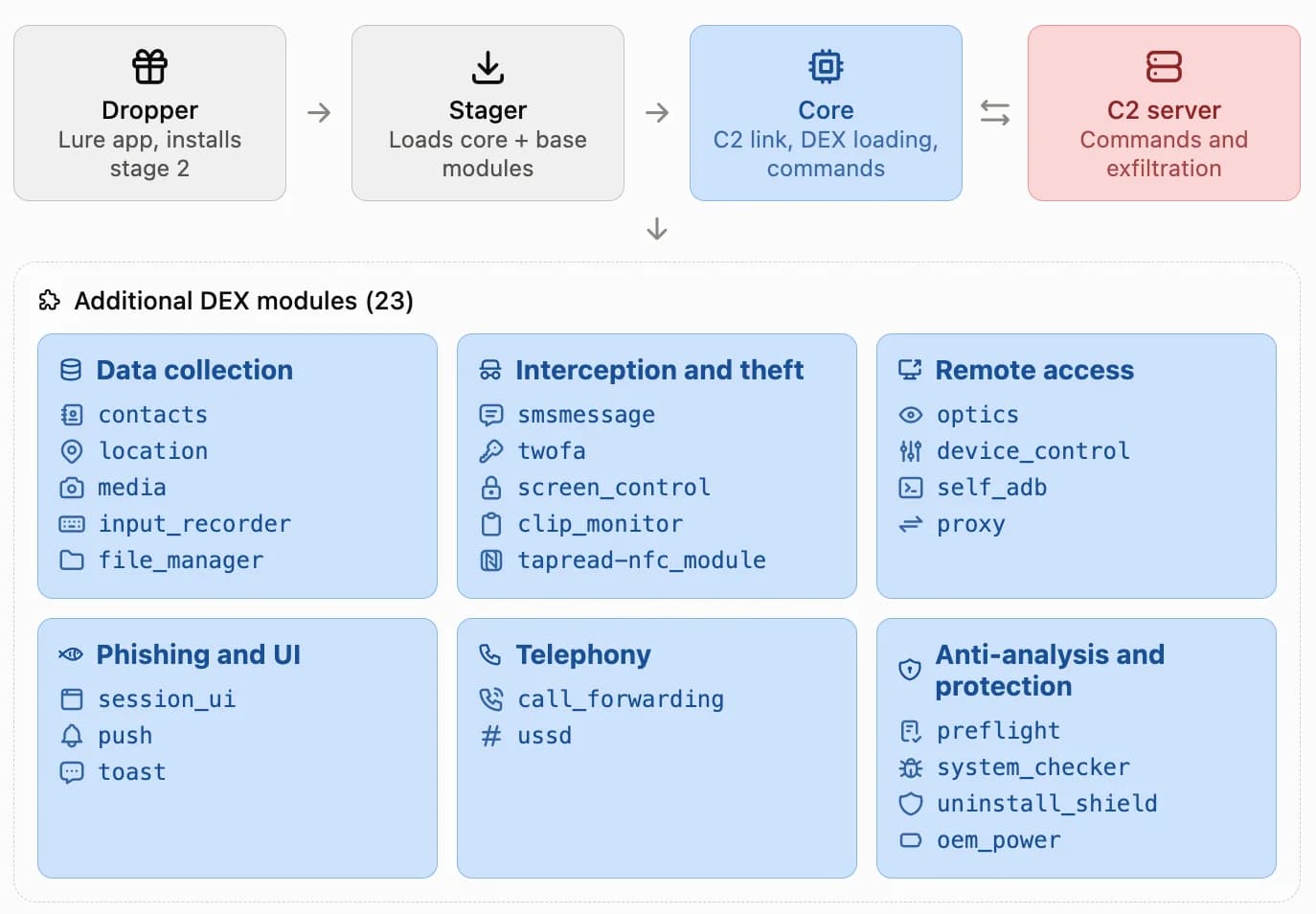 Image: ThreatFabric
That is structurally familiar to anyone wiring coding agents: natural-language operator intent, tool modules, scoring heuristics, and retry loops—only the goal function differs.
ThreatFabric also notes the panel frontend was readable without authentication on 170.168.61.117 (gargona.cash certificate on the dropper), while victim data stayed behind backend auth—a misconfiguration pattern that also appears in exposed Cairn consoles and ARTEX operator leaks.
Infrastructure ThreatFabric named
| Element | Detail |
|---|---|
| Cloudflare fronts | c2ws.brokerok.org, c2data.brokerok.org, c2proxy.brokerok.org, c2api.brokerok.org |
| Moscow host | 95.181.213.21 (offline during research) |
| Amsterdam host | 170.168.61.117 (panel HTTP 8082, HTTPS 8445, bot C2 8443/8444) |
| Backend claim | Panel states Node.js backend; headers did not confirm |
Distribution: traffers, droppers, and Play-review evasion
ThreatFabric documents two parallel channels:
Traffer-driven sideloading. Operators create traffer accounts in the panel. Victims reach landing pages with themes such as IPTV or adult content, then install a dropper APK. The TikTok18+ filename on VirusTotal is a concrete example of how social lures pair with minimal first-stage permissions.
Google Play ambition (unproven in the wild). Dropper builder settings deliberately request few manifest permissions—without Accessibility at first install—to ease Play review. ThreatFabric stresses it did not observe successful Play distribution during the investigation; treat that row as attacker intent, not confirmed store compromise.
Stage mechanics matter for enterprise devices that allow unknown sources on test handsets:
- Dropper obtains install unknown apps approval
- PackageManager session installs stager or pulls core + modules
- Core opens WebSockets, exfiltrates device profile, downloads remaining DEX modules
- Accessibility and ADB paths race to finalize permissions
- LLM console prioritizes high-score bodies for manual fraud
Module inventory (selected)
ThreatFabric documents 23 modules including call_forwarding, smsmessage, twofa, self_adb, device_control, tapread-nfc_module, uninstall_shield, and system_checker anti-analysis. The core proxies Accessibility, network, MediaProjection, and cross-module calls via HostBridge.
Hashes for droppers, core, and each .dex module appear in the report appendix—useful if your mobile CI or MDM ingests ThreatFabric feeds.
| Module (ThreatFabric name) | Role |
|---|---|
optics | Remote control, screencast, phishing overlays—including the screenshot idle trick |
input_recorder | Keylogger with regexes for cards, wallets, passwords |
clip_monitor | Crypto address replacement on clipboard |
smsmessage / twofa | SMS read, send, delete; OTP capture |
self_adb / device_control | ADB shell command execution |
tapread-nfc_module | Contactless card interaction (NFC relay campaigns) |
uninstall_shield | Blocks removal or force-stop |
system_checker | Anti-analysis and environment validation |
The core''s ModuleLoader keeps modules in memory via InMemoryDexClassLoader, so filesystem scans that only look for static APKs may miss loaded .dex stages after the first hour of infection.
LLM prompts as operator playbooks
ThreatFabric''s Russian sample prompt is effectively a runbook template: diagnose offline implants, read integrity, output a numeric attractiveness score, then propose a grant strategy for the next permission dialog. Legitimate SRE agents use the same shape (status → score → recommended action); the difference is authorization and victim harm.
Because the panel supports API-hosted models, stolen or shared API keys in the panel config would bill against the operator—but misconfigured panels (frontend exposed) also leak which models and prompt patterns defenders should simulate in purple-team exercises. If your security team runs internal agents to triage alerts, separate those keys from production fraud-detection keys the way you would separate CI secrets from prod.
What this means if you run AI coding agents
API keys: Bazuka''s panel calls paid model APIs. Separately, Talos documented Volta infostealer ranking victims for SSH keys and cloud configs, and Nik C2 malware falling back to stolen OpenAI keys. Treat .env, mcp.json, and agent settings as tier-one secrets—not committed, not world-readable on shared lab machines.
Node backends: ThreatFabric suspects a Node.js operator backend—the same runtime many MCP servers and local agent gateways use. Hardening auth on admin UIs matters whether the panel runs fraud or internal agent observability.
ADB and test devices: Android developers who enable Wireless Debugging for legit testing should disable it after sessions—Bazuka''s core automates the same menus attackers need.
No kernel magic: Like Beam''s limits, user-space fraud frameworks win through permissions and social engineering, not hypervisor escapes—which means deny lists and human prompts on consequential device settings still help on work phones.
NFC relay context and why Bazuka surfaced now
ThreatFabric opens the report inside an NFC-relay banking trojan investigation—the same crime vertical CERT-In and ARTEX reporting keeps tying to payment API abuse. Bazuka''s tapread-nfc_module slot shows fraud frameworks consolidating relay, overlay, and credential theft under one operator UI instead of three bespoke codebases.
For fintech developers who let coding agents touch payment SDK test apps on Android emulators, keep relay-capable modules in mind when you sideload test APKs: a trojan that ships NFC modules by default can pivot from "test our checkout flow" lures to live card interaction if a QA device has contactless enabled.
Defensive hunting notes (from ThreatFabric IOCs)
Network defenders can watch for brokerok.org subdomains fronted by Cloudflare, panel ports 8082/8445 on 170.168.61.117, and C2 8443/8444 separately from data channels—matching the dual WebSocket design. On endpoints, combine APK hash blocklists from the appendix with behavioral signals: sudden Wireless Debugging activation, Accessibility rebind broadcasts (com.guidocool.cryptomanager.action.A11Y_REBIND in ThreatFabric''s trace), and ChaCha20 key rotation telemetry stored under SharedPreferences names the core reports upstream.
Enterprise mobility teams should treat developer phones with USB debugging history like mini-servers: if an engineer installs a cracked utility app to test an integration, Bazuka''s 23 modules can coexist with corporate email on the same device.
Related criminal and defensive agent reporting
- Volta infostealer LLM victim ranking — desktop parallel to score attractive targets
- Fake ChatGPT and Claude bots scanning
.env— API key hunting targeting developers - Amazon Cairn MONAI Label zero-day — autonomous offensive agent loop published the same week
- US banks blocking agents from customer credentials — institutional response to agent-scale credential access
Frequently asked questions
What is Bazuka compared to older banking trojans?
ThreatFabric says capabilities overlap modern overlay and ATS fraud, but LLM-assisted victim management, ADB bridging, and screenshot idle overlays push operator efficiency—similar to how agent harnesses push developer efficiency.
Can Bazuka reach Google Play?
The panel includes low-permission dropper builder settings intended to ease Play review; ThreatFabric did not observe successful Play distribution during the investigation—traffer sideloading was documented.
Does Beam detect Bazuka on Android?
No. Beam focuses on Claude Code, Codex, and related coding-agent hooks on desktop environments. It does not monitor Android devices. Use mobile threat intel feeds and MDM policies for handsets.
Should I rotate keys after reading this?
Only if you sideloaded suspicious APKs or stored production LLM keys on a machine that also runs unvetted mobile cracks. Routine rotation of agent API keys after infostealer campaigns is still prudent—see Railway breach key rotation guidance for a parallel lesson on env exposure.
Related reading
- ThreatFabric primary report
- Volta infostealer LLM ranking
- Fake ChatGPT bots and
.envscanning - GitGuardian: exposed agentic pentest frameworks
ThreatFabric module hashes, host availability, and panel UI details reflect the November 18, 2026 publication date. Re-check the vendor appendix before threat hunting.