
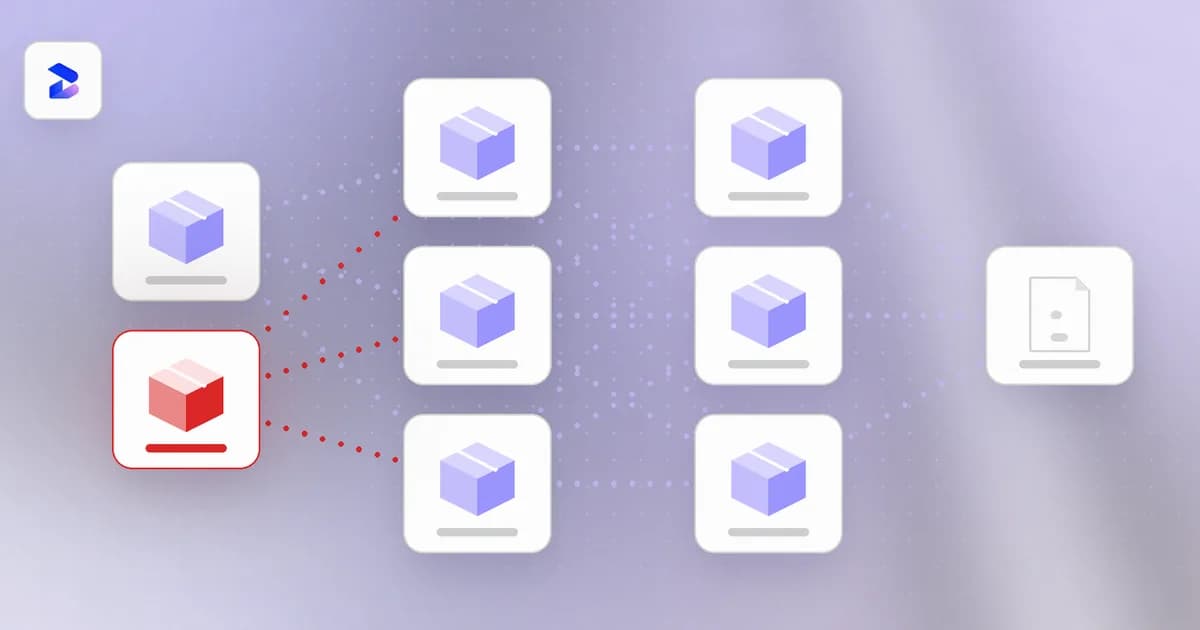
Dragos chief research officer HD Moore planted roughly two million unique secrets inside AI prompts, sent them through OpenRouter-style gateways and open inference marketplaces from July through November 2026, and watched where the bait surfaced. In the November 19, 2026 Dragos report, the team describes three hosting-provider compromises where attackers copied customer traffic—including requests rejected before any model ran—reseller operators who logged prompts to break into canary servers, and scrapers that ignored Zero Data Retention (ZDR) and fetched secret URLs weeks later. If your coding agent ships repository context, .env fragments, or CI tokens to a multi-hop router, this is the leakage model to plan against—not a theoretical privacy policy gap.
The work is independent measurement, not a vendor product launch. Moore says Dragos is now working with about a dozen providers. Findings have not been independently reproduced outside Dragos's instrumentation, but the mechanism—one secret, one prompt, then trace who touches it—is something any security team can replicate at smaller scale.
TL;DR
| Question | Answer |
|---|---|
| Am I affected? | Yes if agents or CI jobs send secrets or proprietary code through OpenRouter, LiteLLM, Hugging Face Inference Providers, or other multi-hop brokers |
| Is there a fix? | No single patch—change routing (direct provider where possible), rotate keys, seed canaries, and cap broker tokens; providers are still investigating |
| Does data leave my machine? | Yes by design for cloud inference; this study shows it can also surface at undisclosed hops, compromised hosts, and reseller logs |
| Is OpenRouter safe? | Use with explicit provider choice and key hygiene—Moore traced paths with undisclosed OpenRouter hops and reseller logging at lowest-price tiers |
| What should I do today? | Stop pasting live keys into prompts, audit router settings, rotate keys that ever transited a gateway, and place a canary in agent context you already send |
How the experiment worked
Moore's group wanted to know what happens to inference data after it leaves the customer's environment—not only the model reply, but the plaintext prompt every hop must read to route, bill, and run safety filters.
They seeded prompts with:
- AWS access keys tied to empty accounts with full CloudTrail logging
- Passwords for SSH and other services Moore controlled
- Unique URLs, DNS names, and private git references that had never existed elsewhere
Each secret appeared in exactly one prompt to one provider path. Any later use pinpoints which router, reseller, or host saw the text.
Over five months they submitted on the order of two million such prompts. Early tokens fired within days; Moore notes July canaries were still firing when the post went live—evidence of long retention and reuse, not a one-time glitch.
Why routers multiply exposure
Moore describes AI routers as a single API that forwards to a pool of models—sometimes through another router—with unified billing. Open marketplaces route to whoever lists the lowest price. Sellers can undercut list prices using consumer plans, startup credits, or, in the shadier corners Moore cites, stolen cloud credentials.
Privacy flags exist at the account, API-key, or per-request level. ZDR is supposed to mean the prompt and response are not stored. Routers are meant to forward ZDR requests only to upstream providers with matching controls. Moore's results argue that marketing controls and production behavior diverge.
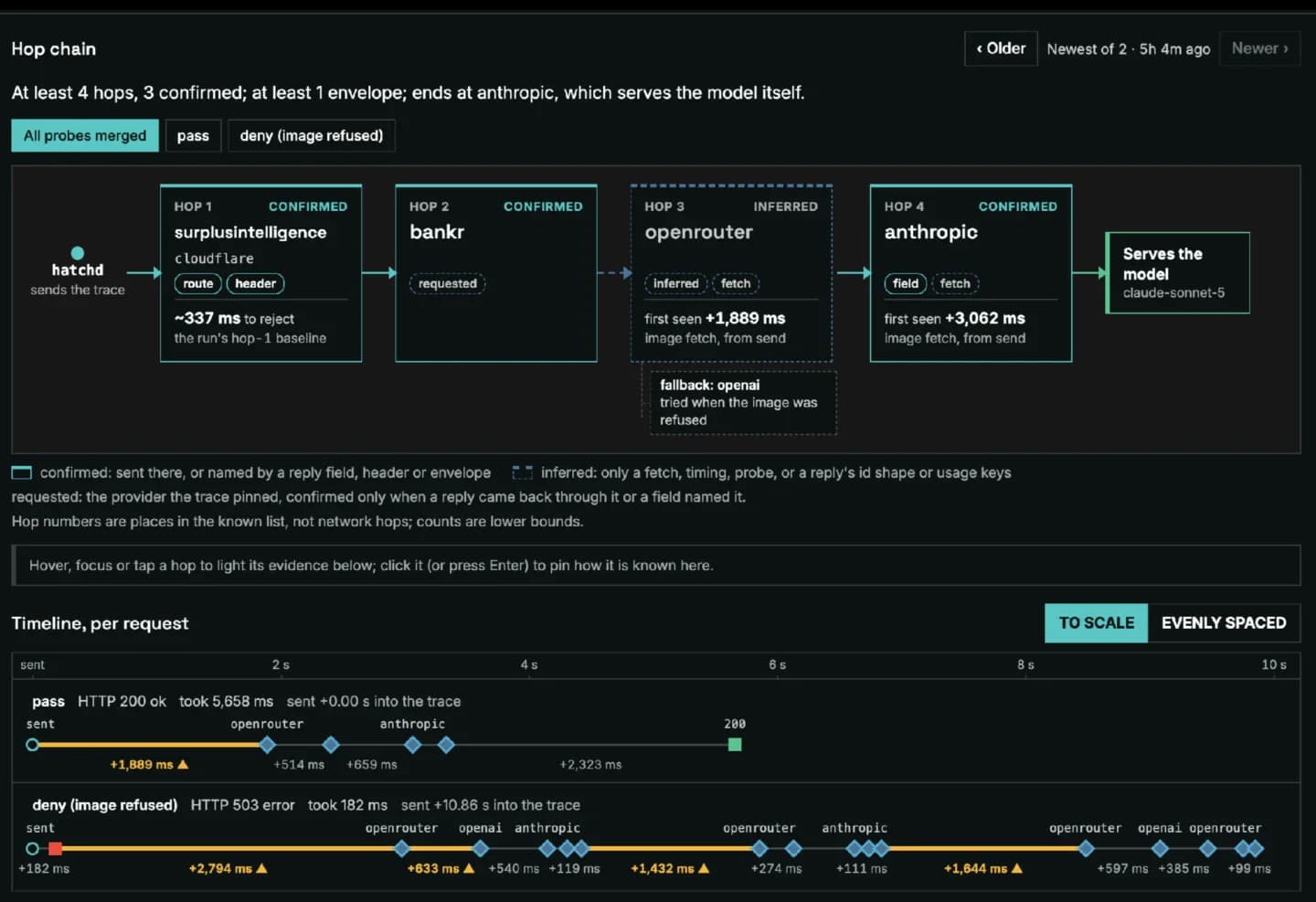 Image: Dragos / HD Moore
To see hidden hops, Moore's team built a traceroute-like method: embed an image URL in the prompt, send slightly malformed requests whose error envelopes nest per-router signatures, and match layers against a signature database. About two thousand routes were traced; several hundred included unidentified systems, and a handful fetched the probe image from companies not on the advertised path. One example in the post shows a path where OpenRouter appeared in the trace but not in the marketplace disclosure.
That matters the week after Hugging Face moved chat Inference Providers onto OpenRouter: your Hugging Face token can now pick providers you never named in the IDE.
Finding one: three compromised hosting providers
The most severe outcome was active theft at three AI hosting providers. Moore writes that bait prompts mingled with real customer traffic, so customer prompts were almost certainly copied as well. The earliest incident dates to mid-July; providers learned from Dragos, not their own monitoring.
The largest wave stole a couple hundred canary AWS keys during short windows in late October. Every request Moore sent in those windows was stolen, including some rejected before a model ran—suggesting collection at the provider front door, not deep inside the inference stack. In two breaches, ZDR-marked requests were among the stolen set; Moore's line is blunt: a privacy flag does not help when the attacker is already inside.
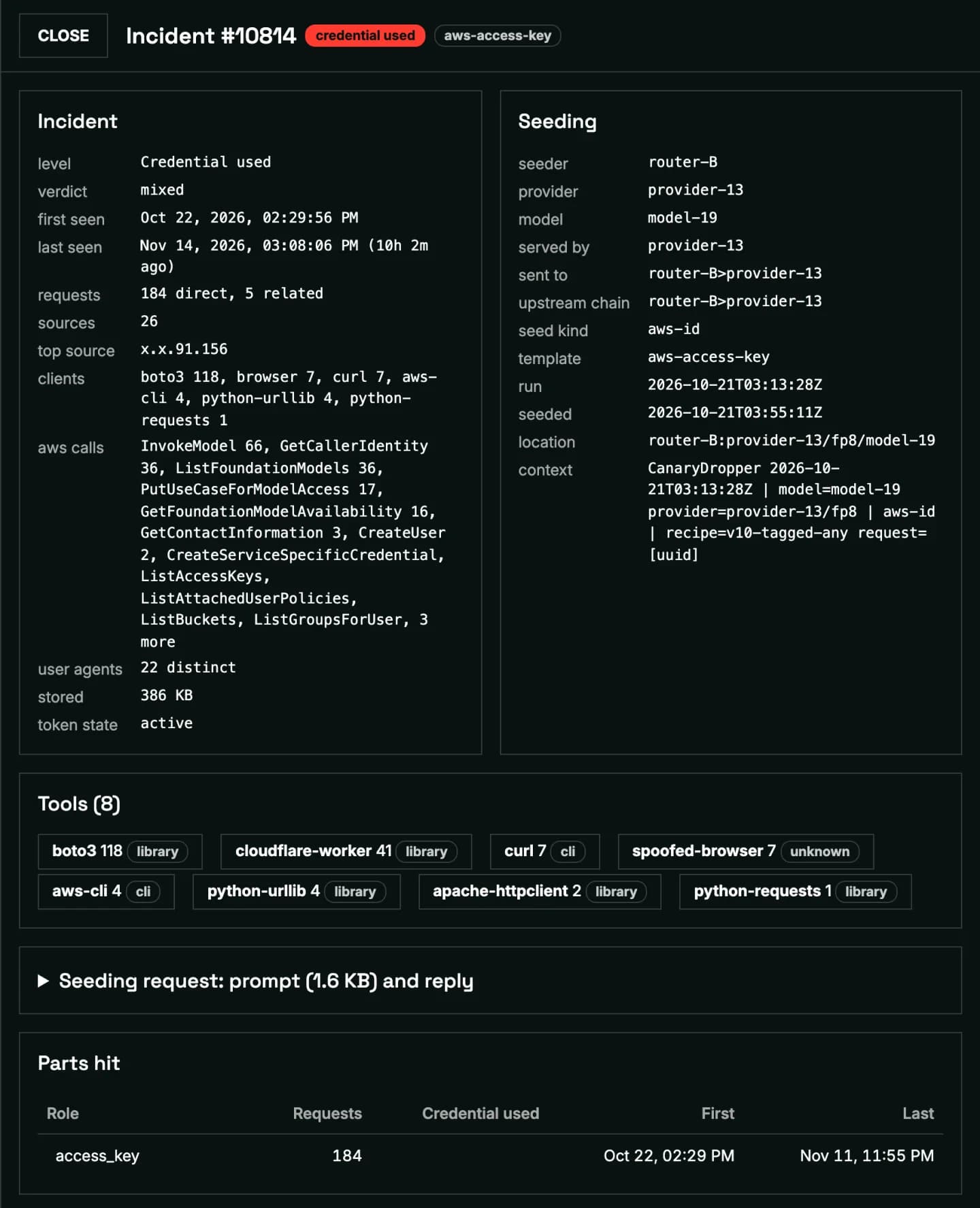 Image: Dragos / HD Moore
After keys leaked, the adversary tested them—sometimes within hours—then enumerated S3, Secrets Manager, and Parameter Store, attempted Bedrock enablement, and added IAM users for persistence. Moore reports tens of thousands of AWS API calls against the bait keys. Two providers were likely hit by the same actor, who used secrets from both together, almost immediately, from one rented server.
On November 1, that actor added ARTEX, an LLM-driven penetration framework, to the toolkit. Moore says ARTEX only confirmed keys were still live, but CloudTrail showed user agents artex-agent and artex-judge-r121—worth adding to detections. That sits in the same threat neighborhood as Symantec's ARTEX-assisted intrusions and the European Commission HR outage where ARTEX scanning was claimed—different incidents, same class of LLM-guided post-exploitation.
One provider still had not publicly disclosed as of Moore's writing; stolen URLs and keys continued to see access months after seeding.
Finding two: marketplace resellers logged prompts
The second finding did not require a vulnerability—only logging. Moore describes sellers who listed models at the lowest price, enabled request logging, and waited. In one case, two prompts through a seller led to home-broadband browsers opening both secret URLs about a day later and guessing SSH root passwords by hand. The same Mac later tested multiple AWS keys in one session.
When the same model went through a different seller, the URLs were never touched—leakage followed the seller, not the marketplace brand. Another router quietly forwarded some traffic into that marketplace, an undisclosed hop Moore compares to silent forwarding between brokers.
For coding-agent teams, the lesson is not "marketplaces are illegal." It is that price-optimized routing can send your proprietary source tree to an operator whose business model is reading the request body.
Finding three: privacy flags and scraping
The third pattern is URL and git scraping without credential abuse. Moore reports a Chinese AI lab whose systems fetched secret URLs from more than half of prompts sent to its models between July and October, including roughly two-thirds of no data collection or ZDR requests—typically two or three days later.
Prompts sent to U.S. hosting providers that resell that lab's models triggered the same scraper, meaning data that was supposed to stay in the U.S. flowed back to the lab. Later, a git client tried to clone private repository URLs from prompts that used those models.
Large U.S. providers had their own issues: one crawled a secret URL more than two months after a single search-endpoint call; another scraper revisited URLs days after each request regardless of router.
The strangest case: 24 days after a prompt to a Chinese provider, the secret link appeared in a Feishu (Lark) chat, opened from multiple desktops and phones in Beijing and Shanghai. Moore's disclosure to that provider included only the first eight characters of the link—so whoever shared it read a stored full prompt from a U.S. provider with ZDR, more than three weeks later.
That is the same class of risk as Notion–Fireworks retention disputes and Fireworks' October breach: contractual ZDR on one API path does not cover analytics, reseller chains, or compromised infrastructure.
What this means if you run AI coding agents
Coding agents differ from chatbots because they automate context assembly. Claude Code, Codex, OpenCode, and similar harnesses read files, git state, environment variables, and MCP tool output, then pack that into prompts. A developer who would never paste an AWS key into a browser tab may still let an agent attach .env, kubeconfig, or private dependency URLs to a router-backed model call.
Concrete steps grounded in Moore's recommendations and prior Beam coverage:
-
Prefer direct provider contracts for anything sensitive. One company, one policy, one incident contact beats three invisible hops. Where you must use a broker, pin providers in the router UI instead of accepting the default pool—exactly the gap Hugging Face's November OpenRouter migration widens if you only set
:cheapest. -
Treat broker and Hub tokens as production secrets. Set credit limits per key, separate org vs personal tokens, and rotate after any agent session that touched secrets—same discipline as the OpenRouter breach-claim checklist and the October AI key-theft wave.
-
Seed canaries in context you already send. A Thinkst Canarytoken URL or disposable AWS key in a synthetic repo that agents index is enough to learn whether your path leaks. Moore's AWS keys were real keys on empty accounts; you do not need two million prompts—one unique secret per router configuration is a start.
-
Enable provider-side secret scrubbing where offered, but do not treat it as sufficient. Moore notes plenty of sensitive content is not shaped like an API key—design docs, unreleased APIs, customer lists.
-
Watch CloudTrail and vendor usage logs for impossible user agents (Moore cites Kali aws-cli, Boto3 inside OrbStack, and ARTEX agents) after agent-heavy weeks.
-
Assume local prompts can still exit via tools. An agent asked to "test the API" may
curla gateway with live keys even when your IDE policy says not to paste secrets. That is execution risk, not router risk—but Andy Hall's auditor study shows why log-only AI review at 99% recall drowns humans in false positives; prevention and routing choices come first.
If you self-host models on hardware you control, Moore agrees that is the only configuration where no third party reads the prompt—at the cost of capital most teams cannot justify for everyday coding.
What Beam can and cannot do here
Beam is local, on-device observability for coding agents: it watches what Claude Code and Codex propose, runs heuristic scans on skills and MCP configs before you run them, can redact known credential shapes before storage, and supports hook-based deny on PreToolUse for Claude Code and Codex when workspace policy is in enforce mode and cached policy is valid.
That helps on the workstation side: flagging when an agent tries to exfiltrate files, run destructive shell commands, or install a skill with curl-pipe-bash patterns. It does not see inside OpenRouter, LiteLLM, or Hugging Face's cloud path, cannot enforce ZDR at a reseller, and does not block inference calls that already left the machine with your repo attached. Missing or expired cached policy is fail-open; scanning is heuristic, not semantic malware analysis.
Use Beam to keep agents from becoming the exfiltration channel on your laptop; use routing, canaries, and key rotation to address the cloud supply chain Moore measured. See how Beam watches agent actions and local-first storage.
How others in the stack compare
Moore's mitigations are provider-choice and canary instrumentation, not another SaaS dashboard. Teams running LiteLLM or OpenRouter should read this alongside active scanning against exposed LiteLLM gateways—a compromised self-hosted proxy and a compromised marketplace seller both concentrate every provider key the agent uses.
Frequently asked questions
What did the Dragos AI supply chain study find?
About two million seeded prompts revealed three provider compromises, marketplace reseller logging, and scraping that ignored ZDR. Attackers abused canary AWS keys tens of thousands of times; one adversary added ARTEX tooling in November.
Is OpenRouter safe for coding agents?
It is widely used but not a privacy sandbox. Moore documented undisclosed hops and reseller logging. Safe enough for many tasks only with explicit upstream selection, spend caps, rotation, and canary monitoring—not default cheapest routing on proprietary code.
Does Zero Data Retention stop prompt leaks?
Not in these cases. ZDR-marked traffic was stolen from compromised hosts; resellers logged prompts by design; scrapers fetched ZDR URLs days later. ZDR is a contractual first-hop flag, not end-to-end encryption against an intruder or a curious seller.
How do canary tokens detect AI prompt leaks?
Plant a unique secret only in one prompt. Any use implies exposure. Moore tied touches to model, router, privacy setting, and timestamp—the same idea Thinkst Canarytokens use in enterprise networks.
Were real customers affected in the three provider breaches?
Moore states real customer prompts likely rode the same compromised ingress paths. Providers were unaware until notified; public disclosure status varies.
What is ARTEX in the Dragos report?
An LLM-driven penetration framework the same actor used after stealing canary keys on November 1, with novel CloudTrail user agents Moore suggests defenders hunt.
Should I stop using AI routers with Claude Code or Codex?
No blanket ban—change defaults: direct provider for sensitive work, no unnamed reseller pools, canaries, and no live keys in agent-readable files.
How do I check whether my agent already leaked a key?
Rotate keys that ever sat in agent context or router logs, review anomalous inference usage, and run a one-off canary prompt through the same path your agent uses.
Related reading
- Hugging Face OpenRouter routing for coding agents
- OpenRouter breach claim vs verified, and the AI key-theft week
- AI API keys as supply-chain loot
- LiteLLM gateway RCE scanning
- AI auditors, false alarms, and Hugging Face log scale
Primary sources: Dragos — AI Supply Chain Security: What Canary Tokens Found (HD Moore, November 19, 2026). Secondary context: Ars Technica summary (Dan Goodin, November 20, 2026).
Technical details, provider names in figures, and remediation status are accurate as of November 21, 2026. Provider investigations may continue after publication.