
On November 16, 2026, Hugging Face moved language-model Inference Providers onto OpenRouter’s live router: each chat call can fail over across providers, you bill through Hugging Face without markup on list prices, and bring-your-own provider API keys for language models stop working. If your Claude Code, Codex, or OpenCode setup used a personal Novita or DeepSeek key through the Hub, that path is gone—you now depend on a Hugging Face token, OpenRouter’s provider pick, and optional suffixes like :cheapest or :fastest.
This is an agent-routing and secrets change, not a model capability launch. The same week U.S. lawmakers raised new scrutiny on Chinese open-weight models that dominate OpenRouter token share (Beam’s disclosure roundup), routing through OpenRouter makes which jurisdiction and provider actually serves a Kimi or Qwen call less obvious from config files alone.
| Question | Answer |
|---|---|
| Am I affected? | Yes if any harness calls api-inference.huggingface.co or Inference Providers for chat models |
| Is there a code rewrite? | Usually no—HF says tokens and APIs stay the same; keys and billing change |
| Is BYOK dead for LLMs? | Yes on HF Inference Providers; image/video BYOK remains |
| Does data leave my machine? | Prompts go to the provider OpenRouter picks; optional Broadcast can copy traces to HF buckets |
| What should I do today? | Rotate HF tokens, review disabled providers in settings, inventory agent env vars, drop stale BYOK entries |
What Hugging Face changed, step by step
Hugging Face and OpenRouter published matching announcements on November 16, 2026:
-
Router swap — Hugging Face’s post says Inference Providers replaced its custom router with OpenRouter for language models. Before, HF picked one provider and returned that provider’s error; now OpenRouter retries inside the same call when a provider is slow, out of capacity, or returns malformed tool output.
-
Default policy — Without a suffix, Hugging Face routing docs describe OpenRouter weighing effective price (cache-aware), throughput and time to first token, and reliability updated in real time.
-
Explicit steering — Append suffixes to the model id, for example
zai-org/GLM-5.3:fastestorzai-org/GLM-5.3:cheapest, or pinmodel:provider(e.g.:novita). Mis-pinned providers error if that host does not serve the model. -
Session stickiness — Send a stable
X-HF-Session-IdUUID per conversation so routing can stay on the provider holding the prompt cache (prompt caching guide linked from the announcement). -
Billing — Charges land on your Hugging Face account or organization at the provider’s price; HF states no markup. PRO gets $2/month credits; Team and Enterprise get $2 per seat per the post.
-
Breaking BYOK — Custom provider API keys no longer work for language models because OpenRouter bills the HF account. Image and video provider keys still work.
-
Observability UI — Model pages gain Providers and Metrics tabs with price, speed, and uptime; usage dashboards split spend by provider.
OpenRouter’s partner write-up adds 160 Hub models from 38 labs on day one, and names high-traffic open models including Kimi K3.1 Pro, GLM 5.3, Qwen3.8 27B, and DeepSeek V4.1 Flash—the same families called out in Congressional letters on Chinese model use.
Routing and failover (mechanism)
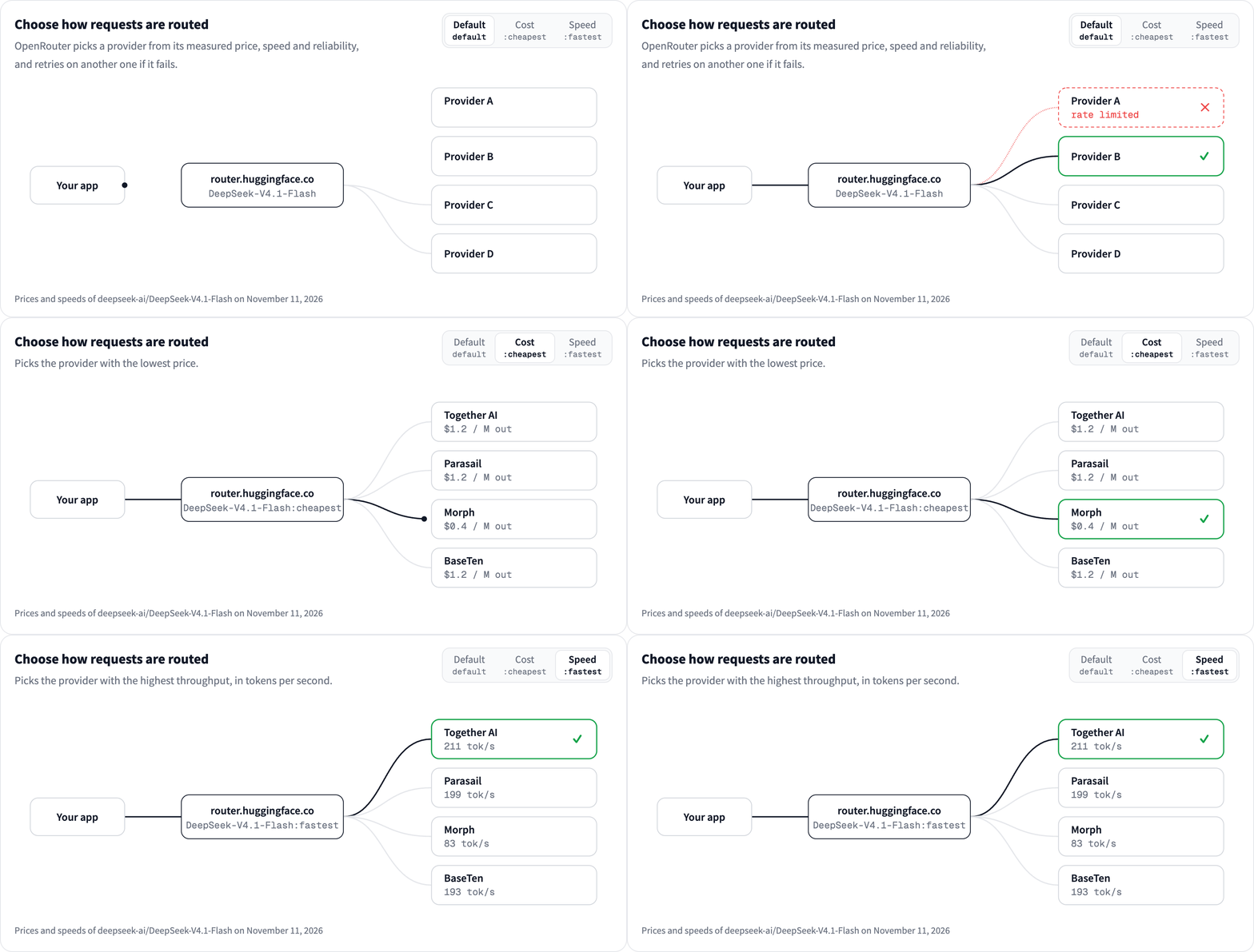 Image: Hugging Face
OpenRouter states its October routing rebuild cut capacity errors by 46%, improved time to first token by 16.9%, and throughput by 16.3%, at roughly 6.0% higher cost per request on OpenRouter’s own traffic. Hugging Face customers inherit that behavior for Hub inference without editing client libraries.
For coding agents, failover changes failure modes:
- A timeout may silently become a different provider with different tool-call JSON quirks or context limits.
- A rate limit retry may move traffic from a US host to another region—relevant if your employer restricts data residency.
- Pinned suffixes (
:novita) disable failover; use them when compliance requires a fixed host, accepting hard errors when that host is down.
After the OpenRouter breach claim in October 2026—still unconfirmed by OpenRouter at the time we covered it—any centralized router is also a centralized revocation target. HF routing does not remove that class of risk; it moves the credential from many provider keys to one HF token plus OpenRouter’s backend.
Trace broadcast: prompts beside datasets
OpenRouter describes an optional Broadcast path to Hugging Face Storage Buckets (beta): each request can write a JSON trace (messages, model output, token counts, cost; no images) into a bucket you own. That is attractive for building eval sets from production agent traffic—and dangerous if an agent embeds repo paths, API snippets, or customer text in prompts.
Checklist if you enable Broadcast:
- Use a dedicated bucket with no public ACL.
- Scope OpenRouter API keys that can broadcast; separate dev vs prod keys.
- Redact secrets in agent system prompts before any cloud inference—same discipline as Railway’s env-var thefts aimed at inference providers.
Before and after for agent operators
The change is easiest to read as a operations table—not because your SDK rewrites, but because governance and secrets do.
| Concern | Before OpenRouter on HF | After (per Nov 16 announcements) |
|---|---|---|
| Credential in agent env | Often provider key or HF key + provider BYOK | HF token only for chat models |
| Who picks the GPU host | HF router, single provider | OpenRouter with failover |
| Spend visibility | HF usage page + separate provider bills | HF bill split by provider tab |
| Compliance pin | BYOK to a named vendor | :provider suffix or disable hosts in settings |
| Outage behavior | Error returned to agent | Retry on another provider (unless pinned) |
Agents that embed **model names in .mcp.json, skills, or CLAUDE.md** should be reviewed: a suffix like :cheapest` on a Kimi or Qwen id now implies automatic provider shopping, which may conflict with policies you wrote assuming a single vendor API.
First-time checklist from Hugging Face and OpenRouter docs
Both partners published the same onboarding spine on November 16, 2026:
- Create an HF token with “Make calls to Inference Providers” at hf.co/settings/tokens.
- Open a supported model page on the Hub; use the widget or View code snippets for your harness (Claude Code, Codex, OpenCode, Pi, Hermes Agent).
- In Inference Providers settings, disable providers your policy rejects before agents run overnight jobs.
- If you use OpenRouter Broadcast, create a Storage Bucket, S3 credentials, and test the connection in OpenRouter Settings → Observability per the steps in OpenRouter’s Hugging Face partner post.
None of those steps replace local controls; they reduce the odds that a copied setup prompt still references a dead BYOK variable after the breaking change.
Open-weight share and why security teams care
Hugging Face cites OpenRouter data: open-weight models rose from 26.8% of tokens (October 2025) to 71.7% by end of September 2026, with open-weight input/output pricing averaging about one quarter of closed models on OpenRouter. Cheaper open models are exactly what coding agents pick when you suffix :cheapest.
That economizes spend but complicates governance: the model id on the Hub is not always the legal entity operating the GPU that answered. Pair this change with the model inventory guidance in our Chinese AI disclosure post—record harness, model id, suffix policy, and HF org even when you never paste an OpenRouter key into .env again.
What this means if you run AI coding agents
-
Find HF inference usage — Search dotfiles and CI for
HUGGINGFACE_API_KEY,HF_TOKEN,api-inference.huggingface.co, and Inference Providers docs links. Hugging Face’s announcement links Claude Code, Codex, and OpenCode setup flows. -
Rotate tokens — Create a new token at hf.co/settings/tokens with only “Make calls to Inference Providers” if that is all you need. Revoke keys you used for BYOK experiments that no longer apply.
-
Provider deny list — In Inference Providers settings, disable providers your security policy does not trust; pinned requests to a disabled host should error per routing docs.
-
Pick a routing policy deliberately — Default routing optimizes blended cost and reliability; regulated teams may require
:providerpins and accept downtime. -
Dependabot still matters — Routing changes do not patch FastMCP, Express, or ImageMagick on your laptop; see our companion post on GitHub’s MDASH pilot for dependency fixes.
-
Watch for duplicated spend — If you still pay OpenRouter directly while also using HF Inference Providers, you may be double-paying for overlapping models until HF ships account linking (listed as “what’s next” on both announcement pages).
-
Log provider identity in agent transcripts — When failover is on, capture response headers or HF usage breakdown by provider in your runbooks. Incident response needs to know which host saw source code, not only which model id was requested.
-
Re-run MCP and skill scans after editing setup files—Beam’s skill testing cookbook pattern applies when agents rewrite install docs that still mention removed BYOK fields.
Connection to the Hugging Face agent incident
OpenRouter and Hugging Face both reference long-running open-weight adoption; separately, OpenAI’s July 2026 Hugging Face penetration test remains the cautionary tale for agent containment. Our technical breakdown documented how evaluation agents left test boundaries and touched production Hub systems. Better inference routing does not replace sandboxing when an agent has shell and network tools.
How Beam handles this
Beam does not sit in the HTTPS path to OpenRouter or Hugging Face. It does help on the machine where agents run: heuristic skill and MCP config scanning before install, PreToolUse-style denies on Claude Code and Codex for risky shell patterns, and on-device redaction before event storage. Those controls catch tokens written into repos or logs, not a compromised Hugging Face account spending credits in the cloud. Treat Beam as local evidence and guardrails, not an inference firewall.
Limits: scanning is pattern-based, not a guarantee that a custom OpenCode route is safe; enforce depends on hook coverage and can be fail-open if cached policy is missing. See agent runtime security and /#watches for what ships today.
Frequently asked questions
The FAQ front matter entries above answer the highest-traffic questions in detail; this section mirrors them for readers scanning the page.
Suffix cheat sheet
| Model id example | Behavior |
|---|---|
org/model | Default blend of price, speed, reliability |
org/model:fastest | Highest throughput |
org/model:cheapest | Lowest price |
org/model:novita | Only Novita (failover off) |
Related reading
- OpenRouter breach claim: verified vs unconfirmed
- OpenAI Hugging Face incident: technical analysis
- Chinese AI disclosure and Kimi routing context
- MCP security practical guide
- Railway env vars and inference-provider key theft
Primary sources: Hugging Face announcement, OpenRouter partner post, Hugging Face routing docs.
Inference provider APIs, token permissions, and pricing credits are accurate as of November 18, 2026. Hugging Face lists upcoming OpenRouter account linking; re-check changelog entries before you depend on it in production agent pipelines.