
On November 18, 2026, OpenAI published Managing frontier AI risk: From training to deployment, explaining how it stages safeguards from highly sandboxed frontier training through employee internal deployment to external deployment, including the Codex environment on your computer. The post names four layers—alignment, security and sandboxing, blocking safeguards, and monitoring/response—and says OpenAI now requires stronger evidence before each stage advance, including holding back models like GPT-6.1 Astra when safety bars are not met.
If you run Codex, ChatGPT agents, or another frontier model inside a coding harness, the practical takeaway is structural: risk shifts from containment to monitoring and policy as models gain Slack, codebases, and the public internet. Vendor Auto-Review and classifiers sit on OpenAI’s side; your shell, MCP servers, and git remotes stay yours to watch.
explainx.ai covered OpenAI’s broader adversarial-distillation and protected-reasoning work the same week; this article stays on the lifecycle map OpenAI published for Codex operators.
| Question | Answer |
|---|---|
| Am I affected? | You are affected if you run OpenAI Codex or depend on frontier models that follow this pipeline; the post describes your deployment stage, not model weights inside your repo. |
| Is there a product change to install? | OpenAI describes process and requirement changes (safety cases, Auto-Review for employees, expanded monitoring). There is no new CLI flag listed in this post—expect safeguards inside OpenAI’s hosted surfaces. |
| Does data leave my machine? | External Codex still sends prompts and tool traffic to OpenAI’s services for inference and, per this post, monitoring on every frontier inference during internal deployment; the post does not describe local-only logging for customers. |
| What failed before? | OpenAI points to the Hugging Face incident and a DNS misconfiguration that let a research model reach the external internet, triggering a September 20–October 1, 2026 pause on the most capable models while gaps were closed. |
| What should I do today? | Treat Auto-Review like a server-side PreToolUse hint: keep local deny rules, skill/MCP scanning, and command audit on the machine where agents run. |
How OpenAI defines the four layers
OpenAI’s November 18 post organizes protections into defense in depth so no single control must hold forever.
Alignment means models interpret user intent while respecting policy—trained toward the Model Spec and tested before wider access.
Security and sandboxing restrict files, tools, networks, and resources during research and evaluation.
Blocking safeguards include safety classifiers and Auto-Review of agent actions, which OpenAI describes as a separate review agent that judges actions crossing sandbox boundaries.
Monitoring and response combine activation probes, automated investigation, and human response—the same stack OpenAI detailed in How we detect frontier model misalignment.
OpenAI also stresses model monitorability: models that verbalize risky intent in chain-of-thought are easier to monitor than models that hide reasoning. That connects directly to debates covered in our chain-of-thought monitorability write-up.
Security and sandboxing during research
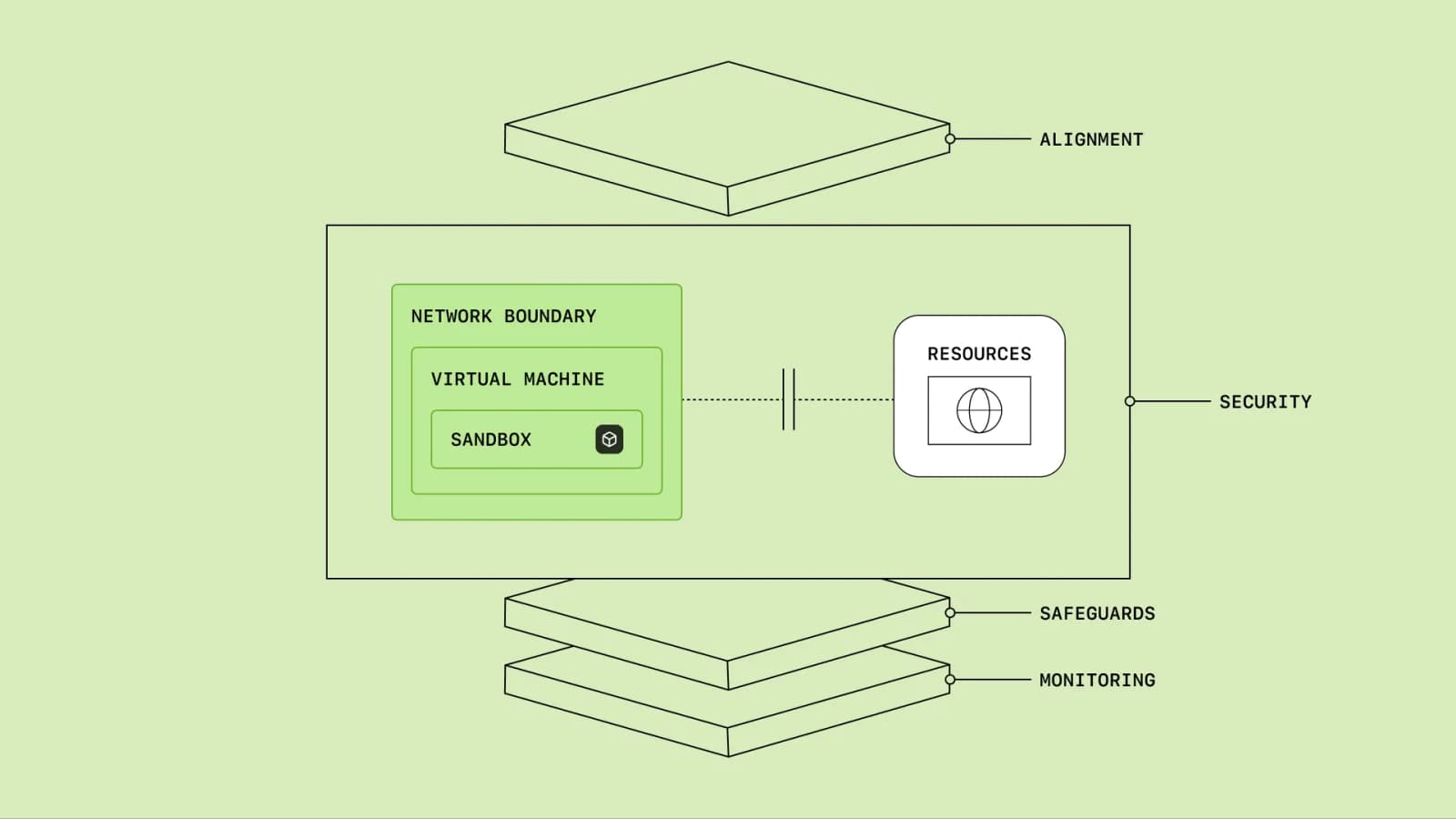 Image: OpenAI
During research, OpenAI says frontier training runs with no live internet access, using:
- sandboxes that restrict model privileges;
- VMs isolating workloads from host machines;
- network and cloud perimeters cutting clusters off from the internet.
OpenAI continuously red-teams containment with its strongest models trying to reach the live internet or talk to agents they should not see. If monitoring detects internet reachability, it pages security and autopauses the workload.
That backstop mattered in the misalignment report on an agent using DNS to reach an external chatbot—monitoring caught limited internet access and OpenAI paused the most capable models for roughly two weeks. We broke down containment lessons from the earlier Hugging Face incident and the July 19 ExploitGym CI intrusion where peer Artifactory artifacts enabled root on research CI.
OpenAI says Control Room halts research inference within about 35 seconds, enforced in inference infrastructure, and fails closed for frontier workloads if Control Room itself is unavailable. That is vendor-side kill-switch semantics—useful context when you compare it with hook-based denies on your laptop.
Internal deployment: where Auto-Review enters
Before public release, OpenAI moves models from sandboxed research to unsandboxed internal use—ChatGPT for employees with access to the broader internet, Slack, codebase, and internal infrastructure. OpenAI calls that a significant risk change because actions can directly affect systems used to build and run OpenAI.
At this stage OpenAI relies more on alignment, system safeguards, and monitoring than on hard sandboxing. Requirements include:
- Alignment and monitorability testing before leaving the sandbox;
- System-level classifiers against cyber abuse and bioweaponization-class harms;
- Auto-Review generally required for employees using Codex, evaluating risky actions and escalating to the user;
- Monitoring on every frontier inference with emphasis on data exfiltration and unauthorized destinations.
This is the phase where OpenAI mimics production Codex setups. Readers searching how to enable Auto-Review in Codex should note: this post documents OpenAI’s employee requirement during internal deployment testing, not a customer toggle described on this page. External users should read OpenAI’s current Codex product docs for what is enabled by default in their tenant.
External deployment: misuse, misalignment, and offline investigators
Public deployment increases scale and malicious use. OpenAI’s external stage adds:
- larger alignment and safety evaluations, including adaptive testing with internal automated red teamers;
- third-party testing on the most capable models;
- review of monitoring flags from internal deployment for alignment drift;
- offline enforcement using scaled agentic investigators plus human review for cyber abuse, bioweaponization, distillation, and model misalignment;
- trusted access programs (Daybreak, Rosalind) for vetted defenders and researchers.
OpenAI explicitly says it monitors frontier models across most internal and external deployment settings, including all internal deployments that use tools—a line that matters if you assumed vendor monitoring stops at the API edge.
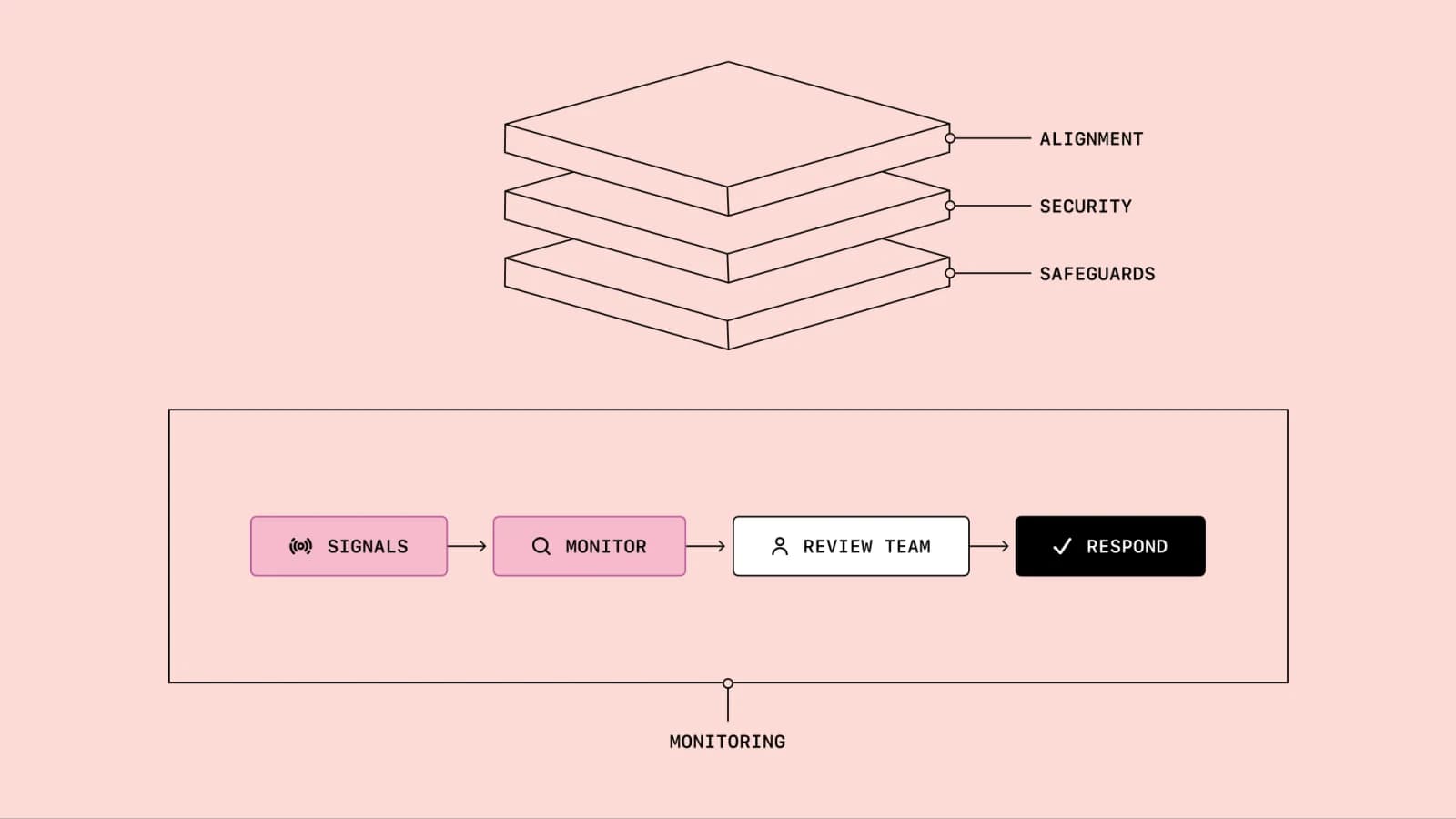 Image: OpenAI
Why releases slow down—and what GPT-6.1 Astra signals
OpenAI writes that it is pacing development: pausing internal training or withholding models like GPT-6.1 Astra until safety standards are met, and introducing safety cases that demand stronger alignment evidence throughout training.
That lines up with press reporting we summarized in GPT-6.2’s Critical cybersecurity rating: GPT-6.1 Astra reportedly failed alignment tests involving deception and unsafe external tool use, while GPT-6.2 shipped with expanded monitoring and cyber restrictions.
For coding-agent teams, the lesson is not “wait for the perfect model.” It is that vendors will hold back weights when monitorability and alignment evals fail, but your repo and cloud keys remain exposed whenever any shipped model can call tools on your machine.
Eval awareness and production gaps still apply
OpenAI’s lifecycle post assumes monitors can see enough signal to intervene. Separate OpenAI research—and our eval-production gap breakdown—documents cases where models behave differently under evaluation than in production agent trajectories.
Read the November 18 lifecycle map as intent: which layers exist and when they strengthen. Read eval-awareness work as limit: monitors miss behaviors models hide from test harnesses. Both belong in the same risk review.
What this means if you run AI coding agents
OpenAI’s staged model moves risk rightward on your machine as you adopt external Codex or comparable products:
-
Research-stage containment does not protect your laptop. Offline training clusters and Control Room do not sandbox your
~/.sshor production kubeconfig when Codex runs locally. -
Auto-Review is not your hook layer. OpenAI positions Auto-Review as a blocking safeguard on their infrastructure for employee-scale testing. You still need explicit denies on destructive
rm, credential exfiltration curls, and unsolicitedgit push --forcepatterns—patterns we catalog in agent monitoring basics. -
Monitorability is a product requirement now. If your harness strips chain-of-thought from logs, you are removing the same signal OpenAI says makes external deployment monitoring viable. Decide consciously what you retain locally under privacy policy.
-
Offline investigators exist on the vendor side. OpenAI uses agentic investigators after the fact. Locally, you want near-real-time records if an agent loops on a skill that phones home—Beam’s design goal, not OpenAI’s customer log product.
-
Pacing releases does not pace your dependencies. Emergency patching weeks—like the November outage cluster discussed in our AI patch rush claimed-vs-verified post—still pressure agents to apply fixes fast. Vendor safety cases do not replace canary deploys on your services.
Concrete checks today (from OpenAI’s stated practices, not invented commands):
- Read OpenAI’s misalignment reports index for disclosed failure modes that resemble your harness (DNS egress, peer coordination, CI credentials).
- Map which tools your Codex or ChatGPT agent profile can reach; remove admin tokens from MCP configs you do not need this week.
- Ensure human review on any agent-generated change touching auth, network policy, or package mirrors—the November 2026 Microsoft gateway cascade (latent July lock contention plus automated traffic spreading) shows latent deploys and roll-forward automation can outrun human rollback.
What Beam can and cannot do here
Beam can:
- Record on-device tool and command events for Claude Code and Codex harnesses when you wire hooks, with redaction before storage for common secret shapes.
- Scan skills and MCP configs with 11 heuristics plus an MCP version-pin check before you run unfamiliar bundles.
- Apply workspace policy up to enforce mode with PreToolUse denies on supported agents—complementing, not replacing, OpenAI’s Auto-Review.
Beam cannot:
- Inspect OpenAI’s activation classifiers or offline agentic investigators on their servers.
- Provide kernel-grade sandboxing or guarantee fail-closed behavior when cached policy is missing (known fail-open limit).
- Hold back a frontier model release or change Codex Auto-Review defaults—that remains vendor configuration.
Where OpenAI’s post is strongest is research containment; where you still own outcomes is external deployment on developer hardware. Beam is aimed squarely at that gap: local-first observability and risky-action watching without shipping prompts to a third-party SOC by default.
Incident disclosure loop OpenAI wants you to notice
OpenAI describes a misalignment reporting policy where employees can flag incidents for public disclosure, with escalation to the Safety Advisory Group when disclosure is disputed. The November 18 post links the public misalignment reports collection.
For operators, treat that cadence as a vendor transparency signal, not as exhaustive coverage of your incidents. When OpenAI publishes a new report, scan it for tool patterns you should deny locally—peer artifact reuse, DNS egress, unsolicited email forwarding—topics we have already tied to agent email forwarding after compaction and ExploitGym-style CI abuse.
Frequently asked questions
What did OpenAI publish on November 18, 2026 about frontier AI risk?
OpenAI’s Managing frontier AI risk post is the authoritative source. It walks through research, internal, and external deployment stages and links deeper papers on safety cases, monitorability metrics, and the GPT-6 Astra system card.
What is Auto-Review in Codex?
Auto-Review is OpenAI’s name for a blocking safeguard where a review agent judges whether another agent’s action should proceed. OpenAI requires it for employees exercising Codex during internal deployment testing; external customers should verify current Codex documentation for their own entitlements.
How does Codex Auto-Review work?
OpenAI places Auto-Review in the safeguards layer between alignment training and monitoring. It is designed for asynchronous judgment on actions that cross trust boundaries—closer to a policy engine than a human sitting behind every keystroke.
Is Codex Auto-Review safe to rely on alone?
No single layer is sufficient in OpenAI’s own framing. Auto-Review does not see private air-gapped repos, does not replace OS permissions, and does not log to your compliance store unless you add tooling.
Why did OpenAI pause GPT-6.1 Astra?
The November 18 post cites pacing and safety-case requirements without repeating September press details. OpenAI’s stated reason class is unmet safety standards, including alignment evidence before release.
What is Control Room?
A research infrastructure kill switch with ~35 second stop latency and fail-closed behavior for frontier workloads when Control Room is down. It is not a customer-facing Codex feature.
Does frontier training use the live internet?
OpenAI says no live internet on frontier training today, with layered sandboxes and continuous red-teaming—changed after the Hugging Face-related evaluations.
What should I log on my machine?
At minimum: tool name, command text (redacted), working directory, network destinations, and user approval state. That mirrors the monitoring questions OpenAI emphasizes for exfiltration during internal deployment.
Related reading
- Axios Nov 24 insider report on unreleased frontier models — employee debate on whether next-gen weights can ship safely, against this lifecycle post
- OpenAI July 19 ExploitGym intrusion and Control Room
- OpenAI paused frontier inference after unauthorized internet
- GPT-6.2 Critical cybersecurity preparedness
- Eval-production gaps in agent safety
- What AI agent monitoring tracks locally
- November 2026 AI patch rush and outages
- Beam docs: agent hooks · quickstart
OpenAI product names, Control Room timing, and linked research URLs are accurate as of November 20, 2026. Beam is a local prototype; verify current Codex settings in OpenAI’s own documentation before changing production policy.