
On November 24, 2026, Wiz announced an integration that feeds Wiz Security Graph context—internet exposure, identities, effective permissions, and sensitive data—into OpenAI Codex inside Daybreak Defense Factory through a new Wiz plugin for Codex. Wiz’s announcement is the primary source; OpenAI’s Defense Factory product page describes the agent-driven investigation and patch-preparation loop Wiz is extending.
For teams that already run Codex, Claude Code, or internal merge bots, the news is not another CVE—it is a trust-boundary change: cloud ASPM findings can now drive repository diffs with machine-generated fixes unless your review gates keep up. OpenAI’s Defense Factory page says agents trace vulnerabilities through your code and return patches engineers review before merge—Wiz’s layer answers which findings deserve that spend when dozens of misconfigurations share the same repo.
That prioritization matters for platform teams who already chase Dependabot, SAST, and Wiz alerts in separate queues. Collapsing graph context and patch authoring into one Codex thread reduces context switching but concentrates risk in merge rights: a single over-privileged token on the Factory connector can touch both cloud inventory metadata and application source. Document who may enable the plugin, which repos qualify, and which finding severities auto-open PRs versus ticket-only triage before you run the first “fix what matters” prompt in production.
| Question | Short answer |
|---|---|
| Am I affected? | Orgs connecting repos to Daybreak Defense Factory with Wiz enabled |
| Is there a fix? | N/A—this is a product integration; govern with branch protection and review policy |
| Does data leave my machine? | Wiz graph + Codex inference are cloud services |
| What to do? | Log which findings triggered agent PRs; require human merge |
Why cloud context matters for agentic remediation
Wiz’s post states a familiar gap: isolated scanner findings rarely explain exploitability. A misconfiguration in IaC might be critical only if the workload is internet-exposed, can reach crown-jewel data, or runs under over-privileged cloud identity.
Daybreak Defense Factory already aims to connect repositories so agents investigate issues and prepare patches engineers approve. Wiz’s integration adds graph-backed answers to questions like:
- What does this repo deploy?
- Is that deployment exposed?
- Which finding IDs correlate with the blast radius?
Developers can issue a plain-language request—Wiz quotes “fix the Wiz findings that matter in this repo”—and Codex is expected to pull findings and deployment context through the Wiz MCP server before drafting changes.
From cloud risk to code
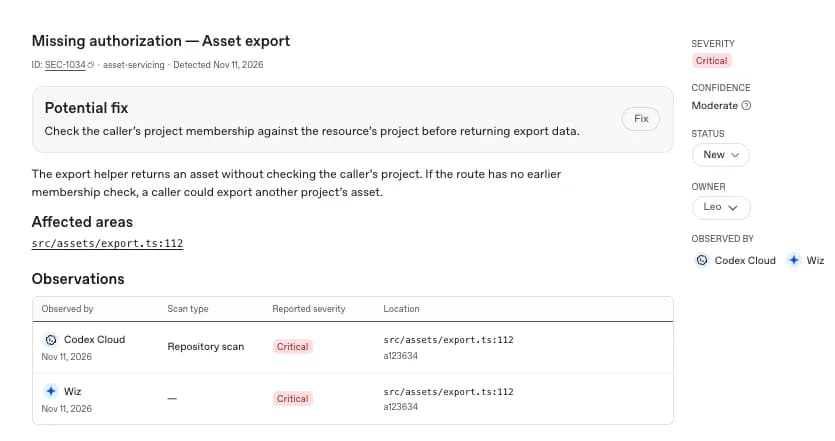 Image: Wiz Research
Wiz lists four outcomes:
- Trace risk to source—tie findings to Dockerfile, IaC, or application code lines.
- Map attack paths—correlate with exposure, IAM, and data sensitivity.
- Accelerate remediation—give Codex enough context to reproduce, patch, and open PRs.
- Hand off to Codex Security—send finding bundles with owners for validation and triage.
That last step mirrors how we covered OpenAI’s November Daybreak keynote: Defense Factory and Red Team sit on opposite sides of the same continuous assurance story, with humans reviewing merges.
Patch the Planet and everyday fixes
Wiz frames the integration inside Patch the Planet—the coordinated PHP2Shell response where Wiz, Calif, PHP maintainers, and OpenAI split discovery, upstream patches, and customer detections. Beam’s PHP2Shell agent-risk analysis explains why model-assisted exploit iteration mattered there.
The November 24 plugin moves that collective-defense model from emergency CVE weeks to routine repositories: same agentic patch loop, fed by live cloud intelligence instead of a one-off coordinated disclosure.
Step-by-step: what happens when the plugin runs
Wiz’s post implies the following happy-path loop—wording is Wiz’s, sequencing is ours for operators writing runbooks:
- Security or platform engineering enables Daybreak Defense Factory on a monorepo or service repo and installs the Wiz plugin for Codex (login-gated in Wiz’s announcement).
- Wiz continues ingesting cloud assets tied to deployments from that repository—Security Graph edges already exist for most Wiz customers.
- A developer or security champion prompts Codex with a Wiz-aware instruction (Wiz’s example: fix findings that matter in this repo).
- Codex calls the Wiz MCP server to fetch finding IDs, severity, exposure context, and resource linkage—the same class of metadata Wiz surfaces in its console.
- Codex traces into Dockerfiles, Terraform, or application source to propose a minimal patch and optional test adjustments.
- Codex Security or human reviewers validate reachability—Wiz explicitly mentions handing bundles with code owners attached.
- Engineers merge after CI—OpenAI’s Defense Factory page stresses review and test before merge.
Failure modes to document internally: stale graph data (repo deploys changed but Wiz link lags), over-broad patches that widen IAM, and duplicate PRs when both Green Agent and Codex plugin open fixes for the same finding.
Data handling and trust boundaries
Neither Wiz’s November 24 post nor OpenAI’s Defense Factory marketing page in our fetch window publishes a new DPA exhibit—treat graph excerpts, finding titles, and generated diffs as confidential security material:
| Data class | Typical flow | Coding-agent note |
|---|---|---|
| Wiz findings | Wiz cloud → MCP → Codex | May include resource IDs and data-class labels |
| Source code | Git provider → Defense Factory | Same scope as any Codex-connected repo |
| Model inference | OpenAI Daybreak | Subject to org Daybreak terms, not local CLI defaults |
| Audit evidence | Your SIEM / ticket system | You must store finding ID ↔ PR mapping |
If Europe residency or customer contract restricts where security findings may be processed, run a legal review before piping production graph into US inference—the same question Beam raised for neocloud inference inventory applies to remediation agents.
How this differs from Wiz Green Agent
Beam covered Wiz Green Agent on November 12—ASPM workflows that draft multi-step fixes, optionally open PRs, and hand guidance to org coding agents.
The Codex plugin is narrower and deeper on OpenAI’s harness:
- Surface: Codex inside Daybreak Defense Factory (OpenAI enrollment), not every ASPM UI export.
- Transport: Wiz MCP server into Codex tool calls—the same MCP trust model as third-party servers in our MCP security guide.
- Audience: Teams already buying Wiz + OpenAI Daybreak, not every Green Agent customer.
If you use Claude Code locally while security runs Wiz + Codex in the cloud, you now have two remediation channels—govern both.
What this means if you run AI coding agents
Engineers with local Codex or Claude Code
- Unchanged unless you connect personal forks to Defense Factory—then your repo tokens and diffs enter the Daybreak pipeline.
- Keep separate credentials for local agents vs Factory-connected bots; rotate if a Factory run overwrites files you still edit locally.
Platform and security teams
- Branch protection on any repo linked to Defense Factory—required reviewers, no direct push to main, CODEOWNERS on security-sensitive paths.
- Log correlation: store Wiz finding IDs, Codex job IDs, and PR URLs in the same ticket—Wiz’s post assumes security and development stay in control, not that agents merge silently.
- MCP inventory: record the Wiz MCP server endpoint, scopes, and which engineers can enable the plugin in Codex—treat it like any other high-privilege tool server in permissions and tool-boundary reviews.
- Diff review focus: agent fixes may touch auth, network egress, or IAM bindings—the same classes of changes PHP2Shell remediation proved models can reason about quickly.
Red-team perspective: Wiz Cyber Model Arena already scores Codex + frontier models on real exploit tasks. Defense Factory uses the same harness family for patching. Assume attackers pursue symmetric speed on your repos if secrets leak.
Review checklist before you merge agent PRs
Use this minimum bar when Wiz + Codex opens a fix—adapt to your SDL:
- Finding linkage — ticket lists Wiz finding UUID, graph screenshot or export, and Codex job/run id.
- Exposure sanity — confirm whether Wiz still shows internet exposure; do not merge network-wide changes based on stale edges.
- Auth diff review — any change to IAM bindings, security groups, or service accounts gets identity-team review even if the app fix is small.
- Secret scan — run gitleaks or platform native scanning on the branch; agents sometimes embed debug tokens while iterating.
- Rollback plan — can you revert without redeploying dependent Terraform stacks?
- Local agent parity — if engineers still use Codex CLI on laptops, verify the Factory PR did not disable hooks or CI checks they rely on (shared responsibility gap).
How Beam handles this
Wiz + Codex Defense Factory is cloud ASPM and org-wide agent remediation. Beam is local-first observability for Claude Code, Codex, and similar harnesses on the developer laptop: it records tool calls, runs heuristic scans on skills and MCP configs (agent hooks documentation), and can deny risky PreToolUse commands when workspace policy is enforce—with fail-open limits if cached policy is missing.
Beam does not ingest Wiz Security Graph, block cloud MCP calls by region, or approve Defense Factory PRs. Use Wiz for exposure-aware prioritization; use Beam when you need on-device evidence that an engineer’s local Codex session did not exfiltrate repo secrets or install unvetted MCP servers alongside the managed Factory plugin.
When to skip the plugin
Wiz’s integration is a defender accelerator, not a requirement for every repo:
- Air-gapped or offline-only codebases should not attach cloud MCP servers.
- Libraries with no deployable artifact may get misleading exposure context—triage in Wiz before enabling Codex.
- Teams without mature branch protection should fix git governance first; agents will amplify weak merge policy.
Related reading
- OpenAI Daybreak Red Team and Defense Factory
- Wiz Green Agent ASPM remediation
- MCP security practical guide
- AI agent security audit checklist
- Wiz AI Security Agent cloud inventory
Product names, enrollment rules, and plugin availability are accurate as of November 24, 2026. Confirm current Daybreak access on openai.com/daybreak and Wiz tenant settings before connecting production repositories.
Frequently asked questions
See front-matter FAQ entries for schema parity; Wiz and OpenAI product pages remain authoritative for pricing, data handling, and supported regions.
Can I use the Wiz plugin without Wiz ASPM?
Wiz’s announcement assumes an existing Wiz Security Graph customer. The plugin pulls Wiz findings; it does not replace Wiz licensing or onboard net-new cloud accounts by itself. Teams with only Codex and no Wiz tenant should use OpenAI’s Defense Factory onboarding without this integration.
Does the plugin change Codex CLI on my laptop?
Not automatically. This is Daybreak Defense Factory + Codex with Wiz MCP—a cloud enrollment path. Local Codex CLI sessions on a developer machine only intersect if engineers manually configure the same MCP server or copy tokens from the Factory environment—both deserve explicit policy.
What is the first command I should run after enabling it?
Wiz does not ship a single CLI in the blog post; start in Wiz by confirming findings are linked to the repository’s deployments, then in Defense Factory run a scoped dry-run PR on a non-production branch with CODEOWNERS enforced before touching main.