
Wiz announced the AI Security Agent in public preview on November 16, 2026 to discover custom AI applications in code and cloud, compare stated purpose to effective tools and permissions, and prioritize attack paths where AI-native flaws meet internet exposure and sensitive data. Security teams running Claude Code, Codex, or internal agent services still need cloud inventory and laptop-side observability — they answer different layers of the same problem.
| Question | Answer |
|---|---|
| What does it do? | Discovers agents, MCP, models, and tools; analyzes prompts and code; graphs cloud impact. |
| Who is it for? | Cloud security and AppSec teams with Wiz deployed — not solo IDE users only. |
| Does it block agents? | No — prioritization and evidence for remediation, per Wiz's post. |
| Overlap with Beam? | Partial: Beam watches local coding agents; Wiz maps cloud-deployed agent apps. |
| How to try it? | Wiz Preview Hub enablement, per Wiz. |
Wiz argues cloud context alone is insufficient because agents operate at the application layer — orchestrating prompts, calling tools, executing business logic — while still depending on identities, egress, and data stores underneath.
For security engineers, the pitch is a single question list Wiz repeats in its announcement: What agents exist? Where is the application fragile? Can that fragility become a path to data? Does stated purpose match powers? Those are the queries you would manually answer by reading repos, Terraform, and IAM spreadsheets; Wiz automates reconstruction and ties answers to exposure already modeled in its graph.
For coding-agent leads, the post matters because the agents you ship to production often start on laptops. A Flowise console left open, an MCP gateway with shell tools, or an internal LangChain service is exactly what Wiz’s agentic attack fingerprints case studies profiled from the attacker side. The new product is the defender’s mirror: inventory and pathing instead of iteration speed.
Wiz says it is public preview through the Preview Hub, not a silent default for every tenant. That matters for change control: enabling graph-heavy AI analysis can surface large backlogs of “critical” AI findings the week you turn it on. Plan owner routing before enablement, similar to turning on a new ASPM category.
Three capabilities Wiz ships
Discover agents without a management API
Custom agents embedded in code may lack a central control plane. Wiz says its agent inventories models, system prompts, MCP servers, gateways, guardrails, and tool definitions across code repos, PaaS, and self-hosted VMs, containers, and bucket-stored code.
Wiz reports customer environments where this approach detected up to five times as many AI agents as traditional discovery engines.
Compare purpose to capabilities
After discovery, Wiz analyzes implementation, instructions, and permissions to reconstruct architecture. It surfaces mismatches such as internal-only agents exposed to the internet or read-only assistants with shell execution tools.
Wiz plans runtime context integration later to validate behavior during execution; the November announcement emphasizes static and configuration intelligence plus source references for reviewers.
Wiz also notes upcoming specialized domains: code-to-cloud analysis and AI SAST in the same product family. The November post focuses on inventory + purpose + pathing; treat SAST promises as roadmap language until Wiz documents rule packs and CI gates separately.
Code and repo coverage specifics
On code repositories, Wiz says it ingests application code, prompts, and configurations throughout development. That is where coding agents leave fingerprints: checked-in system prompts, tool manifest JSON, MCP server lists, and gateway configs that never register in a cloud API because they only exist in Git.
On PaaS, Wiz targets custom agents defined in code on supported platforms—think hosted runtimes where the vendor does not expose a unified “agents API” but your deployment still calls models and tools.
On self-hosted estates, coverage includes VMs, containers, serverless, and even code stored in buckets (a pattern teams use for fat Lambda bundles or user-data scripts). If your org mirrors Git to object storage for DR, that last bucket is part of the attack surface Wiz describes.
Prioritize AI-native risk with cloud correlation
Wiz uses reasoning over instructions, tools, and access to flag issues deterministic rules miss — for example an unauthenticated endpoint accepting attacker-controlled system instructions when the connected agent can run shell commands.
Findings feed the Wiz Security Graph to combine external exposure, egress, IAM, and data sensitivity. Wiz's worked example walks from an unvalidated URL query leaking OAuth tokens to PII and financial data in storage reachable through an ineffective guardrail.
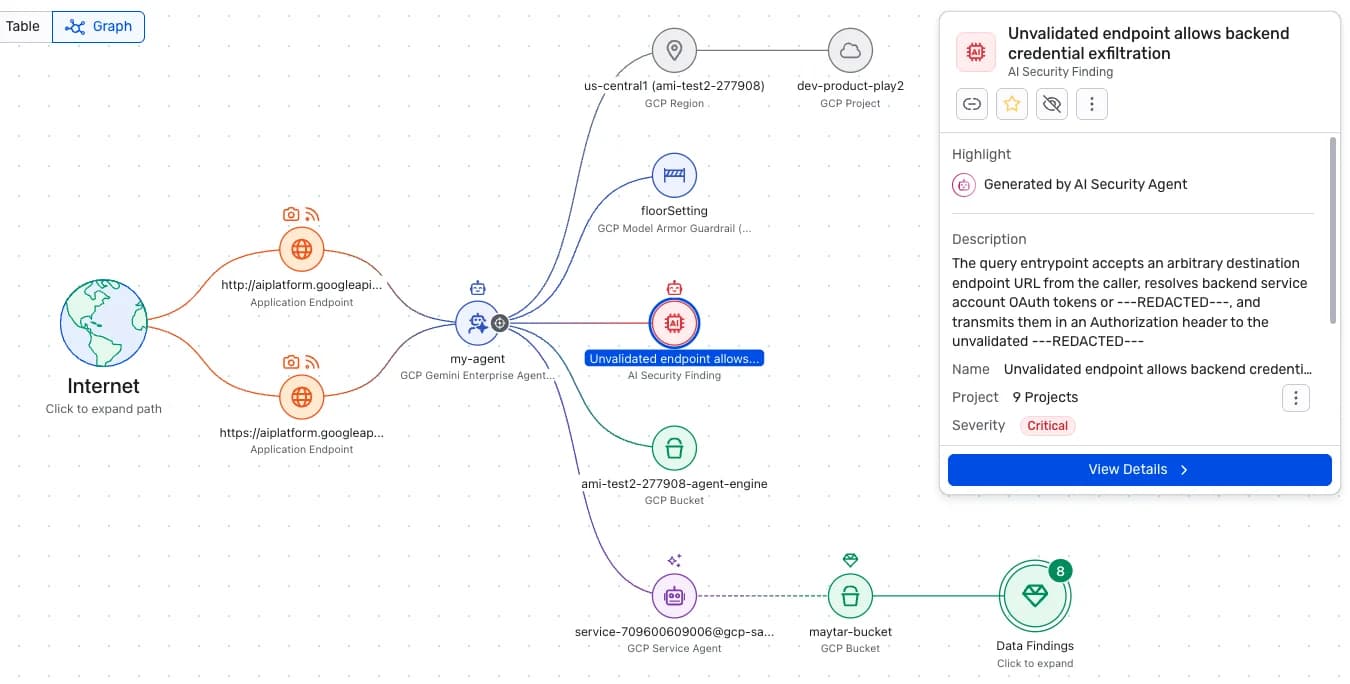 Image: Wiz
That narrative parallels what Beam documented in Wiz's agentic attack fingerprints and Cyber Model Arena offensive agent benchmarks — automation expands who can operate agents, while defenders need both app-layer and infra-layer visibility.
Example attack path Wiz describes
Wiz's sample internal cloud assistant looks benign from infrastructure alone: service identity, storage access, guardrail enabled. After application inspection:
- Unvalidated query entrypoint accepts arbitrary destination URLs.
- Backend OAuth tokens leak in an
Authorizationheader. - Internet-reachable endpoints sit upstream of an overprivileged service account.
- Guardrails fail to block traversal into buckets holding PII and financial data.
The Security Graph ties those nodes into one critical issue with an end-to-end path explanation — the sort of story ARTEX and Cairn campaigns illustrate from the offense side at machine speed.
What enterprises ask before buying cloud agent visibility
Even without Wiz, teams running Claude Code at scale eventually need answers auditors repeat:
| Question | Why it shows up | What Wiz claims |
|---|---|---|
| What AI agents do we have? | Shadow IT and repo sprawl | Automated inventory including non-framework apps |
| Which agents can execute code? | Insider-threat models | Tool and capability mapping vs stated purpose |
| What is internet exposed? | CWE-918 style SSRF chains | Graph correlation with egress and public endpoints |
| Where is sensitive data reachable? | GDPR, PCI scope | Data findings tied to graph paths |
| Can we prioritize one critical path? | Patch Tuesday overload | Single attack path explanation with evidence |
Wiz’s BigQuery agent hypothetical in the announcement is illustrative, but the shape matches real misconfigurations Beam sees discussed after red team reports: over-broad service accounts, guardrails that do not cover storage traversal, and user-controlled URLs fed to backends that hold OAuth tokens.
None of that replaces dependency patching on developer laptops or Anthropic CVD timelines for harness bugs. Cloud inventory catches deployed agents; it does not read every PreToolUse hook denial on a contractor laptop.
Connection to Wiz’s offensive research line
Wiz already markets Cyber Model Arena as an offensive benchmark for agent stacks. The AI Security Agent is the defensive bookend: same vendor thesis that agents change speed and coverage, now applied to customer environments.
If your security team read Wiz Cyber Model Arena to understand pass@1 exploit rates, read this launch as “find those stacks in prod before attackers do.” The fingerprints post adds behavioral IOCs; this product adds architecture cards and IAM-linked impact.
What this means if you run AI coding agents
Cloud agents ≠ laptop agents. Many developers run Claude Code or Codex locally while the company also ships LangChain-style services in AWS or GCP. Wiz targets the deployed application; your IDE session still needs permission hygiene — see Claude Code VS Code symlink prompts for a fresh boundary example.
Inventory MCP before production. Wiz explicitly names MCP servers in discovery (MCP is an open standard for connecting AI applications to external tools and data). The same components on a laptop should pass MCP security review before settings.json commits spread org-wide.
Do not conflate guardrails with safety. Wiz's example shows guardrails enabled while traversal still reaches sensitive buckets. Coding-agent teams should assume tool lists and OAuth scopes are the real boundary, not marketing labels on a guardrail card.
Align with disclosure velocity. Shorter vendor disclosure windows — see Anthropic's 30-day CVD update — increase pressure to patch agent frameworks and cloud wrappers together.
How Beam handles this
Wiz AI Security Agent is built for multi-account cloud security programs: graphing exposure, IAM, and data at scale. Beam is local-first observability for coding agents on developer machines — Claude Code, Codex, and similar harnesses — with on-device storage, heuristic scans of skills and MCP configs, and optional PreToolUse deny when workspace policy is in enforce mode (agent hooks).
Beam is the stronger fit when your risk question is what did the agent try to run on this laptop and did we flag the skill before install, without routing every prompt through a cloud graph. Wiz is the stronger fit when the question is which customer-facing agent endpoints are internet reachable with shell tools and bucket access.
Beam does not replace Wiz's Security Graph, cloud IAM analytics, or fleet-wide SaaS agent inventory. It does not see BigQuery agents in another team's GCP project unless you also run collectors on those hosts. Wiz does not, by itself, record every PreToolUse proposal in a developer's local ~/.claude session.
Many organizations will use both layers: Wiz for deployed agent apps, Beam for the coding agents that write and ship them — see introducing Beam and what agent monitoring tracks.
When you trial the preview, export one critical path finding into your existing ticketing and patch cadence. If the graph says an internal agent is internet reachable with shell tools, fix SGs and IAM before debating whether the model prompt is polite. Wiz’s value is ordering work by exposure × capability, not replacing code review on the repo that defined the agent.
Related reading
- Wiz agentic attack fingerprints
- Wiz Cyber Model Arena benchmarks
- MCP security practical guide
- Unit 42 Cairn autonomous attacks
- Introducing Beam local-first security
Frequently asked questions
What is the Wiz AI Security Agent?
Per Wiz's November 16, 2026 announcement, it is a public-preview product that discovers AI applications and agents in code repos, PaaS, and self-hosted cloud workloads, analyzes prompts and tool wiring, and connects findings to the Wiz Security Graph for exploitability and impact.
How is Wiz AI Security Agent different from normal cloud scanning?
Wiz says traditional inventory misses agents defined only in application code without a management API. The AI Security Agent uses application-layer analysis plus cloud context to surface paths like unauthenticated endpoints feeding agents that can run shell commands.
Does Wiz AI Security Agent block coding agents on my laptop?
No. Wiz positions it for cloud estates and repositories. It does not replace local PreToolUse hooks or IDE permission prompts on developer machines.
What environments does Wiz scan?
Wiz lists self-hosted VMs, containers, serverless, supported PaaS custom agents, and code repositories. It claims up to five times more agent detections than traditional discovery in customer environments.
How does Beam compare to Wiz AI Security Agent?
Wiz maps cloud-wide agent risk and exposure graphs. Beam is local-first observability for Claude Code, Codex, and similar coding agents on the laptop, with skill/MCP heuristic scans and optional hook denies, without shipping telemetry off-device by default.
Is Wiz AI Security Agent generally available?
Wiz says it is in Public Preview through the Wiz Preview Hub as of November 16, 2026, not automatic production-wide enablement.
Product capabilities and preview status are accurate as of November 16, 2026 per Wiz's announcement.