
On November 10, 2026, security firm Claroc published GhostShares 2: a census of apps people build with Grok Build and publish on grok.me. Of 37,571 live apps Claroc tried, 35,578 opened for anyone with the link with no sign-in—about 94.7%. The list included internal business data, employee rosters, patient briefings, and JavaScript bundles with plaintext passwords. Nobody hacked Grok; the exposure comes from default sharing, per-app DNS hostnames, and auth logic Grok generated. If your developers use Grok Build—or shadow Lovable, Replit, v0, or Bolt the same way—this changes what you should audit on developer laptops and in passive DNS. Below: the attack chain Claroc documented, fixes SpaceXSI was asked to make, and concrete checks for teams that also run AI coding agents.
TL;DR
| Question | Answer |
|---|---|
| Am I affected? | Yes if anyone at your company published a Grok Build (or similar) app with Anyone with the link and stored customer, HR, or health data there. |
| Is there a fix? | Per app: set Only you or Invited users, fix team membership checks, remove secrets from client-side code, unpublish abandoned apps. No platform patch from Claroc's report—SpaceXSI defended the default. |
| Was it exploited? | Claroc did not claim in-the-wild theft; they read open pages and tested only their own two apps for write access. |
| Does data leave my machine? | Browser downloads app JavaScript; a timesheet app exposed 18 employee accounts with plaintext passwords in code every visitor fetches. |
| What do I do first? | Search passive DNS for *.grok.me tied to your org, open findings in incognito, and align with Grok endpoint controls on machines that also run agents. |
What Claroc found
Claroc's methodology is deliberate and narrow. On November 8, 2026 they worked from 43,601 grok.me hostnames gathered with subdomain discovery, loaded only the first page of each app once from the public internet without signing in, and reviewed offline copies. They did not sign in to third-party apps, submit forms, or use credentials they saw—except on two apps they built themselves to test Grok's defaults.
The headline counts:
- 37,571 apps still online during the window.
- 35,578 opened publicly (94.7%).
- 1,993 returned HTTP 401 (Only you or Invited users).
- ~1 in 10 open apps held sensitive or internal material; Claroc estimates 650–800 with private data after AI-assisted triage and manual review.
- 24 open apps were built by SpaceXSI and X staff, including a confidential onboarding plan, a sales territory map of 594 accounts, and X advertising proposals (one marked confidential for a U.S. federal agency).
- 30 additional identifiable organizations had internal data exposed (26 with 1,000+ employees, 6 Fortune 500)—Claroc is notifying them and withheld hostnames in the public write-up.
Confirmed examples Claroc lists include a hospital group roster above 3,500 employees, an ICU patient briefing with labs and ventilator status, a fire department shift board with badge numbers, and a contractor timesheet whose script held 18 accounts with plaintext passwords (including admins).
SpaceXSI told a reporter (quoted in Claroc's post) that apps stay private until the creator shares them and that publishing takes several steps. Claroc's counterpoint: in a paid account they used, the publish panel offered Anyone with the link with that option already selected, and 35,578 owners completed that path.
How passive DNS turns "secret links" into a searchable inventory
The mechanism matters for security teams more than the headline number.
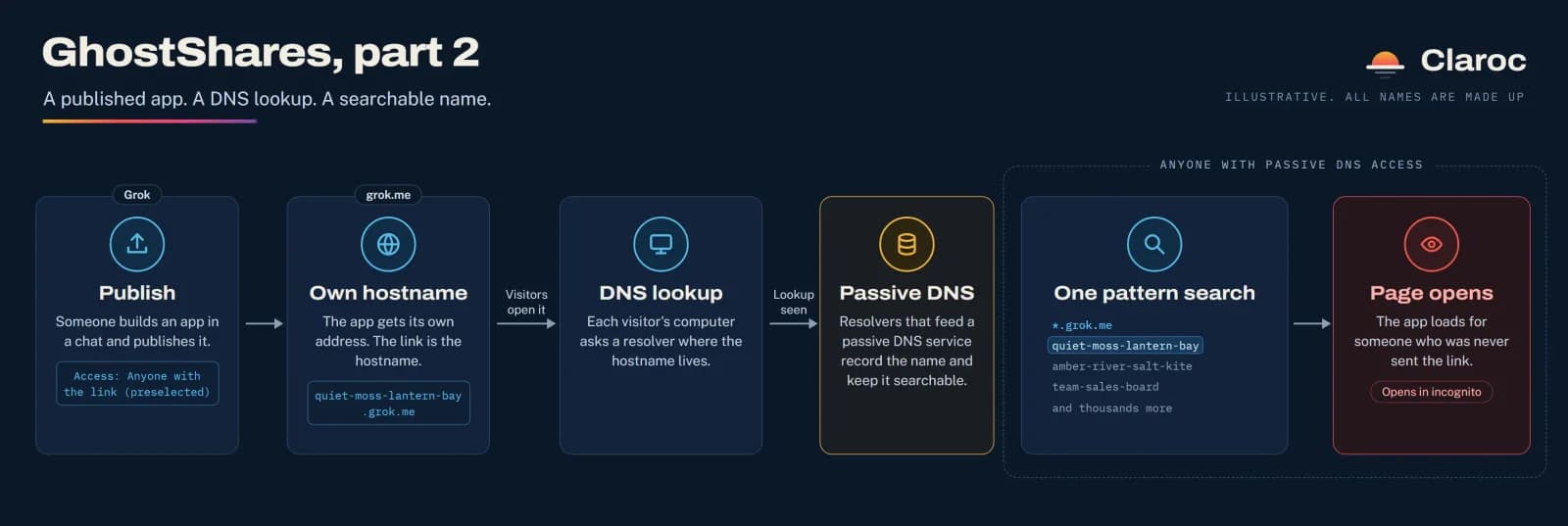 Image: Claroc Research
Each Grok Build app gets its own hostname: <name>.grok.me. When someone opens it, resolvers answer the lookup. Passive DNS providers collect those queries; subscribers can search by pattern (for example *.grok.me). Claroc compares this to their earlier Meta Muse GhostShares work: Grok uses four random words so URLs are hard to guess, but guessing is unnecessary once the name appears in a dataset.
Claroc also contrasts ChatGPT's app hostnames: sharing defaults to Only me until changed, and while DNS still lists published apps, a discovered hostname leads to an app strangers cannot open if access stays private. Artifact links on claude.ai/public/artifacts/ keep secrets in the path, so DNS never sees the identifier—though search indexing can still leak shared paths, as Claroc notes from 370,000+ Grok shared chats indexed in Google in August 2025 (a separate exposure class from grok.me apps).
What Grok generated when nobody asked for security
Claroc built two test apps on Grok's free build tier but needed a paid account to publish—matching how many employees will experiment.
Test 1 — contact list, no sign-in. They asked Grok to save contacts "so every visitor sees them." The app got a database and no login. From incognito, they added a row the next visitor could see.
Test 2 — "team" customer list with Google sign-in. Grok added Continue with Google and Continue with X. Claroc found the generated code adds whoever signs in to the team before checking membership, so the membership check always passes. An uninvited Google account could read, edit, and delete customers on Claroc's app only.
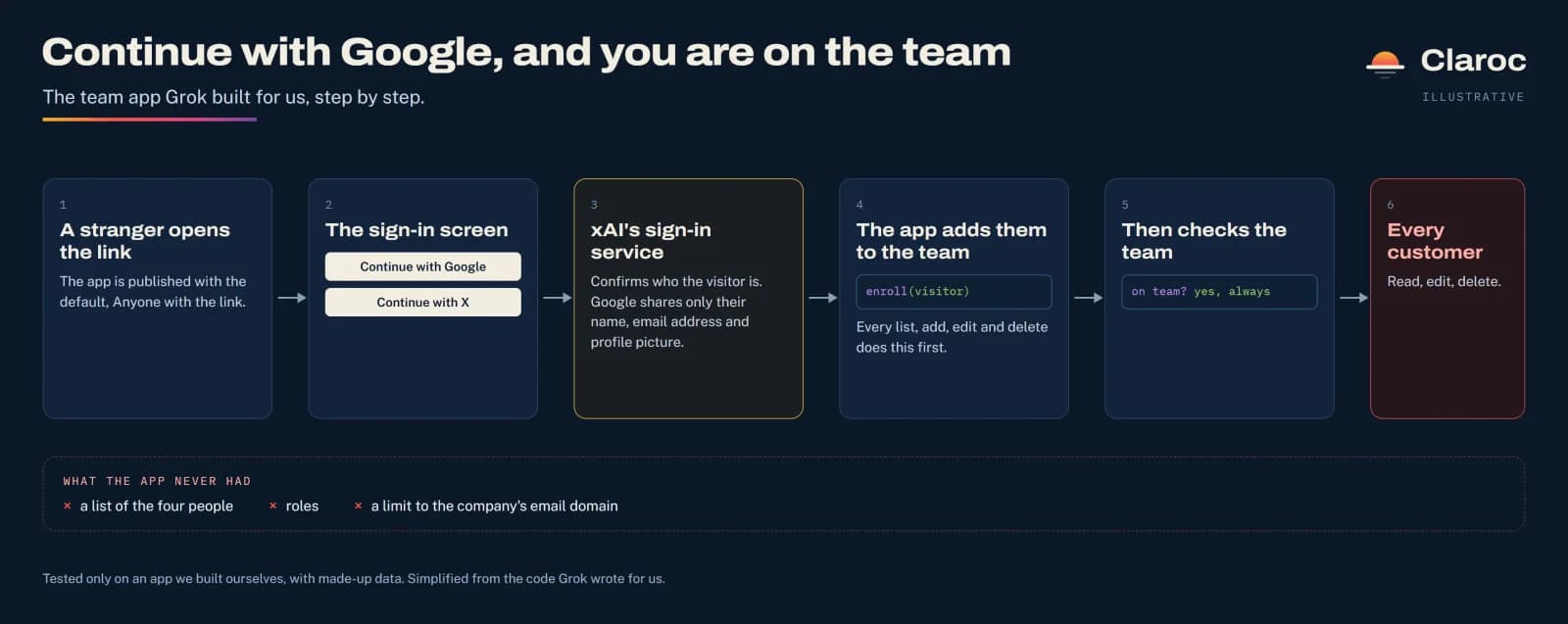 Image: Claroc Research
Switching to Only you made the first app return 401 to strangers; unpublishing took the second offline within seconds—but nothing in the default publish flow pushed builders toward those settings.
That pattern rhymes with agent-generated code on developer machines: the fastest path ships working software without authorization boundaries, and shadow IT never routes through review.
Timeline and vendor response
| Date | Event |
|---|---|
| Nov 8, 2026 | Claroc reports issue to SpaceXSI via security.txt with counts, test apps, and four requested product changes. |
| Nov 9, 2026 | Claroc reports the other 22 SpaceXSI/X staff apps. |
| Nov 10, 2026 | SpaceXSI answers media questions; removes 24 staff apps; does not state it will notify all other app owners. |
| Nov 10, 2026 | Claroc publishes; begins notifying affected organizations. |
Claroc asked SpaceXSI for: path-based links instead of per-app DNS names, org-domain "everyone in my company" access, Only you as default with a pre-publish audience summary, and a warning when a database ships without sign-in.
What this means if you run AI coding agents
Coding agents and AI app builders often land on the same laptops:
-
Inventory shadow builders. Claroc lists Grok, Lovable, Replit, v0, Bolt, Base44, Google AI Studio as needing no IT rollout. Ask teams what they published in the last 90 days.
-
Passive DNS review. If your security team subscribes to passive DNS, search builder domains your employees use. Opening apps in incognito mirrors Claroc's test.
-
Treat client bundles as secret stores. Agents that
curlor scrape internal grok.me apps may pull passwords embedded in JS into prompts or logs on disk—same class of leak as hard-coded keys in agent-fetched pages. -
Separate agent credentials from app-builder accounts. A Grok session that can publish
grok.meshould not share SSO with production admin roles. -
Patient and HR data. If your exposure includes health rosters, review retention and sharing policy with legal and privacy teams before you unpublish or export.
-
Unpublish abandoned apps. Claroc notes unpublishing a
grok.meapp takes it offline quickly—use that before archiving links in wikis agents read.
How this compares to other AI app builders
Claroc is explicit that Grok is not alone. ChatGPT, Lovable, Replit, Base44, Google AI Studio, Meta Muse, v0, and Bolt all mint per-app hostnames when you deploy. The difference Claroc measured is defaults and auth quality, not whether DNS can list names.
| Builder | Default share setting (per Claroc tests) | Hostname shape | Stranger opens a discovered hostname |
|---|---|---|---|
| Grok Build | Anyone with the link preselected | word-word-word-word.grok.me | Usually yes (94.7% in census) |
| ChatGPT apps | Only me until changed | <app>.<user>.chatgpt.site | No, if access stayed private |
| Shared chats (many labs) | Link in path | …/share/<id> | Path not in passive DNS; search may still index |
That table is why security teams should not treat "we do not use Grok" as closure. Any builder your sales or ops team adopts can publish customer tables with weekend velocity. Claroc's enterprise guidance—passive DNS sweep, incognito open, outside-account sign-in test, grep client JS for passwords—applies across vendors.
Developers are especially likely to experiment because Grok Build ships beside the same Grok CLI people already use for coding tasks (modern-web guidance plugins even document grok plugin install). A territory map and a internal API dashboard share one publish button.
Operational checklist for security and platform teams
Work through these in order; each step mirrors Claroc's recommendations and extends them to agent workstations.
- Announce a reporting channel for
grok.me,*.replit.app, and siblings so shadow apps surface without waiting for passive DNS. - Run a passive DNS pattern search for builder domains; export hostnames; assign owners by content, not by URL randomness.
- Open each hostname once in a private window; record HTTP status and whether data loads without auth.
- Attempt sign-in with a personal Google account on any "team" app; if you get in, treat ACLs as broken, not "good enough."
- View page source or network tab for hard-coded passwords, API keys, or employee lists in bundled JavaScript—the timesheet case Claroc screenshot is not exotic obfuscation.
- Unpublish or set Only you on anything without an owner; Claroc reports seconds to unpublish on Grok.
- On dev laptops running coding agents, search shell history and agent transcripts for
grok.meURLs agents may have fetched into the repo—those fetches can copy secrets from client bundles into git.
For orgs with health or HR data in exposed apps, treat notification as regulatory, not PR. Claroc began direct outreach to affected companies on November 10 because SpaceXSI's public response did not commit to owner notification.
What Beam can and cannot do here
Beam is built for local coding agents (Claude Code, Codex, and similar): it records tool use, flags risky shell and credential patterns, scans skills and MCP configs with 11 heuristics, and can deny some PreToolUse actions when workspace policy is in enforce mode. It does not audit hosted Grok Build apps, grok.me ACLs, or passive DNS. If an agent downloads a leaky grok.me page into the workspace, Beam may redact known secret formats before storage when the collector runs—but that is reactive and heuristic, not a substitute for unpublishing the app. Enforcement is hook-based, not a network sandbox; Cursor-only workflows get advisory notes rather than deny. See what Beam watches on the landing page for the event classes it captures on-device.
For always-on assistants and connectors, pair this with locking down Muse, Dots, and Grok Bot at the integration layer.
Claroc itself sells discovery and hardening prompts for AI-built apps—a different layer from Beam's session-local agent telemetry. Teams may need both: Claroc-style published app inventory and Beam-style what your coding agent did after it found a link.
Frequently asked questions
The FAQ entries in the front matter mirror the sections above. Key actions: change access to Only you, test Google sign-in with an outside account, grep JS for passwords, and delete apps nobody maintains.
Related reading
- AI agent security basics for coding assistants
- How to stop Grok from running dangerous commands on your machine
- Keeping Muse, Dots, Claude Duet, and Grok Bot safe
- November 2026 attacks timeline
- Hugging Face on targeting of open AI platforms
Primary source: Claroc, GhostShares 2 (November 10, 2026). Secondary context: Cyber Security News summary (November 11, 2026).
Version numbers, counts, and vendor statements reflect Claroc's publication and SpaceXSI's quoted responses as of November 11, 2026.