
Palo Alto Networks Unit 42 published Recent Trends and Tactics of Agentic AI Attacks on November 24, 2026, summarizing more than ten real-world campaigns between July and September 2026 where attackers pointed autonomous AI agents at footholds on internet-facing web applications and let machines drive reconnaissance, credential harvesting, cloud abuse, and lateral movement at speeds humans rarely sustain. If you run Claude Code, Codex, Cursor, or self-hosted agent harnesses, the report is not about your IDE being hijacked—it is about what happens after a web shell lands on infrastructure your agents may later authenticate to with keys they copied from tickets or .env files.
Unit 42 is explicit: techniques are ordinary; velocity and fingerprints are not. Campaigns hit government, logistics, hospitality, manufacturing, agriculture, and education. Success still depended on classic failures—exposed apps, weak credentials, misconfigured cloud roles—not a new class of “AI-only” vulnerability.
explainx.ai carries the wider November threat-news timeline (a separate news site, not Beam). This post unpacks Unit 42’s mechanisms, detection markers, and checks coding-agent teams should run on the assets attackers pivot toward.
TL;DR
| Question | Answer |
|---|---|
| Am I affected? | Indirectly if you operate internet-facing apps, self-managed GitLab, shared staging environments, or cloud roles agents can reach with stored credentials |
| Is there a patch? | No single CVE for “agentic AI.” Patch the web apps and identity paths that provided web shells; rotate secrets attackers hunt after foothold |
| Does data leave my machine? | Not via this report’s entry path. Exfiltration happens post-compromise on servers and cloud APIs—often using credentials your agents also touch |
| New exploit class? | No, per Unit 42—known CVEs and open-source tools, iterated by agents when binaries fail |
| Key hunt signal? | Section headers like ===[Title]=== in shells, burst command rates, chain-of-thought comments in dropped scripts |
| Overlap with Cairn? | Different dataset. Unit 42’s November 12 Cairn/CL-STA-1238 post is sector-specific; this November 24 article is a cross-campaign tactics synthesis |
What makes an attack “agentic” in this report?
Unit 42 draws a line between chatbots and autonomous loops:
- A human selects a target and establishes initial access—almost always a web shell on a vulnerable web app.
- An LLM with tool-calling observes, plans, executes, and re-plans without per-step manual typing.
- The human periodically reviews machine-readable summaries and sets strategic objectives (“prioritize payment buckets,” “probe the IT vendor”).
- The agent carries out tactics—hundreds to thousands of commands—until blocked or satisfied.
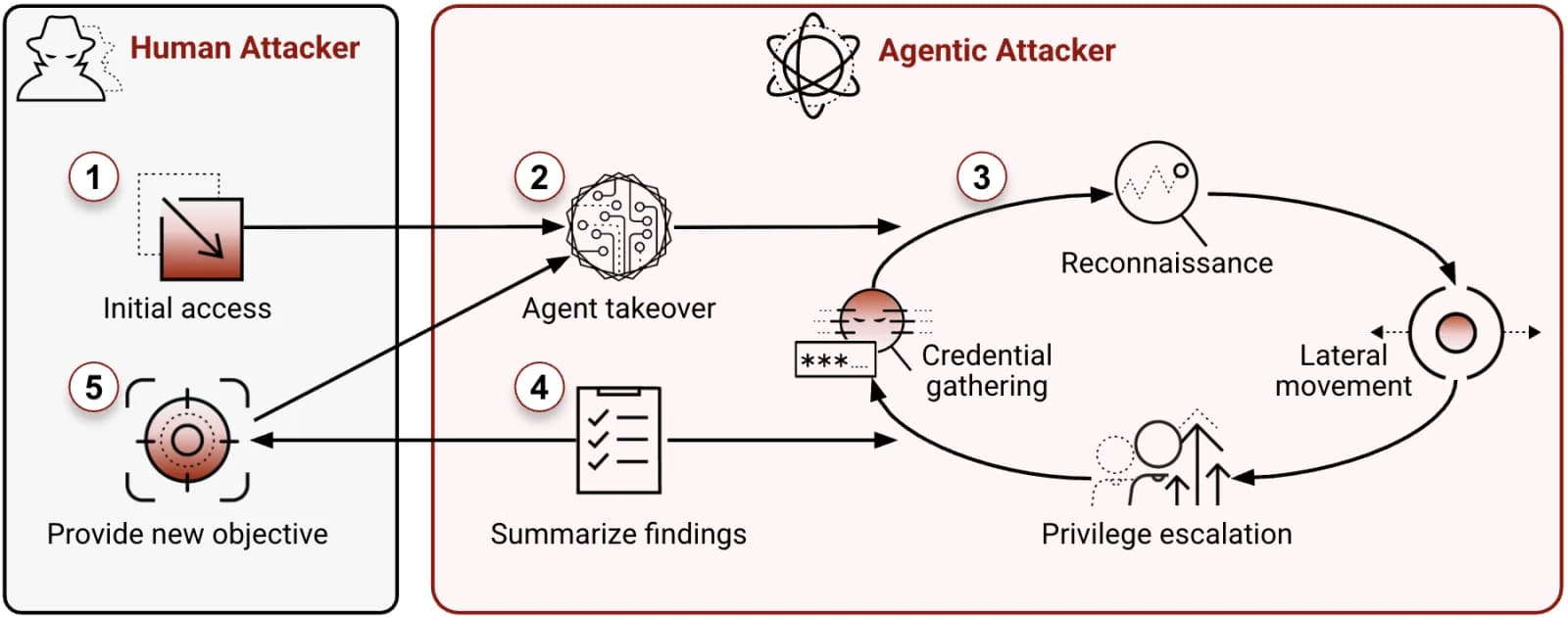 Image: Palo Alto Networks Unit 42
That model mirrors offensive agent harnesses defenders already track—Cairn CL-STA-1238, ARTEX-style campaigns, and exposed pentest consoles on Shodan—but Unit 42’s November 24 post aggregates tactical patterns seen across multiple operators, not one framework brand.
Speed and volume: the measurable shift
Unit 42 quantifies operational tempo where incident responders can measure it:
- In one intrusion, an agent ran ~800 unique commands in 140 minutes, moving from web shell through cloud enumeration and database probing.
- A 12-day campaign exceeded 8,000 unique commands.
- Median inter-command gap fell from 23.9 seconds under human control to 1.4 seconds under agentic control in a subset Unit 42 compared.
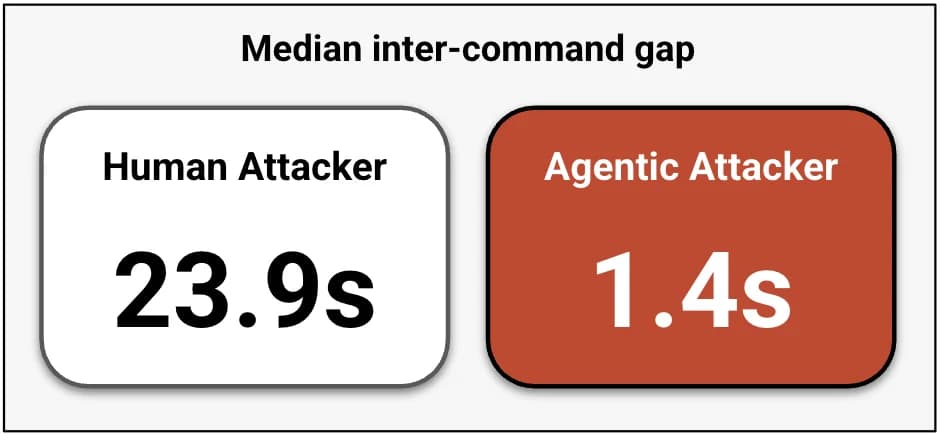 Image: Palo Alto Networks Unit 42
For coding-agent teams, the lesson is log cadence, not mysticism: if compromised host telemetry shows shell activity firing faster than a human can read output, treat it as automation—whether LLM-driven or not—and isolate before secrets propagate into GitLab, CI workload identity, or agent-readable env files on developer laptops (LLMjacking patterns Beam documented in platform breaches).
Behavioral fingerprints defenders can hunt
Unit 42 argues payload hashes matter less when attackers generate bespoke scripts per victim. Instead they recommend process and content markers:
Section headers and delimiters
Agents wrapped command output with markers such as ===[Title]=== so models parse results faster. Unit 42 says such headers are rare in interactive human shells unless a prebuilt script already contained them.
Chain-of-thought comments
In more than half of campaigns, recovered Python, Bash, or PHP contained step-by-step reasoning comments—plain language explaining why the next action was chosen. That is reminiscent of coding-agent transcripts, but on attacker-dropped files on victims.
Burst Base64 delivery
Base64 encoding through web shells is ordinary. Unit 42’s distinction is volume and uniqueness: 40–100 unique encoded payloads in one session, each target-specific, with no hash reuse across victims—unlike humans reusing the same implant file.
Security-product awareness
Agents excluded EDR paths from find commands while separately enumerating whether nmap, nuclei, lynis, and similar tools were present. In one case an agent applied strace to wdavdaemon to study Microsoft Defender for Endpoint behavior—treating blue-team software as a debug target.
These markers align with Unit 42’s earlier ARTEX behavioral guide and Symantec’s AI-assisted PowerShell modules reports: automation leaves prose in places humans stay terse.
Attack chain patterns Unit 42 observed
Web shells as the universal launchpad
Every analyzed campaign started with a web shell on an internet-facing server. Unit 42 says humans prefer web shells for agentic operations because they offer cheap, persistent code execution without maintaining compiled implants—though agents sometimes dropped additional shells themselves across dozens of paths within minutes (for example 40+ ASPX locations on a Windows IIS server in one case).
Multi-platform and multi-cloud fluency
Agents pivoted Linux → Windows via SMB, abused AWS IMDSv2 after IMDSv1 failed, enumerated 20 AWS services across eight regions, and pursued payment-related S3 paths when configs revealed financial data. None of that requires a novel AI capability—it requires breadth at machine speed, which lowers the bar for operators who are not specialists in every OS.
Adaptive exploit selection
When prebuilt exploits failed, agents fetched GitHub PoCs, tried PwnKit, then wrote C on-target, then retried in Python. Unit 42 cites CVE-2026-31431 (Copy Fail) and CVE-2024-1086 among recurring kernel attempts. The pattern matches human tradecraft, but the retry loop is tighter.
Vendor and sister-company pivoting
After one compromise, an agent read NGINX vhost configs, discovered sister companies, and systematically probed each with CSRF token harvesting, credential reuse, and SQL injection iterations against an admin panel—while a parallel thread brute-forced a vendor GitLab using names harvested from marketing pages.
GitLab hardening takeaway
Unit 42 closes with GitLab recommendations: MFA, sign-in rate limiting, IP allow lists, and current versions. That matters directly when coding agents store personal access tokens in skill files or CI variables attackers enumerate after foothold—see practical MCP and supply-chain guidance for parallel secret hygiene on developer machines.
Infrastructure and attribution clues
Signature-based attribution weakens when every script is freshly generated, but Unit 42 still recovered infrastructure leads:
| Artifact | Why it matters |
|---|---|
| 204.194.54[.]240 | Staging, CyberStrikeAI UI, open tool directories—also cited by ReliaQuest in a related agentic case |
| /home/kali/exploitmasteryai/... | Accidental path paste exposing operator environment |
| webhook.site and pastebin URLs | One-shot C2 and web shell retrieval |
| English-only rewrite of WMI backdoor | Human asked the agent to remove Chinese comments—linguistic leakage |
Unit 42 did not tie behaviors to a specific LLM vendor; implementations were too diverse. Defenders should lean on orchestration host imagery and C2 overlap, not model branding in a comment string.
What this means if you run AI coding agents
Coding agents on laptops are rarely the initial web-shell vector, but they amplify impact after compromise:
- Inventory internet-facing apps your team deploys via agent-generated Terraform or scripts—especially staging hosts agents spin up and forget.
- Rotate API keys, GitLab tokens, and cloud workload-identity bindings when IR finds web shells; assume attackers will search repos the way Unit 42 describes.
- Hunt SIEM rules for delimiter headers, more than one command per second sustained shell activity, and verbose comments in dropped
.pyfiles under/tmpor web roots. - Rate-limit admin interfaces and disable open registration on anything agents test against production-like data—CERT-In’s agentic-framework payment advisories stress the same workflow abuse surface from a different angle.
- Do not let agents disable EDR exclusions or punch firewall holes to “debug latency” on edge devices—post-compromise agents in Unit 42’s cases mapped defensive tools first.
How Beam handles this
Beam is local-first observability for developer machines: it watches supported PreToolUse hooks on Claude Code and Codex, heuristically scans skills and MCP configs, and redacts secrets before storage. It does not sit on your Linux web servers, block web shells, or attribute nation-state campaigns. Where it helps is preventing your agent from committing the tokens and curl-to-bash patterns attackers later hunt on servers, and giving you an on-device audit trail when IR asks what the laptop touched during an incident. Limits: heuristic scans, hook coverage gaps on some harnesses, and fail-open behavior when cached policy is missing—see what agent monitoring software tracks for an honest scope chart.
Detection and response checklist
| Step | Action |
|---|---|
| 1 | Confirm no unauthorized web shells under web roots; agents sometimes “test” uploads that persist |
| 2 | Review GitLab/auth logs for burst failures and MFA gaps on self-managed instances |
| 3 | Alert on IMDS token churn and S3 ListBucket spikes from app roles |
| 4 | Baseline shell inter-arrival times on bastions; investigate sub-2s sustained medians |
| 5 | Block egress to known staging IPs from Unit 42’s IOC list after validating currency in your threat feed |
| 6 | After eradication, re-scan skills/MCP agents used on laptops that had production kubeconfig or cloud creds |
Unit 42 publishes additional IOCs in the article body (150.242.254[.]199, 206.123.152[.]217, 38.253.224[.]12, and others). Pair with November’s attacks tracker context when correlating your case to the month’s AI-run attack pattern bucket.
How this differs from Unit 42’s Cairn post
Both are Unit 42, both involve autonomous offensive agents, but they answer different reader questions:
| Nov 12 Cairn / CL-STA-1238 | Nov 24 tactics roundup | |
|---|---|---|
| Scope | One Chinese-nexus campaign, Cairn fork, sector victims | 10+ campaigns, multiple sectors and operators |
| Entry | Cairn blackboard Reason–Explore loop | Web shells + assorted orchestration (incl. CyberStrikeAI) |
| Defensive focus | Password spray, API exposure, union data theft | Cross-platform speed, fingerprints, cloud payment pivoting |
Read both: Cairn for confirmed sector outcomes; November 24 for hunting methodology when you do not yet know which framework name will appear in IR tickets.
Related reading
-
Jesta OpenCode six-minute financial recon (November 2026) — lone operator, no framework name in traffic, behavior-only detection.
Primary sources: Unit 42, November 24, 2026, GitLab application hardening, Cyber Threat Alliance overview
Frequently asked questions
What did Unit 42 publish on November 24, 2026 about agentic AI attacks?
Unit 42’s Recent Trends and Tactics of Agentic AI Attacks summarizes more than ten campaigns from July–September 2026 with web-shell entry, machine-speed command bursts, and detectable AI-operator fingerprints.
What is an agentic AI attacker according to Unit 42?
An autonomous LLM-driven loop that plans and executes intrusion steps without continuous human typing, while humans retain target selection and strategic objectives.
Did agentic AI attackers use novel zero-day exploits?
No, per Unit 42—known CVEs, open-source tools, and iterative on-target scripting when prefabricated exploits failed.
How fast do agentic AI attackers run commands?
~800 commands in 140 minutes in one case; median gaps near 1.4 seconds vs 23.9 seconds for humans in a compared phase.
What are chain-of-thought comments in attacker scripts?
Reasoning prose embedded in malware scripts explaining next steps—common in AI-generated code, rare in manual live shells.
How do agentic AI attacks usually start?
Web shells on vulnerable internet-facing applications in every campaign Unit 42 analyzed.
What infrastructure did Unit 42 tie to agentic campaigns?
Examples include 204.194.54[.]240 with CyberStrikeAI, plus webhook and pastebin retrieval URLs listed in the report.
What should teams running coding agents do after this report?
Harden exposed apps, protect GitLab, rotate secrets agents store, and hunt delimiter headers and burst shell rates on servers your agents authenticate to.
Campaign counts, timings, and IOCs reflect Palo Alto Networks Unit 42 as of November 24, 2026.